The Gospel for All the World
Lesson 8 – Chart 1
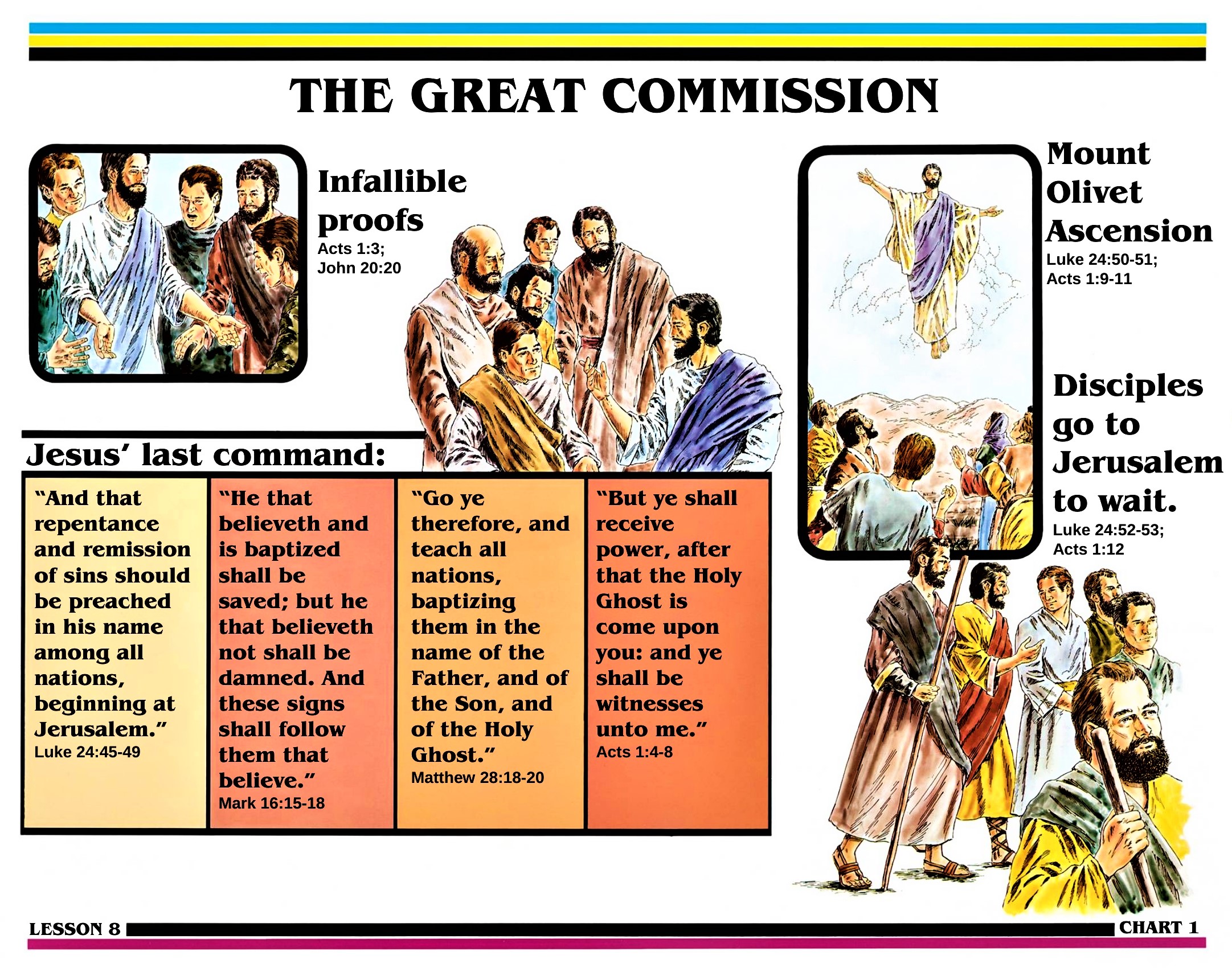
The Great Commission
Chart Objective:
To examine Christ’s commission to His followers to continue the ministry He had begun. The “good news” of His death, burial, and resurrection would free men from sin’s slavery.
Chart Outline:
A. Infallible proofs
B. Jesus’ last command
C. Mount Olivet Ascension
D. Disciples go to Jerusalem to wait
A. Infallible proofs
Acts 1:3; John 20:20
Can you imagine the bewilderment and sheer joy of seeing and conversing with someone you believed to be dead? That experience we reserve for heaven. But should it happen here, we would be quite shocked!
What questions would fill your mind as you eagerly talked with a friend fresh from the grave?
Similar emotions and expressions must have overwhelmed Christ’s disciples as they stared in amazement at their risen Lord.
Following the events of Easter morning, two followers were returning home to Emmaus, seven miles away. Dejected and grief-stricken by the loss of their Friend, they were too preoccupied to suspicion Who had joined their walk homeward.
While they confided their grief, the kind traveler began to vividly explain how Christ’s death was part of God’s plan. Familiar prophecies throughout the Old Testament were quoted as the puzzle took shape.
Talking at length, the trio soon arrived in Emmaus where the couple invited their new acquaintance to share food and lodging.
As the stranger gave thanks and proceeded to distribute the bread, either some familiar gesture or perhaps the wounds in His hands revealed His identity. But the moment they recognized Him, Christ vanished from their sight (Luke 24:31)!
Astonished, the couple raced back to the upper room in Jerusalem where their friends were assembled behind locked doors. Once admitted, the pair excitedly described their roadside visitor.
However, the group had equally joyous news. The Lord had indeed risen and had personally appeared to Simon Peter that afternoon!
As each one happily related their encounter with the risen Lord, suddenly a hush filled the room. Jesus stood among them. So unexpectedly! The door was still locked, but there He was!
The first recognition was His voice— “Peace be unto you.” Then further evidence was offered as He urged, “Behold my hands and my feet, that it is I myself.” Here was positive proof of the One Who had suffered death.
To dismiss the notion that He was a ghost, Jesus calmly assured, “Handle me, and see; for a spirit hath not flesh and bones, as you see me have” (Luke 24:39). Mary could not touch Him in the garden as He was ascending to heaven’s mercy seat. But now He freely invited their inspection.
To further confirm their faith, Christ asked, “Have ye any meat?” As they watched, He ate broiled fish and honeycomb. Unquestionable proof! This was no ghost, but a glorified human body!
A week later, Jesus reappeared to show Himself to Thomas, who had been absent. Very skeptical, Thomas had demanded to see nail prints and wounds. But all unbelief fled as he exclaimed in total assurance, “My Lord and my God!” The most doubtful was convinced of the risen Lord!
B. Jesus’ last command
Luke 24:45-49; Mark 16:15-18;
Matthew 28:18-20; Acts 1:4-8
Before His ascension, Christ appeared to more than five hundred believers at once (I Corinthians 15:5-6). Other isolated appearances occurred during the next forty days.
One of the last encounters was on a mountain in Galilee. Here Jesus spoke seriously to His carefully selected staff of the momentous task ahead. Into the hands of common, ordinary men of simple learning and occupation, the kingdom of God would be entrusted.
As he had accomplished His redemptive plan, they must become His representatives and continue the ministry Christ had begun.
This “good news” was too valuable to be enjoyed by an exclusive few. They must encircle the globe with the salvation story. Every man, woman, boy and girl has a right to know!
Four different accounts of the great commission are given in the Gospels and the Book of Acts. Although expressions vary, the worldwide scope was clear. His gospel must be carried to “all nations,” to “every creature,” and to “the uttermost part of the earth.”
That command encompasses the true love of Calvary. Suffering and dying for the sins of the whole world was Christ’s part. Our part is to inform every person of the good news!
Somewhat varied details are offered in each account. Just as the trial, crucifixion, and resurrection were written from different perspectives, so is the great commission recorded in four separate, incomplete statements. Together, a full step-by-step description of the salvation plan emerges.
Luke begins with “repentance and remission of sins”:
“And said unto them, Thus it is written, and thus it behoved Christ to suffer, and to rise from the dead the third day: and that repentance and remission of sins should be preached in his name among all nations, beginning at Jerusalem. And ye are witnesses of these things. And, behold, I send the promise of my Father upon you: but tarry ye in the city of Jerusalem, until ye be endued with power from on high” (Luke 24:46-49).
Mark added “believing the gospel” and “water baptism”:
“And he said unto them, Go ye into all the world, and preach the gospel to every creature. He that believeth and is baptized shall be saved; but he that believeth not shall be damned. And these signs shall follow them that believe; In my name shall they cast out devils; they shall speak with new tongues; they shall take up serpents; and if they drink any deadly thing, it shall not hurt them; they shall lay hands on the sick, and they shall recover” (Mark 16:15-18).
Matthew also stressed “water baptism”:
“And Jesus came and spake unto them, saying, All power is given unto me in heaven and in earth. Go ye therefore, and teach all nations, baptizing them in the name of the Father, and of the Son, and of the Holy Ghost: teaching them to observe all things whatsoever I have commanded you: and, lo, I am with you alway, even unto the end of the world” (Matthew 28:18-20).
The Book of Acts, written by Luke, explains what is promised to those who repent, believe, and are baptized—the “baptism of the Holy Ghost”:
“And, being assembled together with them, commanded them that they should not depart from Jerusalem, but wait for the promise of the Father, which, saith he, ye have heard of me. For John truly baptized with water; but ye shall be baptized with the Holy Ghost not many days hence . . . But ye shall receive power, after that the Holy Ghost is come upon you: and ye shall be witnesses unto me both in Jerusalem, and in all Judaea, and in Samaria, and unto the uttermost part of the earth” (Acts 1:4-8).
We shall see how each command was obeyed on the Day of Pentecost.
Christ had mentioned returning to His Father, but they could not grasp its dynamic impact. For them—as well as us—Jesus’ ascension launched a new era with the greatest challenge ever given to mortals: “Go into all the world, and preach the gospel to every creature!”
C. Mount Olivet Ascension
Luke 24:50-51; Acts 1:9-11
Final parting remarks ignited hope to the disciples’ sagging spirits. Within themselves, they were totally incapable of obeying Jesus’ commission. But He would provide assistance. Reinforcements would soon appear!
A special, mysterious power would be given each of them to accomplish the impossible task assigned that day. “Tarry,” Christ instructed, “until ye be endued with power from on high.” Completing their assignment would be unthinkable without an inoculation of supernatural power!
More explicit instructions then followed. They must go to Jerusalem and wait for this promised blessing from the Father. Then suddenly, He was “taken up.” While they stared into the sky, a cloud received Him out of their sight.
Perhaps three of them remembered when Christ appeared with clouds on the Mount of Transfiguration. Would the cloud dissolve and Jesus rejoin them as He had on that day?
Instead, they sensed the presence of two white-garbed figures. It was useless to stand gazing upward, the angelic visitors assured. This same Jesus would indeed reappear in the same way He had left. Not immediately, but He would come again! In the same manner . . . and at the precise spot where He had ascended!
Zechariah also prophesied the return of Christ to earth with His feet touching the Mount of Olives (Zechariah 14:4)! What a hope! He is coming again!
D. Disciples go to Jerusalem to wait
Luke 24:52-53; Acts 1:12
From Mount Olivet to Jerusalem was a Sabbath day’s journey, or three-fourths of a mile. The “upper chamber” is probably the home of John Mark’s mother. Here the disciples, Mary the mother of Jesus, and numerous other followers awaited Jesus’ promised power.
Meanwhile, Peter reminded that Judas must be replaced with a more worthy apostle. God had designated twelve apostles corresponding to the twelve tribes of Israel (Luke 22:30).
The chosen one must have accompanied their group throughout Jesus’ ministry and have personally witnessed His resurrection. Matthias was elected to fill the vacant position.
Business ended, the group readied themselves to wait for the promise. “All continued with one accord in prayer and supplication” (Acts 1:14). Fasting might have accompanied their prayerful vigil.
When would it happen? How would it feel? How would they know when it arrived? Their uncertainties would soon be answered in a most emphatic manner!