The Covenant Name
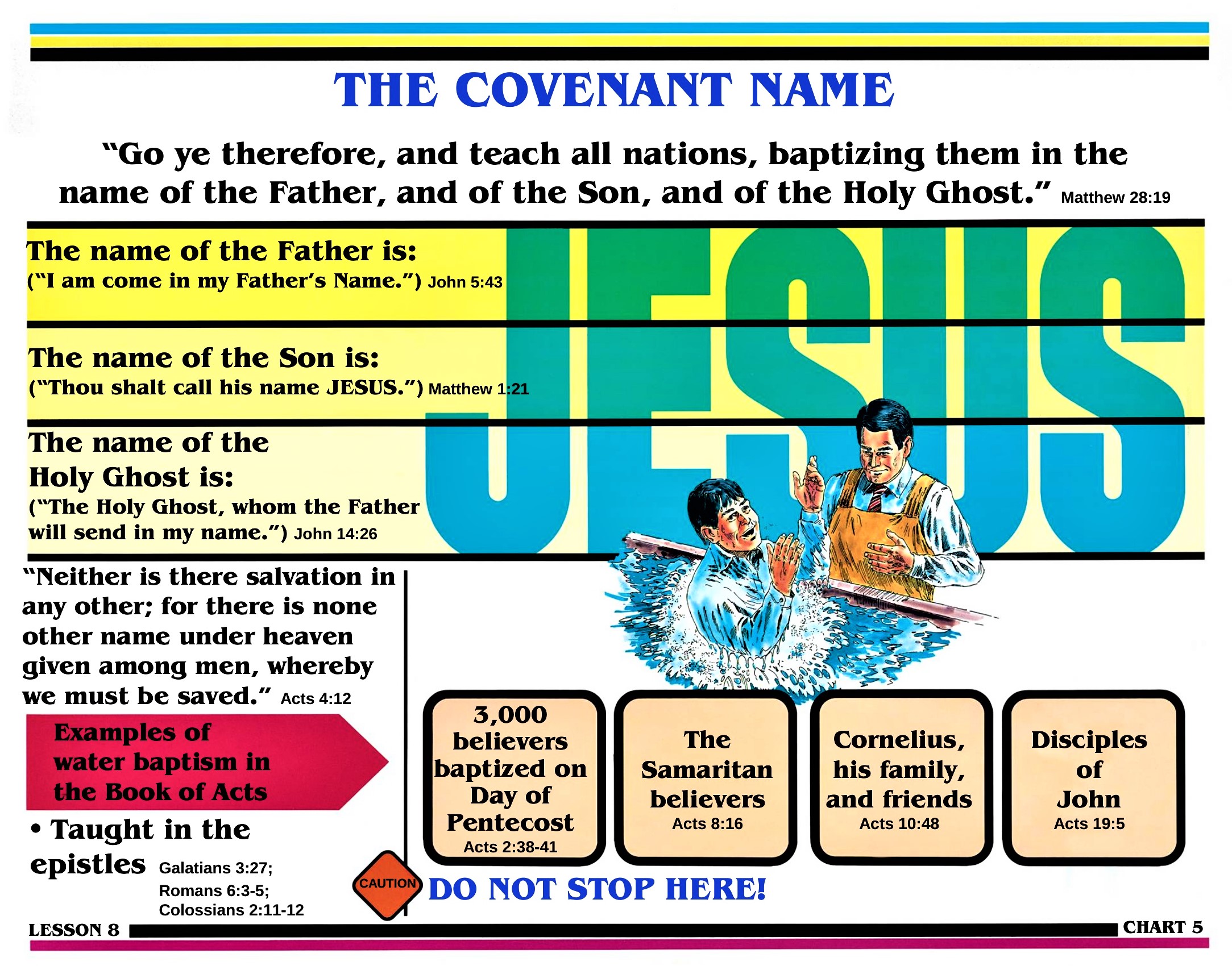
Chart Objective:
To examine the proper way to administer water baptism. Proof is given in the Book of Acts and the epistles that the apostles called the actual name of Jesus Christ rather than the descriptive titles in Matthew 28:19.
Chart Outline:
A. The Covenant Name
B. The “Name” of the Father, Son, and Holy Ghost
C. Practiced in the Book of Acts; taught in the epistle
A. The Covenant Name Matthew 28:19
Matthew’s Gospel presents a different aspect of the great commission:
“Go ye therefore, and teach all nations, baptizing them in the name of the Father, and of the Son, and of the Holy Ghost” (Matthew 28:19).
Shrouded in this single verse is an important ingredient for salvation overlooked by many sincere believers—the saving name of Jesus!
Before selecting a verse of Scripture and declaring it to be the exclusive command of Jesus, ALL His teaching on that subject in all four Gospels must be examined. To find the correct meaning of Matthew 28:19, we must analyze how baptism was practiced in the Book of Acts and taught in the epistles.
Matthew mentions titles, but no name. However, his message was not contradictory to the other three Gospel writers. All the apostles perfectly obeyed the command when they baptized in the name of the Lord Jesus.
B. The “Name” of the Father, Son, and Holy Ghost John 5:43; Matthew 1:21; John 14:26
We know the name of the Son, but what is the name of the Father and the Holy Ghost? The identity is clarified in these three verses:
“I am come in my Father’s name, and ye receive me not: if another shall come in his own name, him ye will receive” (John 5:43). “And she shall bring forth a son, and thou shalt call his name JESUS: for he shall save his people from their sins” (Matthew 1:21). “But the Comforter, which is the Holy Ghost, whom the Father will send in my name, he shall teach you all things, and bring all things to your remembrance, whatsoever I have said unto you” (John 14:26).
No record is given of any person in the early church being baptized other than “in the name of the Lord Jesus Christ.” All reference and church history records declare that during the lives of the apostles, no other wording was ever used in baptism. No authentic first-century book records a single instance of other wording during the first hundred years of the early church.
It is generally acknowledged that the Book of Matthew was written approximately A.D. 62. By then, approximately a half million converts had already been baptized. Most were converted through the preaching of Peter and Paul. Matthew’s writing agreed exactly with the preaching of these two great apostles!
We may conclude that Peter correctly used the authority given to him by Christ when he prescribed baptism in the name of Jesus.
C. Practiced in the Book of Acts; taught in the epistles
Acts 2:38-41; 8:16; 10:48; 19:5;
Galatians 3:27; Romans 6:3-5;
Colossians 2:11-12
On four separate occasions in the Book of Acts, people were baptized in the name of Jesus: three thousand believers on the Day of Pentecost; Samaritan believers; Cornelius’ household; and John’s disciples at Ephesus:
“Then Peter said unto them, Repent, and be baptized every one of you in the name of Jesus Christ for the remission of sins, and ye shall receive the gift of the Holy Ghost . . . Then they that gladly received his word were baptized: and the same day there were added unto them about three thousand souls” (Acts 2:38, 41).
“(For as yet he was fallen upon none of them [Samaritan believers]: only they were baptized in the name of the Lord Jesus” (Acts 8:16).
“And he commanded them [Cornelius’ household] to be baptized in the name of the Lord” (Acts 10:48).
“And he said unto them, Unto what then were ye baptized? And they said, Unto John’s baptism. Then said Paul, John verily baptized with the baptism of repentance, saying unto the people, that they should believe on him which should come after him, that is, on Christ Jesus. When they heard this, they were baptized in the name of the Lord Jesus” (Acts 19:3-5).
In addition, the epistles imply that baptism in Jesus’ name is correct:
“For as many of you as have been baptized into Christ have put on Christ” (Galatians 3:27).
“Know ye not, that so many of us as were baptized into Jesus Christ were baptized into his death?” (Romans 6:3). “Buried with him in baptism” (Colossians 2:12).
“And whatsoever ye do in word or deed, do all in the name of the Lord Jesus, giving thanks to God and the Father by him” (Colossians 3:17).
A primary reason for including Jesus’ name in water baptism—and every other deed—is because of its power to effect remission of sins. This name of Jesus is the only name by which we can be saved (Acts 4:12):
“Neither is there salvation in any other: for there is none other name under heaven given among men, whereby we must be saved.”
Authority is first invested in His name through inheritance:
“Hath in these last days spoken unto us by his Son, whom he hath appointed heir of all things, by whom also he made the worlds; . . . when he had by himself purged our sins, sat down on the right hand of the Majesty on high; being made so much better than the angels, as he hath by inheritance obtained a more excellent name than they” (Hebrews 1:2-4).
A second reason for the power and authority of Jesus’ name is His conquest over death, hell and Satan:
“Wherefore God also hath highly exalted him, and given him a name which is above every name: that at the name of Jesus every knee should bow, of things in heaven, and things in earth, and things under the earth; and that every tongue should confess that Jesus Christ is Lord, to the glory of God the Father” (Philippians 2:9-11).
Invested in the exalted name of Jesus is authority and power over Satan’s dominion. What other name could possibly be used to initiate believers into the New Covenant than the wonderful name of Jesus?
Again, we caution—“Do not stop here!” There is more. The best is yet to come!