“Repent, and Believe the Gospel”
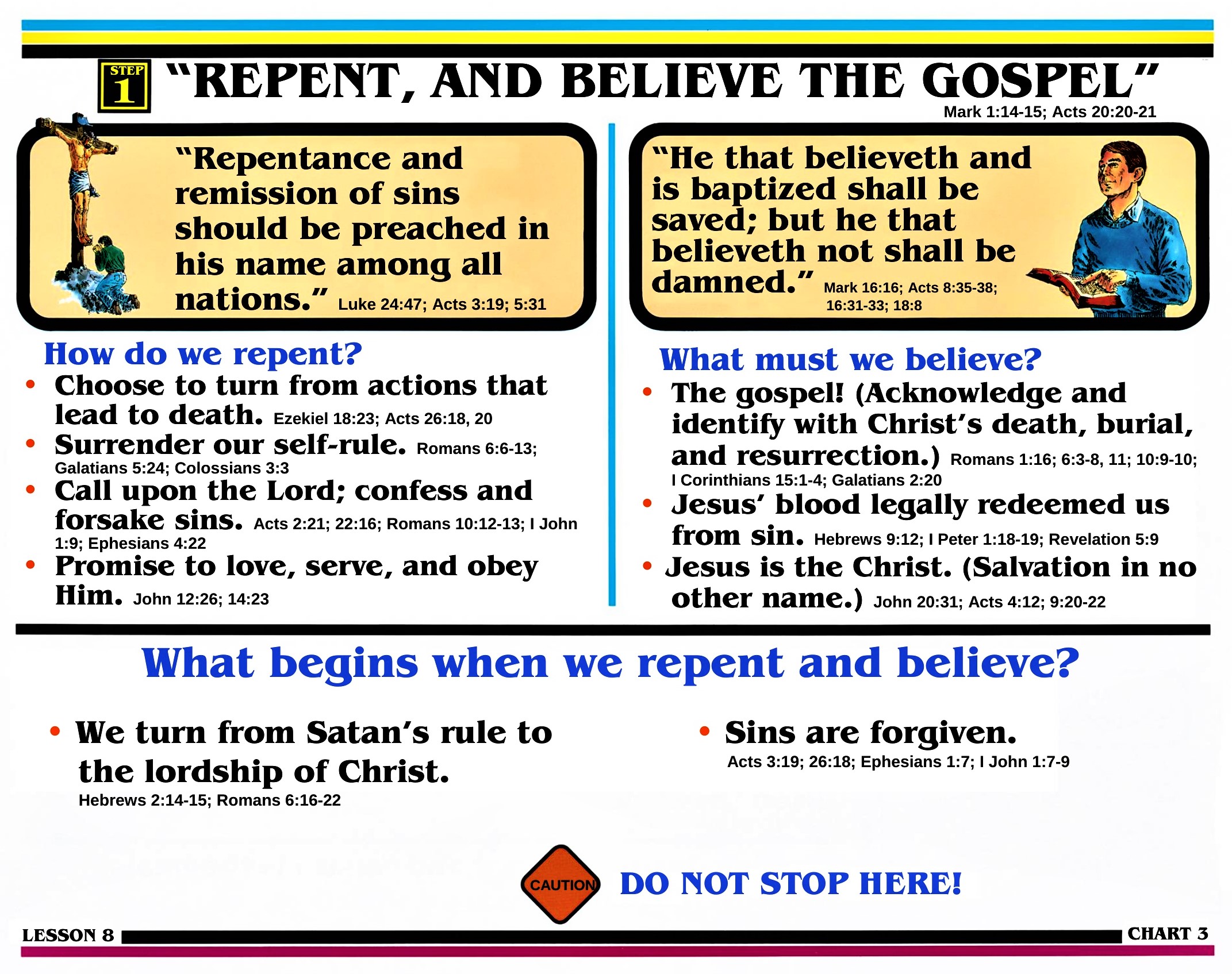
Chart Objective:
To discover the importance of the initial stages of salvation outlined in the great commission. Some very wonderful things begin as faith grows in the heart!
Chart Outline:
A. “Repent, and believe the gospel”
B. How do we repent?
C. What must we believe?
D. What begins when we repent and believe?
A. “Repent, and believe the gospel”
Mark 1:14-15; Acts 2:38
Now that we have examined Peter’s message at Pentecost, does it agree with Jesus’ words?
“Jesus came into Galilee, preaching the gospel of the kingdom of God, and saying, The time is fulfilled, and the kingdom of God is at hand: repent ye, and believe the gospel” (Mark 1:14-15).
Both sermons are in complete harmony! In answer to the curious spectator’s question, “What meaneth this?”, Peter related the moving story of the Lord’s death, burial and resurrection. It convicted their hearts! They were ready to repent and be baptized in the name of the Lord. They believed the gospel message! Upon completing his Asian missionary work, Paul recounted to the elders at Ephesus the most important message he had preached:
“And how I kept back nothing that was profitable unto you, but have shewed you, and have taught you publickly, and from house to house, testifying both to the Jews, and also to the Greeks, repentance toward God, and faith toward our Lord Jesus Christ” (Acts 20:20-21).
Salvation cannot begin until we believe the gospel. Believing allows us to enter into covenant with Jesus Christ. But unless we “continue” to believe and obey, our faith could be aborted. Many of the Jews “believed” on Jesus, yet were responsible for His death. Notice Jesus’ word of caution:
“As he spake these words, many believed on him. Then said Jesus to those Jews which believed on him, If ye continue in my word, then are ye my disciples indeed” (John 8:30-31).
B. How do we repent?
Jesus began His ministry with a call to repentance and concluded with this command:
“Repentance and remission of sins should be preached in his name among all nations, beginning at Jerusalem” (Luke 24:47).
(Turn to Lesson 6—Chart 3 and review “What is Repentance?”)
As taught in Lesson 6, repentance is not just an emotional feeling, but a decision. When we truly repent, we change our mind, our attitude, and purpose about sin. Paul said that God had sent him to the Gentiles:
“To open their eyes, and to turn them from darkness to light, and from the power of Satan unto God, that they may receive forgiveness of sins, and inheritance among them which are sanctified by faith that is in me” (Acts 26:18).
As we bow at the foot of the cross, we choose to turn away from actions that lead to eternal death.
Jesus died on the cross; our death at the altar of repentance is a surrender of self-rule. Christ must control our lives and guide decision making.
As we call upon the Lord; confess and forsake sins and are baptized, His blood cleanses us of every wrong we have ever done. John assured us,
“If we confess our sins, he is faithful and just to forgive us our sins, and to cleanse us from all unrighteousness” (I John 1:9).
To “confess” means to put thoughts into words. We tell God how bad we feel about all the wrong things we have done and our desire to forsake sins. Humbly we ask Him to become our Savior and Lord and then promise to love, serve, and obey Him.
Leaving the place of commitment, we repair wounded relationships and clear the conscience of bad feelings toward others. Our relationship with God will never be right unless our relationships with people are equally right.
Although we feel a genuine hatred and disgust for the sinful things once loved, always remember that we hate sin—but never the sinner.
We are leaving the family and lordship of Satan to join a new family with a new Lord. Pleasing our new Master must become our greater desire.
C. What must we believe?
Mark gives this account of Jesus’ great commission:
“He that believeth [the gospel] and is baptized shall be saved; but he that believeth not [the gospel] shall be damned” (Mark 16:16).
Two forceful words are emphasized in this command. If we “believe” the gospel, we shall be “saved.” What does it mean to be “saved”?
From the Greek sozo, the word “saved” means to preserve or rescue from natural dangers and afflictions; save from death; bring out safely from a situation fraught with mortal danger; save or free from disease; from demonic possession; be restored to health, get well; keep, preserve in good condition; thrive, prosper, get on well; save or preserve from eternal death (Arndt & Gingrich, A Greek English Lexicon of the New Testament).
The gospel “saves” or delivers from all the power and effects of sin. Therefore, salvation is a process that begins with repentance, but it is not completed at this first step.
Jesus declared:
“But he that shall endure unto the end, the same shall be saved” (Matthew 24:13).
Our eternal destiny depends upon being obedient and “enduring” to the end.
What essentials must we believe? Because of the saving power of the gospel, we must believe what Jesus did for us. Paul said,
“For I am not ashamed of the gospel of Christ: for it is the power of God unto salvation to every one that believeth” (Romans 1:16).
Not only do we acknowledge Christ’s death, burial, and resurrection, but we also experience the gospel message.
“Therefore we are buried with him by baptism into death: that like as Christ was raised up from the dead by the glory of the Father, even so we also should walk in newness of life . . . our old man is crucified with him, that the body of sin might be destroyed, that henceforth we should not serve sin” (Romans 6:4, 6).
As He was crucified on the cross, we crucify our “old man” at the altar of repentance. As He was buried in a tomb, we bury the “old man” by being baptized in water. As He came forth from the grave, we rise from the water to walk in a new life in the Spirit.
When Jesus’ blood legally redeemed us from sin, Satan lost his dominion over mankind. However, each person must assert his rights and refuse to be enslaved by the enemy. Only those who act upon this “good news” will be free from spiritual bondage.
“Through death he might destroy him that had the power of death, that is, the devil; and deliver them who through fear of death were all their lifetime subject to bondage” (Hebrews 2:14-15).
We must also believe that Jesus is the Christ. He is the Messiah; He is the God-Man, the Incarnation; the seed of the woman. Jesus told His accusers: “If ye believe not that I am he, ye shall die in your sins” (John 8:24). Repeatedly, the Scriptures emphasize the importance of believing that Jesus is the Christ:
“But these are written, that ye might believe that Jesus is the Christ, the Son of God; and that believing ye might have life through his name” (John 20:31).
“Neither is there salvation in any other: for there is none other name under heaven given among men, whereby we must be saved” (Acts 4:12).
“But Saul increased the more in strength, and confounded the Jews which dwelt at Damascus, proving that this is very Christ” (Acts 9:22).
To repent means that we:
• Choose to turn around. Surrender our self-will.
• Call upon the name of the Lord. Confess and forsake sins.
• Promise to love, serve, and obey Jesus.
• Believe the gospel story of Jesus’ death, burial and resurrection.
Faith in Jesus Christ and obedience to
God’s Word leads to life. We are “begotten”
from the dead through the power of the
Word.
“In Christ Jesus I have begotten you through the gospel” (I Corinthians 4:15).
“Seeing ye have purified your souls in obeying the truth through the Spirit . . . being born again, not of corruptible seed, but of incorruptible, by the word of God” (I Peter 1:22-23).
D. What begins when we repent and believe?
Faith in God is vital in our approach to God, for we are saved through faith and not by our works.
“But without faith it is impossible to please him: for he that cometh to God must believe that he is, and that he is a rewarder of them that diligently seek him” (Hebrews 11:6).
To be “righteous” means upright, just, without condemnation, in good standing with God. We must understand that we must forsake our efforts to be worthy of God if we are to receive the righteousness of God. Self righteousness is as filthy rags in God’s sight (Isaiah 64:6). Our righteousness is based on the law, but the righteousness of God comes through faith in Christ.
“And be found in him, not having mine own righteousness, which is of the law, but that which is through the faith of Christ, the righteousness which is of God by faith” (Philippians 3:9).
“What shall we say then? That the Gentiles, which followed not after righteousness, have attained to righteousness, even the righteousness which is of faith” (Romans 9:30).
“For with the heart man believeth unto righteousness; and with the mouth confession is made unto salvation” (Romans 10:10).
“Grace” means that God is greatly pleased to show us His loving-kindness and favor, although we have done nothing to merit or deserve it.
“Even when we were dead in sins, hath quickened us together with Christ, (by grace ye are saved;)” (Ephesians 2:5).
“For by grace are ye saved through faith; and that not of yourselves: it is the gift of God: not of works, lest any man should boast” (Ephesians 2:8-9).
To be “justified” means: free from condemnation; as if we had never sinned.
“And by him all that believe are justified from all things, from which ye could not be justified by the law of Moses” (Acts 13:39).
We receive the Holy Ghost by our faith in Jesus Christ. When we realize that we are sinners before God and that Christ died to save us, our faith leads us to repent. But faith does not stop with repentance. It brings us to water baptism in the name of Jesus. It does not stop at baptism. For by faith we receive the Holy Ghost. We do not earn the right to receive the Spirit by “works” of repentance or baptism, for the Holy Ghost is a gift from God. By faith we accept God’s gift.
“In the last day, that great day of the feast, Jesus stood and cried, saying, If any man thirst, let him come unto me, and drink. He that believeth on me, as the scripture hath said, out of his belly shall flow rivers of living water” (John 7:37-38).
Faith alone does not save us, but it is the channel by which God communicates His gift of life to us. We cannot save ourselves by believing, but by believing we allow God to save us. By faith we repent, submit to water baptism, receive the Holy Ghost, and follow a lifestyle of holiness. We started by faith and we live by faith.
But we must caution—DO NOT STOP HERE! Salvation has merely begun. There is no stopping place in this new walk of faith.