A New Day Dawns For Man!
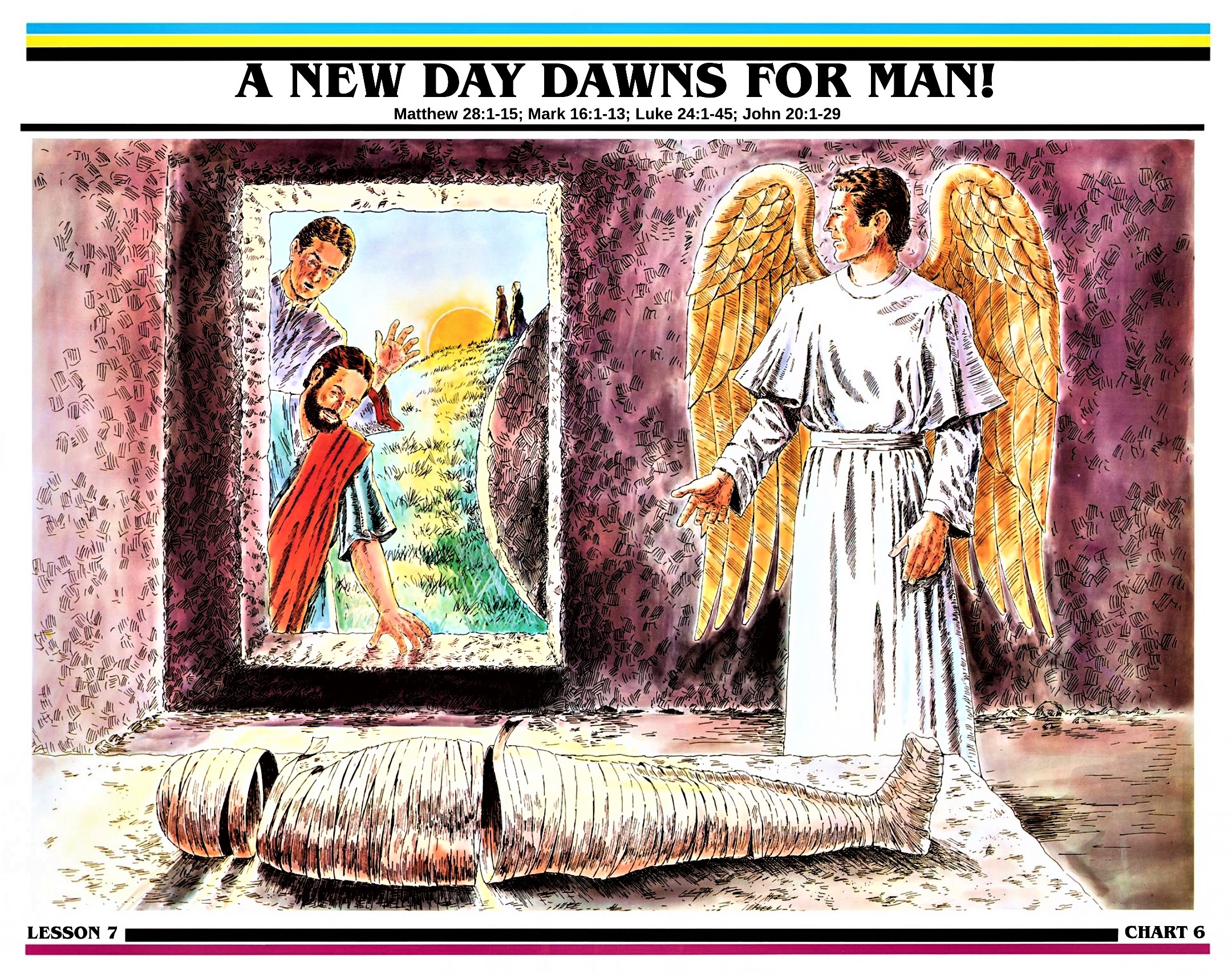
Chart Objective:
To discover the wonderful hope of the Resurrection! Sin and death had been forever conquered! Indisputable evidence also surfaced that proved the reality of the risen Christ!
Chart Outline:
A. A New Day Dawns for Man!
B. Living proofs
A. A New Day Dawns for Man!
Matthew 28:1-15; Mark 16:1-13;
Luke 24:1-45; John 20:1-29
Christ’s crucifixion was implemented by the vicious hands of enemies. But then the tender hands of friends arrived.
Two unexpected supporters requested the Lord’s body from Pilate. Joseph of Arimathea was a wealthy man and member of the Sanhedrin. Only a man of prestige could have retrieved the Lord’s body. Not even His own disciples dared try.
While the eleven were terrorized by fear, Joseph and Nicodemus courageously showed their reverence by preparing Christ for burial.
Nails were pulled from the cross to free His limbs and a sheet of pure linen was wrapped around His body. Jewish burial customs prescribed that beginning with the feet, at least three layers of white linen strips be repeatedly wound around the corpse, with another wrapped around the head.
Between each linen layer was aloe spices mixed with gummy myrrh. About one hundred pounds of spices were used on Christ’s body (John 19:39).
The combination of numerous linen strips with the glue-like myrrh provided a shroud encasement similar to papier-mache, weighing approximately 120 pounds. Such a custom- made shroud would be extremely difficult to remove (McDowell, The Resurrection Factor, pages 52-53).
The body was taken to Joseph’s new sepulchre in a garden near the crucifixion site. Once inside the entrance, the embalming was hastily completed. Nicodemus provided the fragrant myrrh and aloes. The body was then placed on a shelf or recess hewn in the walls of the tomb.
Their work completed with utmost speed, Joseph and Nicodemus closed the tomb entrance with a large stone. Jewish tombs were usually four and a half to five feet high. Engineers estimate that the entrance would require a stone one and a half to two tons!
How could two men position a stone that large? It had been held in place with a wedge as it rested in a groove or trench sloping toward the entrance. Once the wedge was removed, the heavy rock eased into position (McDowell, The Resurrection Factor, page 54).
From a distance, the women lingered to see where His body was taken. Such a hasty burial was unsatisfactory to them. Their loving devotion planned a more thorough preparation once the Passover and Sabbath were past.
Jesus was dead, but the chief priests could not rest. Haunted by His claims of rising from the dead, they carefully planned to ensure safety for the body. Again they requested Pilate’s help.
Wearied from their many demands, the governor ordered soldiers to watch. With guards as witnesses, the tomb was closed with the Roman seal.
The purpose of the seal was to prevent anyone from tampering with the grave. After careful inspection, the stone was fitted in place. A cord was stretched across the rock, fastened at both ends with sealing clay stamped with the Roman governor’s official signet.
Thus, the Roman seal publicly announced that Jesus’ body was definitely inside the tomb. To break the seal would incur the wrath of Roman law.
Consisting of a troop of four to sixteen men, each guard was trained to protect six feet of ground. If sixteen men were positioned in a square of four per side, this strictly disciplined “fighting machine” could protect thirty-six yards against an entire battalion (McDowell, The Resurrection Factor, pages 56 and 59).
Had the disciples dared approach the tomb, their attempts would have been worthless. One soldier could have dealt with the entire group singlehandedly, sending them scurrying as they had hours earlier when Christ was arrested by troops in Gethsemane (Matthew 26:56).
The Sabbath passed peacefully. Before daybreak the next morning, a group of sad women trudged from the outskirts of Bethany towards the tomb. Having been absent the previous two days, the women were unaware of the Roman guard stationed at the tomb. While some distance away, they must have felt an earthquake tremor when an angel descended from heaven to roll away the stone and then sit upon it.
Terrified, the Roman guards fell to the ground as dead men. Upon gaining their composure, they fled into the city to report the strange happening.
By examining the four Resurrection accounts in the Gospels, there may seem to be a discrepancy or contradiction. But closer examination explains the varied reports.
No two witnesses to the Resurrection encountered the same situation, nor at the same time. Their reactions were also varied. Mary was overwhelmed with emotion. The disciples were amazed and frightened. Each occasion had its own peculiar atmosphere and revealed different details.
All through the Gospels are varied portraits of Christ. No four news reporters would write identical accounts of an event. Individual creativity in news reporting is to be expected.
Nor are the details contradictory. In some plausible way they correlate to compose the larger picture.
John’s record begins first: “When it was yet dark.” Matthew’s account starts moments later, “as it began to dawn toward the first day of the week.” Soon after, Luke’s description begins “very early in the morning.” Mark mentions “early in the morning . . . at the rising of the sun.” All were stated clearly to show different times.
Approaching the tomb, the women questioned what to do with the heavy stone. But as they came closer, they noticed it was gone. Bewildered, Mary hurried to tell Peter and John.
As she turned away, the other women must have ventured closer to investigate. Different descriptions are given of the angelic visitations. At times two angels were visible; then only one. However, innumerable angels must have converged in the garden, revealing themselves as directed.
Beholding two angels, the women were terror- stricken! “Fear not,” comforted the heavenly visitor. “He is not here: for he is risen. Come, see the place where the Lord lay.”
Meanwhile, John outran Peter to the tomb. Leaning inside, they saw an amazing sight! Peering over to the wall where Christ had lain, they saw undisturbed graveclothes—still in the form of the body, but slightly caved in and empty—like a hollow caterpillar cocoon. That was enough to make a believer out of anyone!
Mary Magdalene returned to the tomb to weep. Unaware of His resurrection, she was still concerned about the missing body. Noticing a man’s form nearby, she questioned the whereabouts of Christ’s body.
A single word—“Mary”—brought her to His feet. The resurrected Lord had appeared first to her! However, she could not touch Him. At that moment, He was taking His righteous blood to heaven’s mercy seat, thereby legalizing man’s redemption.
Mary Magdalene, out of whom Christ had cast seven demons, was the first eyewitness to the risen Lord. She was then told to inform Christ’s brethren of His resurrection.
While the shocked disciples scurried back and forth to the tomb, the city was astir with other activities. The terrified Roman guard had fled their gravesite post. To abandon an assigned duty would incur the death penalty. Fearing the governor’s wrath, they confided in the chief priests, who were more interested in the tomb’s safety. Hearing the amazing events, the Jewish rulers hastily summoned the Sanhedrin. They must move quickly!
The trembling guards were told to report that while they slept, Christ’s disciples came by night and stole the body away. That lie was indeed dangerous! They could be penalized with death for sleeping on guard.
If the soldiers were asleep, how could they have known what had happened? If they were awake, why didn’t they arrest the grave robbers? If it were a case of theft, why where the graveclothes left intact?
Pitiful as the story was, the soldiers followed instructions and spread the word about their lack of valor in guarding the tomb.
B. Living proofs
Critics argue that the Resurrection story is a mere legend, concocted years later. However, the accounts were circulated and recorded by the original eyewitnesses. Peter, who had viewed the empty graveclothes on Resurrection morning dismissed any possibility of myth, assuring his readers that he saw it happen!
“For we have not followed cunningly devised fables, when we made known unto you the power and coming of our Lord Jesus Christ, but were eyewitnesses of his majesty” (II Peter 1:16).
At least fifteen different post-resurrection appearances were witnessed by Christ’s followers. Paul related that around A.D. 56, almost five hundred firsthand eyewitnesses were still alive (I Corinthians 15:6).
Something had happened for the course of history to be changed from B.C. (before Christ) to A.D. (the Latin Anno Domini—“the year of our Lord”). What notable event could change the world calendar?
That event was an empty tomb a fifteen-minute walk from the center of Jerusalem would have confirmed or disproved! Could the early church have survived for a single day in its hostile surroundings had Christ not risen from the dead?
The resurrection of its Founder was preached within steps of Joseph’s tomb! The Resurrection could not have been maintained in Jerusalem had the tomb not been empty.
All Jewish authorities had to do was produce the body and the disciples would have been silenced forever. Rather, they forcibly brought the apostles before their council and threatened them with death unless they ceased preaching a risen Christ.
The Jews were powerless to produce Christ’s body! Their threats acknowledged that He was indeed risen!
Yes, the evidence was all too clear to any who cared to check. All Jerusalem was aware of the details. What further proofs were needed? He is alive!