Peter Receives Kingdom Keys
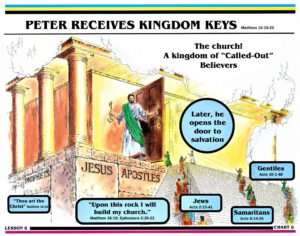
Chart Objective:
To study Peter’s accurate perception of Christ’s true identity as the Son of God. The keys to the new spiritual kingdom given him by Jesus were later were used to open the door of salvation first to the Jews, then to the Samaritans and later, the Gentiles.
Chart Outline:
A. “Thou art the Christ”
B. “Upon this rock I will build my church”
C. The church! A kingdom of “called-out”
believers
D. Later, Peter opens the door to salvation
E. Jews, Samaritans, Gentiles
A. “Thou art the Christ” Matthew 16:16
Christ’s Galilean ministry was coming to a close. Only days before, He had multiplied loaves and fish while the awed multitude sought to proclaim Him as their King. Had Christ decided to overthrow Roman dominion, countless numbers would have enthusiastically joined the revolution. Had He publicly announced Himself as the Messiah, Jesus would have been heralded as the deliverer of the people.
Instead, He declined their offered crown to seek solitude away from the clamoring throngs. No one as yet understood His mission. Since their spirits were still dead, they could not grasp the significance of a kingdom that was not of this world.
As Christ retired with His chosen Twelve to a secluded area, He began to talk with them more intimately.
“Whom do men say that I the Son of man am?” (Matthew 16:13).
Jesus had never before asked such a startling question! Seemingly He paid no attention to the opinions or praise of men. This question, however, was asked for the benefit of the disciples. Their vague ideas must be clarified.
Having freely mixed with Christ’s audiences, the disciples had frequently heard unbiased comments about their Master—His miracles, teaching, authority and claims. Such a unique personality as Jesus Christ had evoked interest and curiosity throughout the country. However, the Twelve reluctantly had to admit that to their knowledge, no one believed Jesus to be the Messiah.
Oh yes, there were many varied opinions. Some, like the terrified Herod Antipas, thought He was a resurrected John the Baptist. Some supposed He was Elijah. Others suspected Him to be Jeremiah or another of the Old Testament prophets.
Having asked this question—not for His own information—Christ sought to crystallize their convictions and faith. Pondering their comments for a moment, He then asked a much more probing question:
“But whom say ye that I am?” (Matthew 16:15).
Although asked of all the disciples, Peter became the mouthpiece that day for the Twelve, as he so often did. Boldly He declared,
“Thou art the Christ, the Son of the living God” (Matthew 16:16).
Christ was quite pleased with Peter’s accurate analysis. If anyone at this point should have understood that He was the Messiah, surely it should have been these men who had witnessed mighty miracles that only God could perform.
Peter’s confession was an absolutely complete description of Christ! Knowing the Old Testament Scriptures concerning the “God-Man” Who was to come, Peter knew that the “Son,” or humanity of Jesus, would be born of a virgin, would dwell among men, and would be their God (Isaiah 7:14; 9:6; 35:4-6)!
Here, without doubt, was the Christ! The God of the Old Testament for Whom they had waited!
Peter also explained in one breath that not only was Jesus the Christ, or Messiah, but the “Son of the living God!” God—in His human form—had accompanied them for almost three years. And Peter had recognized Deity through the wrapper of human flesh! (See John 14:8-11; 10:30-38.)
Both His office and nature were explained in this one statement. Jesus’ office was that of the long-expected Messiah. His nature was that of human flesh—the “Son of the living God.” Divinity and humanity had joined to become the Savior of the world!
B. “Upon this rock I will build my church” Matthew 16:18; Ephesians 2:20-22 Christ was especially pleased with Peter’s perception.
“Blessed art thou, Simon Barjona: for flesh and blood hath not revealed it unto thee, but my Father which is in heaven. And I say also unto thee, That thou art Peter, and upon this rock I will build my church; and the gates of hell shall not prevail against it. And I will give unto thee the keys of the kingdom of heaven: and whatsoever thou shalt bind on earth shall be bound in heaven: and whatsoever thou shalt loose on earth shall be loosed in heaven” (Matthew 16:17-19).
What did Christ mean in these statements? Many questions have arisen since the day Christ made this declaration. Did Jesus indicate that the rock foundation of His church was Peter? or Peter’s confession? or Christ Himself?
When Jesus first called Peter to become His follower, he was named “Cephas,” which means “stone” or “rock.” The literal translation of Christ’s statement is:
“Thou art Petros and upon this petra I will build my church.”
The word “Petros” indicates a small stone, while “petra” indicates a boulder of gigantic proportions, such as the Rock of Gibraltar. Thus, Peter was only a small part of that great Rock on which Christ would build His church. The wise Master-Builder stood ready that day to lay the firm foundation stones of His enduring church. Since Peter was the first to acknowledge the true deity of our Lord, it was in this rock-like disciple that Jesus discerned a suitable stone to lay first on the foundation rock. Thus, Peter was only a small, but very important part of the church’s foundation. We also are included in the building:
“And are built upon the foundation of the apostles and prophets, Jesus Christ himself being the chief corner stone; in whom all the building fitly framed together groweth unto an holy temple in the Lord: in whom ye also are builded together for an habitation of God through the Spirit” (Ephesians 2:20-22).
C. The church!
A kingdom of “called-out” believers Thus, we know that the church’s foundation is built upon Christ, the apostles and prophets and that we also, “builded together” as “lively stones” (I Peter 2:5-6), compose a part of this structure called the church.
The church is not built merely on confessions, but on men who have made confessions— men inspired by God to teach His great truths. It is on rock-men like Peter who acknowledge the true deity of Christ that the church of the living God is built.
The stone which gained the honorable position of being laid immediately next to the corner was the apostle Peter.
Here in Christ’s declaration, we encounter the word “church” for the first time in the New Testament. The word is derived from the verb “ecclesia,” meaning “to call out.”
“Church” connotes a new meaning from the synagogue assemblies where Jews met for worship. In our Lord’s words to Peter, special emphasis is placed on the word to distinguish it from that of the Jews. Thus, the Christian community in the midst of Israel would be “called-out” ones. Today, Christ’s true “church” represents a group of “called-out” believers distinctively set apart from the world.
D. Later, Peter opens the door to salvation
Christ continued in His reply to confer on Peter the “keys of the kingdom of heaven” (Matthew 16:19).
In Eastern customs, the “key” was a symbol of authority. Made with a crook at one end, it was worn around the neck as a badge of office. To present a key was equivalent to bestowing great trust, distinction and responsibility.
The authority given Peter was to open the door of faith and salvation to the entire world—a door that would never again be closed or reserved for one elite group. Because Peter understood who Jesus was, he was qualified to receive the key that would open the door of salvation to everyone!
E. Jews, Samaritans, Gentiles Acts 2:12-41; 8:14-25; 10:1-48
On the Day of Pentecost, Peter opened the door of salvation to the Jews by explaining the strange phenomena in the upper room (Acts 2). This was the first sermon with instructions for obeying the gospel.
Later, Peter was also responsible for laying hands upon the Samaritans to receive the Holy Spirit (Acts 8).
Finally, Peter opened the door for the despised Gentiles to be baptized with the Holy Spirit as he preached to the household of Cornelius in Caesarea (Acts 10).
On these three occasions, Peter introduced each ethnic group to the gospel. By using the “key” of authority given him by Christ, he admitted or gave directions to those desiring salvation.
Peter’s newfound authority was never designed to allow him to forgive sins, for only God can do that. But he was inspired by the Holy Ghost to proclaim the terms whereby men could enter the kingdom. Using his newly acquired key, Peter held open the door for 3,000 souls who heard his message on the Day of Pentecost. In the same sermon, Peter assured every person rightful admission to salvation.
“Then Peter said unto them, Repent, and be baptized every one of you in the name ofJesus Christ for the remission of sins, and ye shall receive the gift of the Holy Ghost. For the promise is unto you, and to your children, and to all that are afar off, even as many as the Lord our God shall call” (Acts 2:38-39).
Regardless of race, creed or national origin, the key still fits the door. How thankful we are that the promise still applies to believers in the twenty-first century!
No, Peter should never be thought of as the head of the church. Because of his accurate perception of who Christ is, he was only allowed the honor of becoming “Head Usher” or doorkeeper, unlocking the door to salvation for the entire world!
A second responsibility given Peter was that of “binding” and “loosing.” These familiar terms to the disciples were constantly used in the Canon-Law of the rabbis.
To “bind” means to prohibit; to “loose” means to permit. Binding and loosing simply inferred to prohibiting or permitting certain actions. This was was also claimed by the rabbis. Christ now transferred these two powers to His apostles. Under the guidance of the Holy Spirit, what Peter and then the church would loose or bind on earth would also be loosed or bound in heaven (John 20:23).
Although Christ never attempted to organize those who believed in Him, He knew that the apostles must do so. As the Levites had been designated to minister in holy things and interpret the law, so the apostles would occupy positions of authority. They too must be prepared to teach and apply doctrines concerning practical life and conduct. Therefore, special endowments were provided for equipping His followers for service (I Corinthians 12:28).
The next lesson will reveal the beautiful new covenant Christ made with His chosen Twelve on the eve before His death and the glorious resurrection story.