Lesson 6 – Chart 4
Jesus Christ, the Hope of the World
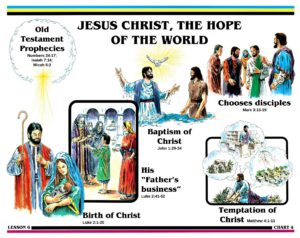
Chart Objective:
To examine the birth, mission, and preparation of the Son of God for a ministry that would lovingly reach toward a needy, though skeptical world.
Chart Outline:
A. Birth of Christ; Old Testament Prophecies
B. His “Father’s business”
C. Baptism of Christ
D. Temptation of Christ
E. Chooses disciples
A. Birth of Christ
Luke 2:1-20 Old Testament Prophecies
Numbers 24:17; Isaiah 7:14; Micah 5:2
Six months after the announcement of John’s birth, the angel Gabriel was commissioned to deliver a similar message in Nazareth. In this secluded village lived a young virgin named Mary of the tribe of Judah. She was espoused, or engaged, to Joseph, also of the house of David.
This quiet, young girl was told that through the operation of the Holy Spirit, she would give birth to a Son. She must name the child Jesus, meaning “Yahweh the Savior.” Mary would be the highly honored mother of the Messiah!
Startled by the amazing announcement, Mary was then encouraged with news that Elisabeth, her elderly cousin, was also expecting a child. An age of wonders had begun!
Quickly Mary prepared to visit Elisabeth in the Judean hills. As the youthful relative arrived, Elisabeth greeted Mary as “the mother of my Lord.” That salutation fully confirmed the angel’s words!
As Elisabeth rejoiced, she felt the baby in her womb also leap for joy!
Three months later, Mary returned to Nazareth. Imagine Joseph’s confusion when informed that his wife-to-be was expecting a child. Espousal among the Hebrews was much more binding than modern engagements. Because it was considered the beginning of marriage, espousal was legally binding and not easily broken.
While Joseph struggled with his problem, an angel appeared in a dream, revealing the truth of Mary’s story. Her child was indeed conceived of God’s divine Spirit!
Joseph was instructed to continue his marriage plans and name Mary’s baby, Jesus (Matthew 1:20-21). Her child would be a Savior—not from political bondage, but from sin—man’s most dreadful bondage.
Centuries earlier, Isaiah had prophesied that the Messiah would be God manifest in the flesh (Isaiah 7:14)! Jesus would also be the “God-Man” promised to Adam and Eve at the dawn of history.
Micah had predicted that the Messiah should be born in Bethlehem (Micah 5:2). However, it seemed inevitable that the child would be born in Nazareth, the home of Mary and Joseph.
With meticulous care, the Almighty arranged for the birthplace to coincide precisely with Micah’s prediction. The heathen emperor at Rome, Caesar Augustus, decreed that every subject of the Roman Empire must be taxed. All must register according to their family lineage.
Every citizen had to endure the hardship of being enrolled to fulfill prophecy. Joseph and Mary were forced to travel from Nazareth to their ancestral home in Bethlehem.
At the completion of the one-hundred-mile trip, Mary sensed it was time for the birth of her child. But they had come too late. Every guest chamber was filled to capacity.
Earth’s most important birth should have been heralded from every shore! But the precious Christ child came secretly, in a common stable among cattle. The first bed of the King of kings was a feedbox for livestock!
As shepherds were tending their flocks nearby, a majestic choir of angels appeared in the skies singing of peace on earth and the birth of a Savior. Specific instructions were given and the men hurried to Bethlehem where they found Mary, Joseph and the baby lying in the manger.
Lowly shepherds were the only worshipers to celebrate the greatest event of the ages!
The shepherds’ unusual account of a heavenly choir became another important link in the wondrous chain of events that would crown the life of this child. How it must have greatly encouraged Mary and Joseph!
Most sheep used for daily Temple sacrifices grazed in Bethlehem pastures. Therefore, the shepherds who first heard news of the Savior’s birth,
“Made known abroad the saying which was told them concerning this child. And all they that heard it wondered at those things which were told them by the shepherds” (Luke 2:17-18).
Humble shepherds proved to be effective heralds in announcing the Messiah’s coming to devout worshipers at the Temple.
Superstition has fixed the date of our Savior’s birth as December 25. This date first appeared in the fourth century. However, shepherds would not have tended their sheep in open fields during winter months. Jesus was probably born during the warmer spring or summer months. Yet it is good to observe this momentous occasion every day of the year—so why not on Christmas Day also?
Having been born under the dispensation of law, Jesus was required to submit to prescribed customs and ordinances. On the eighth day, the Christ child was named and then circumcised—the sign of becoming a covenant member.
At the age of forty days, Mary and Joseph presented their child to the Lord at the Temple for the Jewish rite of purification. Simeon, a just and devout man, had been assured that he would not die until his eyes had seen the Lord’s Christ. When he beheld Mary holding the babe, he was certain that day had arrived!
Taking Jesus in his arms, Simeon blessed God for being permitted to see His salvation, a light to lighten the Gentiles and the glory of His people Israel (Luke 2:32).
The GENTILES? Yes! Wise men from the East seem to have been the first to fulfill God’s purpose for the Gentiles. To the Jews, God spoke through an angel. But to the Gentiles through a star. Each was given in language perhaps best understood.
Who were these wise men? Probably they were of the “magi,” which were royal Persian scholars trained in astronomy and wisdom of the ancient world. Like the Jewish tribe of Levi, the Magi were entrusted with priestly functions. They were familiar with Old Testament prophecies about the coming Redeemer since Daniel was once prime minister of Persia under Darius and Cyrus (Daniel 6:1-3, 28).
In fact, the year of Christ’s birth could almost have been pinpointed from Daniel’s prophecies alone! He had predicted that the Messiah would come into Jerusalem as a Prince, 483 years after the Persian emperor Artaxerxes gave the decree for exiled Jews to rebuild their city and wall (Daniel 9:25-26; Nehemiah 2:7-8). This decree was given about 446 B.C. Of course, Messiah would be born more than thirty years before coming to Jerusalem as a “Prince” (Morris, The Bible Has the Answer, page 203).
Perhaps the wise men had also viewed with keen interest Balaam’s prophecy stating that the Messiah’s appearance would be signaled by a “star” out of Jacob (Numbers 24:17).
More than “three” wise men were likely in the caravan. When this large entourage suddenly appeared at Herod’s palace demanding to see a newborn “King of the Jews,” all Jerusalem was disturbed.
Many months had passed since the first appearance of the star. The Persians assumed that such a notable child would surely be in the king’s palace.
When Herod received this frightening announcement, he sent them to Bethlehem, instructing that they return and report their visit.
Fearing for his own crown, he planned to destroy the child as soon as He was found. But God prevented Herod’s evil plot by warning the wise men in a dream to return home another way.
Soon after the Magi departed, Joseph was also warned in a dream to flee into Egypt with the young child and His mother. There they remained until after Herod’s death.
Realizing that the wise men had deceived him, Herod became furious. In a mad rage, he commissioned soldiers to kill all the males in Bethlehem under two years of age. To find the one child threatening his empire, the brutal monarch killed them all!
When Herod died, an angelic voice instructed sleeping Joseph to return to Israel with Jesus and Mary.
After arriving back at Nazareth, we are told of no more angelic announcements, prophetic words, nor worship from mysterious strangers. Jesus’ boyhood was ordinary and unnoticed.
Why are no details given of Christ’s youth? Childhood records were not preserved of ANY ancient hero. The important influence of childhood years upon the adult life is a recent idea. But in ancient times, such details seemed insignificant.
B. His “Father’s business”
Luke 2:41-52
Jesus was a normal, healthy child. But He never once committed a sin. Nor did He perform any miracles in those early years. John describes His first to be that of changing water into wine (John 2:11).
Matthew tells us Jesus was the eldest in a family of at least seven children (Matthew 13:55-56). Being Mary’s “first-born” Son indicated there were others also.
In Nazareth, every Jewish boy attended synagogue school. At the age of five or six, formal education began. Bible study began with the books of the law, continuing to the writings of the prophets.
Moses’ law was very demanding about religious education in the home. Parents were commanded to train their children about God and His laws. This special mark of Judaism is one reason for the permanence of the Jew in history.
All Jewish men were required to attend three great feasts at Jerusalem: the Passover, Pentecost, and Tabernacles. Women were allowed, but not required to come. Although Jewish families had been scattered to distant lands, devout Jews faithfully attended these feasts.
At the age of twelve, Jesus made His second visit to the Temple. The first was His circumcision and dedication to God. This time He chose to come. Twelve-year-old boys were known as “sons of the law,” meaning they were personally obligated to observe the ordinances.
After observing the feast, Mary and Joseph started home. Instead of joining the pilgrims from His hometown, Jesus lingered at the Temple, thoroughly absorbed in the rabbis’ teachings and answers. After a day of travel, Mary and Joseph missed Jesus and began to inquire of kinsmen and friends. No one had seen Him.
Quickly they returned to Jerusalem to continue their search. After three days they found Him at the Temple, reasoning with the learned scholars. The group was astonished at His understanding and answers. Jesus’ reply to Mary and Joseph was:
“How is it that ye sought me? wist ye not that I must be about my Father’s business?” (Luke 2:49).
Jesus was aware of His future destiny, yet He obediently returned to Nazareth with His parents and was submissive to them. What a lesson for young people today!
From the age of twelve until the beginning of His ministry at age thirty, nothing is recorded of Jesus’ life. However, from His later use of Old Testament Scriptures, we are certain He was thoroughly trained in the synagogue schools.
No reproach could be found in His life— spiritually or physically. In this one verse of Scripture we discover four areas of development:
“And Jesus increased in wisdom and stature, and in favour with God and man” (Luke 2:52).
• Wisdom. Mental growth and acquired knowledge.
• Stature. Physical growth. He became strong and healthy.
• Favor with God. Spiritual growth, in preparation for His mission as the Son of God.
• Favor with man. Social development and behavior. Jesus learned how to get along well with others and communicate effectively.
What a delightful personality Jesus must have had! Never was He happier in later years than when surrounded by publicans and sinners or feeding famished crowds. Jesus was a great lover of mankind and thoroughly enjoyed being with people.
C. Baptism of Christ John 1:29-34
John the Baptist had begun preaching a message of repentance and baptism about six months before Jesus entered public ministry. As John was baptizing in the Jordan River, Jesus came with others to be baptized.
The legal age for a priest to begin officiating was thirty years. Having reached that age, Jesus was ready to begin His ministry.
Although John did not immediately recognize his cousin, he felt the power of divine presence. John’s spirit witnessed that a sinless, sacred person stood before him.
But Jesus was waiting to be baptized! The baptism of repentance was accompanied by confession of sin. How could Jesus confess if He had no sin?
John instantly felt his own unworthiness in the presence of the Savior. Since Jesus had greater authority from God, the roles of ministry should have been reversed. John needed the baptism of the Holy Spirit, but Jesus had no need for the baptism of repentance. After Jesus persuaded that this was God’s plan, John reluctantly cooperated.
Why was Jesus baptized? In Christ’s answer to John, we find both the reason why He desired baptism and the true significance of Christian baptism. As explained to John, He was baptized to “fulfil [to complete] all righteousness” (Matthew 3:15). Here are some reasons for His baptism:
• He was our perfect Example.
Deliberately, Jesus established a pattern which He intended all His believing disciples to follow.
“Leaving us an example, that ye should follow his steps” (I Peter 2:21-22).
• He was part of the human race. Christ was made “in the likeness of sinful flesh.” Baptism was not for Deity, but mankind. Therefore, we know Jesus was Man as well as God.
• He was our high priest. The high priest was washed and anointed prior to serving. At Jesus’ baptism He was “washed” and “anointed” with the Holy Spirit.
• He was the spotless Lamb of God. Sacrificial lambs were carefully inspected for blemishes or defects before being presented to the priest. To be the spotless Lamb of God, Jesus must also be washed, prepared, scrutinized, and accepted for sacrifice by the Father.
• He submitted to the initiating rite of the New Covenant. At birth, Jesus was circumcised, the initiating rite of Abraham’s covenant. When He assumed public leadership, Christ introduced the initiating ordinance of the New Covenant—an inner circumcision of the heart through water baptism. After fulfilling all righteousness under the Old Covenant, Jesus gave His own body and blood to institute the New Covenant (Isaiah 42:6).
After being immersed in water by John, Jesus “went up straightway out of the water. ” Then a most amazing thing happened! The heavens opened and the Spirit of God descended upon Jesus bodily like a dove. A voice said, “This is my beloved Son, in whom I am well pleased.”
How John must have rejoiced at those assuring words. This was the Christ, the Savior of the world!
Jesus’ baptism in water and anointing of the Holy Spirit is one of the few pivotal events in all Bible history. His baptism introduced a new messianic age and prepared the way for the New Covenant to be initiated.
D. Temptation of Christ Matthew 4:1-11
Immediately after His baptism and anointing with the Spirit, Jesus retreated to the wilderness for a time of prayer, fasting, and preparation for His upcoming ministry.
Throughout the forty days, Satan waited like a wild beast for the precise moment to pounce upon his prey. Christ’s temptation was further preparation for the great work He was about to begin.
First Satan appealed to the strong natural appetite of hunger. “If thou be the Son of God, command that these stones be made bread,” he challenged.
Yes, Christ could have used His supernatural power to feed the crowds and generate a massive following. But that was not His plan. His kingdom would be built by feeding hungry hearts rather than satisfying their natural craving for food.
“But he answered and said, It is written, Man shall not live by bread alone, but by every word that proceedeth out of the mouth of God” (Matthew 4:4).
Since Jesus would not use His newly developed powers to satisfy the natural appetite, Satan resorted to other suggestions that challenged His position as the Messiah. Probably by suggestion or imagination, Jesus was taken to the pinnacle of the Temple and asked:
“If thou be the Son of God, cast thyself down: for it is written, He shall give his angels charge concerning thee” (Matthew 4:6).
This brilliant idea might have appealed to the carnal mind. What a breathtaking beginning for His ministry! Leap from the tremendous Temple height to the assembled worshipers below! Such a spectacular miracle would accomplish His mission instantly!
What could He lose? God’s Word had already declared that angels would keep Christ from harm.
This would have been a simple method—compared to the tedious instruction, the slow changes that must be effected in men’s thinking and the weary ministry actually chosen by Christ. Yet He steadily refused to work a miracle for the sake of proving His power.
“Thou shalt not tempt the Lord thy God,” was the Master’s reply. We tempt God by placing ourselves in dangerous situations to which He has not called us. Christ’s miracles were always performed to relieve distress or increase faith among His followers. He would not display His power to satisfy the curiosity of Satan, Herod, or the Pharisees. Christ’s high and holy character never yielded to such base motives.
The most difficult temptation was reserved for last. The pinnacle of the Temple was not high enough. Jesus must be taken to a lofty mountain for a broader view. All the kingdoms of the world were viewed instantaneously as Satan offered this tempting bargain:
“All these things will I give thee, if thou wilt fall down and worship me” (Matthew 4:9).
Would Jesus selfishly seize power and glory by an unholy act of submission? The throne He had come to claim could be attained so much simpler than the plan He had been considering the last forty days. No self-denial, no self-sacrifice, no shedding of blood. What a bargain! The carnal mind eagerly welcomes such a proposition!
Although Satan was indeed prince of this world, Christ had no intention of gaining world acceptance through a deceptive scheme. Again Jesus defeated the enemy with God’s Word:
“Then saith Jesus unto him, Get thee hence, Satan: for it is written, Thou shalt worship the Lord thy God, and him only shalt thou serve” (Matthew 4:10).
It would be impossible to improve on the Lord’s method of dealing with the devil. Only the inspired Word of God can expose and defeat Satan’s lies.
Note that Christ used the same weapon available to every believer—the Word of God! Scripture is much more useful than for comfort and devotion. It is the most effective weapon in our hand against Satan’s enticements!
With each temptation, Christ began His rebuttal with this statement: “It is written . . . It is written . . . It is written.” And we must do the same.
But how can we know what is written if we are not acquainted with our Bible and its invaluable contents? Here is the whole purpose for our home Bible study! By becoming acquainted with the Bible, your life will be more rewarding, more fulfilling, and victorious!
Having utterly failed, Satan was forced to flee in response to the Master’s command: “Get thee hence, Satan.” Although conquered, he was not through with the Conqueror. He departed “for a season.”
Then angels came and ministered unto Jesus. Perhaps we do not always sense the presence of angelic forces while being tempted, but they are near. The sooner we resist, the sooner we can be encouraged and strengthened by God’s helpers.
E. Chooses disciples Mark 3:13-19
Following His bout with the tempter in the wilderness, Jesus returned “in the power of the Spirit” (Luke 4:4) to the place John was baptizing.
One of John’s great contributions was to direct two of his disciples to Jesus. Both were later chosen as apostles.
When Andrew and John heard of the coming Messiah, they wanted to meet and follow Him. So great was Christ’s impression upon them, they became disciples for life. Quickly they transferred allegiance from a closing ministry to a beginning one.
Andrew also became the first soulwinner by bringing his brother Simon Peter to Jesus. Although Andrew never wrote an epistle nor founded a church, he opened a new career to one of the greatest apostles.
Soon afterward, Philip was brought within the circle of Christ’s influence. Philip, in turn, found Nathanael (Bartholomew), a devout Jewish scholar who readily accepted Jesus as the Messiah.
During His first year of ministry, these five men followed Christ while maintaining their occupation. However, the day came when Christ asked for a deeper commitment.No longer would they be fishermen, but “fishers of men.” Simon Peter and Andrew, along with their fishing partners, James and John, forsook all to become official followers of Christ.
Soon afterward, Matthew was asked to join the group (Matthew 9:9). Jesus saw something special in this despised tax collector. Being an eyewitness to the majority of events, Matthew’s occupation of record keeper provided skills for becoming a narrator of the Gospel bearing his name.
Jesus took about a year and a half to complete His choice of apostles. Most were with Him about two years. The selection and training of men to whom His work would be entrusted was an extremely important part of Jesus’ earthly mission.
His entire cause was staked upon twelve men. Jesus wrote no books; He left no elaborate church government; He established no school of philosophy; He organized no great armies to carry His banners. He merely gathered twelve men, mostly outdoorsmen—men of the earth, farmers, fishermen and lowly government officials. None were of the nobility or aristocracy. In simple faith they depended heavily upon Him for the future.
There was the inner circle: Peter, James, and John; the quiet workers—Andrew, Philip, Nathanael, Thomas, and Matthew. There were the little known three—James the less, Thaddeus (Jude), and Simon Zelotes. Finally, the traitor, Judas Iscariot, completed the dozen assistants.
At first, the twelve were sent forth two by two. In this way, they would be serviceable to one another, providing companionship, encouragement and strength. Some apostles were not famous, nor their actions celebrated. But to each was given a distinct call, a commission and an obligation to become a “fisher of men.”