John the Baptist Paves the Way
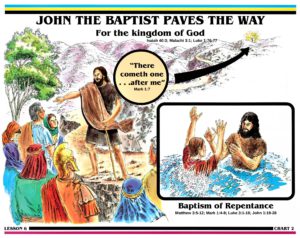
Chart Objective:
To examine John the Baptist’s unique ministry of preparing the Jewish nation for their Messiah and his baptism of repentance.
Chart Outline:
A. John the Baptist Paves the Way for the
Kingdom of God
B. “There cometh one after me”
C. Baptism of Repentance
A. John the Baptist Paves the Way for the
Kingdom of God Isaiah 40:3; Malachi 3:1; Luke 1:76-77
Although it had been four hundred years since an anointed prophet’s voice had been heard, Malachi’s final words had echoed across the centuries:
“Behold, I will send my messenger, and he shall prepare the way before me” (Malachi 3:1).
Both Malachi and Isaiah predicted that a forerunner would prepare the way for the Christ (Isaiah 40:3). Although the Jews were familiar with these prophecies, they were unaware of John’s preparatory mission.
Just as John prepared the way for Christ’s first coming, so messengers are going now into homes around the world to declare the “good news” that Christ will soon come again.
With the coming of John, God began to deal with men in a different way. John’s purpose was to acquaint people with the New Covenant concept. The law and the prophets were coming to a close and the kingdom of God was about to begin:
“The law and the prophets were until John: since that time the kingdom of God is preached, and every man presseth into it” (Luke 16:16).
John’s miraculous birth declared that a special man had been selected for a special mission. The angel Gabriel stood by the aged priest, Zacharias, while he was ministering in the Temple to announce that a son would be born to he and Elisabeth.
This child was to be named John. He must touch neither wine nor strong drink and would be great in the sight of the Lord. John’s mission was to prepare the people for Messiah’s coming.
Six months later, the same angel, Gabriel, appeared to Elisabeth’s cousin, Mary, in the city of Nazareth to announce the birth of the Messiah.
Although John was born into the priestly family of Aaron, he preached in the wilderness rather than the Temple.
John’s early years were spent in isolation. Having being dedicated to God as a Nazarite, John’s uncut hair waved in the wind. For food, he ate the most common source supplied by the desert—locust and wild honey— the food of the very poor. Locusts, salted and eaten with butter or wild honey, resembled parched corn and tasted like shrimp.
Rough camel hair garments and a strange diet did not make John great. However, luxury and self-indulgence were certainly absent from the man whom Christ called “the greatest of the sons of men.”
B. “There cometh one . . . after me” Mark 1:7
At age thirty, the legal age for admission to the Temple service, John came blazing forth from the solitary desert. Stepping out of isolation, he began preaching at the wilderness edge near the Jordan River.
John’s message heralded the coming King and His new law. To receive the Messiah, preparation must be made in individual hearts. His message was: “The kingdom is ready! Are you?”
Unaccustomed to hearing from God, the Jewish people needed a forerunner to awaken them.
C. Baptism of Repentance Matthew 3:5-12; Mark 1:4-8; Luke 3:1-18; John 1:19-28
The time had arrived! Christ was still at Nazareth with His family, unknown and unrecognized by the throngs. But John boldly announced the coming Savior.
This strange new prophet, with the “spirit and power of Elijah,” came with a special anointing that attracted the masses. Assuredly he proclaimed, “If you want to enter this kingdom, you must prepare yourself by repenting of your sins. Show your firm belief that God is truly forgiving your sins by allowing me to baptize you.”
Until then, God had dealt with His people through the law, the priesthood, and the Temple. Now, a strange, new message was being proclaimed!
The entire system of Judaism was coming to a close. Soon the law would be fulfilled in the Messiah Himself. Even the Old Covenant sign of circumcision would be replaced by the New Covenant sign of water baptism.
To receive the new system, the old must be abandoned. Everyone must repent and confess his sins as he waded into the muddy Jordan River to be baptized.
To state that sins would no longer be remitted with blood sacrifices was unthinkable to the Jewish scribes and Pharisees. Yet the time was approaching when the method to rid oneself of sins was through repentance and faith, followed by baptism in water!
The air was charged with excitement as this stern, boisterous preacher commanded the attention of the entire populace. Multitudes went to hear him! “Jerusalem, and all Judaea, and all the region round about Jordan” (Matthew 3:5).
The wilderness was no longer lonely or isolated. It trembled with thronging, curious crowds. John’s preaching could not be resisted!
So large was his congregation, the Temple authorities in Jerusalem became quite concerned. Spies were sent to scrutinize this wild man who, without permission, was announcing a new dispensation—the advent of the kingdom of God and the baptism of the Holy Spirit (Matthew 3:2, 11).
John’s unique ministry was to baptize (meaning “to dip”) people in water. The Jews knew about “ablutions” imposed upon candidates who washed themselves to identify with the Jewish nation. But John’s baptism, unlike the traditional ceremonial washing for uncleanness, was a commitment to the coming Messiah.
Much alarm spread throughout the Jewish religious authorities because of John’s strange practices. How dare he insist that pious Jews submit to his baptism?
John’s baptism was for the remission of sins. To remit sins means to dismiss, release, or forgive. It was like saying, “I want all the world to know that I have repented of my sins and turned to God, and I am depending upon Him to forgive me.”
John’s immersion in water was preparatory to Christ’s baptism of the Holy Spirit. John confessed, “I indeed baptize you with water; but one
mightier than I cometh, the latchet of whose shoes I am not worthy to unloose: he shall baptize you with the Holy Ghost and with fire” (Luke 3:16).
Several years later we find Paul “rebaptizing” John’s converts at Ephesus (Acts 19:1-6). John’s baptism was a temporary rite preparing believers to enter the kingdom of God. Yet it did not remove the necessity of the later baptism instituted by the apostles—“in the name of Jesus Christ” (Acts 2:38).