“Good Things to Come!”
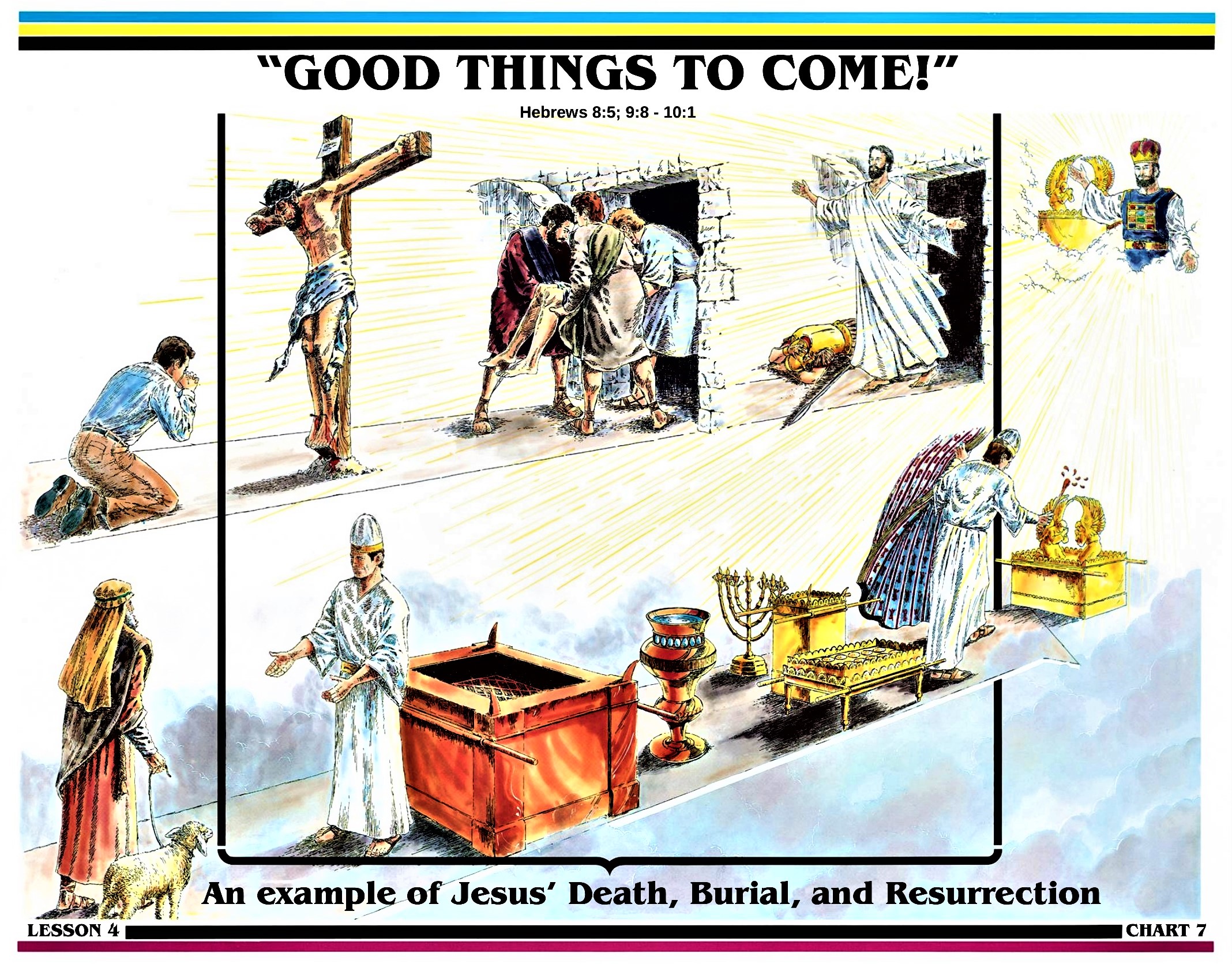
Chart Objective:
To determine how the Tabernacle foreshadowed Christ’s redemption from sin and the gospel message.
Chart Outline:
- “Good Things to Come!”
- An example of Jesus’ Death, Burial, and Resurrection
A. “Good Things to Come!” Hebrews 8:5; 9:8 – 10:1
When Paul recalled the beautiful illustration of redemption found in the Tabernacle, he said,
“But Christ being come an high priest of good things to come, by a greater and more perfect tabernacle . . . neither by the blood of goats and calves, but by his own blood he entered in once into the holy place, having obtained eternal redemption for us” (Hebrews 9:11-12).
As a whole, the Tabernacle typifies the Man, Jesus Christ. Our first glimpse of the “good news” about Jesus’ death, burial, and resurrection is seen in Moses’ writings.
Although the sacrificial blood of lambs, goats, and oxen could never erase or dismiss sin, it provided a temporary remedy. It pointed toward the blood of God’s “Lamb” Who would “redeem” or purchase man’s freedom from sin.
When an Israelite offered a sin offering, he brought a young lamb or goat. After laying his hand upon the victim and confessing his sin, he prayed for atonement and then slit the animal’s throat. The priest then dipped his finger in the blood. Seven times he sprinkled the blood on the horns of the brazen altar before pouring the remainder on the ground in front of it.
When a sin offering was made for the whole congregation of Israel or for the high priest himself, blood was sprinkled seven times before the veil separating the Holy Place from the Holy of Holies.
Then the high priest carried the entire carcass of the victim past all the tents of Israel to a ceremonially clean place outside the camp to burn it with fire. Because the sin offering was so loathsome in God’s sight, the awful burden must be removed far away.
Within and without the Holy Place one “voice” was heard—the voice of the blood of atonement crying out for peace with God.
Perhaps the whole blood-smeared Tabernacle was obnoxious to some; but God was teaching Israel that His anger against sin is severe! His broken law will be satisfied only with the giving of life for life.
B. An example of Jesus’ Death, Burial, and Resurrection
An Israelite’s sin offering (shown on the lower part of the chart) was a foreshadowing of Christ’s sacrificial offering for our redemption. Notice the similarities:
- The blood of an innocent lamb was sprinkled on the brazen altar and throughout the Tabernacle as a sin covering.
- The priest washed himself before entering the Tabernacle
- The priest enjoyed the beauty of the Holy Place, ate the bread and smelled the incense.
- Once a year the high priest went behind the veil into the most holy presence of God.
Because of Jesus’ death, burial and resurrection—which is the “gospel,” or “good news”—every believer becomes a priest and is eligible to enter the holy presence of God. The veil that once separated man from a holy God has been ripped apart!
What does the Tabernacle mean to us today? How is it an example of New Covenant salvation? First, the brazen altar reminds us of the cross and Jesus’ blood that cleanses and remits our sins. Our “death” at the altar is not physical, but a mental surrendering of our will to God’s will. He must become our Savior and Lord. Promising to love, serve, and obey our new Lord is the basis for entering into covenant with Him.
The brazen laver reminds us of water baptism and Jesus’ burial. When we “bury” the old man, we are buried with Jesus Christ into His death, and His blood remits or washes away our sins.
Then we receive the seal of the covenant, the wonderful gift of the Holy Spirit. Our bodies become the temple, or tabernacle where God’s Spirit dwells (I Corinthians 3:16-17).
Life in the “Tabernacle” is glorious! His Word becomes our sustaining Bread of Life at the table of shewbread; the altar of incense represents our daily communion with Him in prayer and praise; His light, like the golden candlestick, begins to shine through us, attracting others to Jesus Christ.
But best of all, the way has been opened into the Holiest of Holies—the very presence of God Himself! We can freely enter into His presence any hour of the day.
Because of Jesus’ death, burial, and resurrection, we can leave Satan’s family and our old death nature and receive everlasting life!
The Tabernacle was God’s way of announcing, “Good things are coming!”