A New Way of Worship
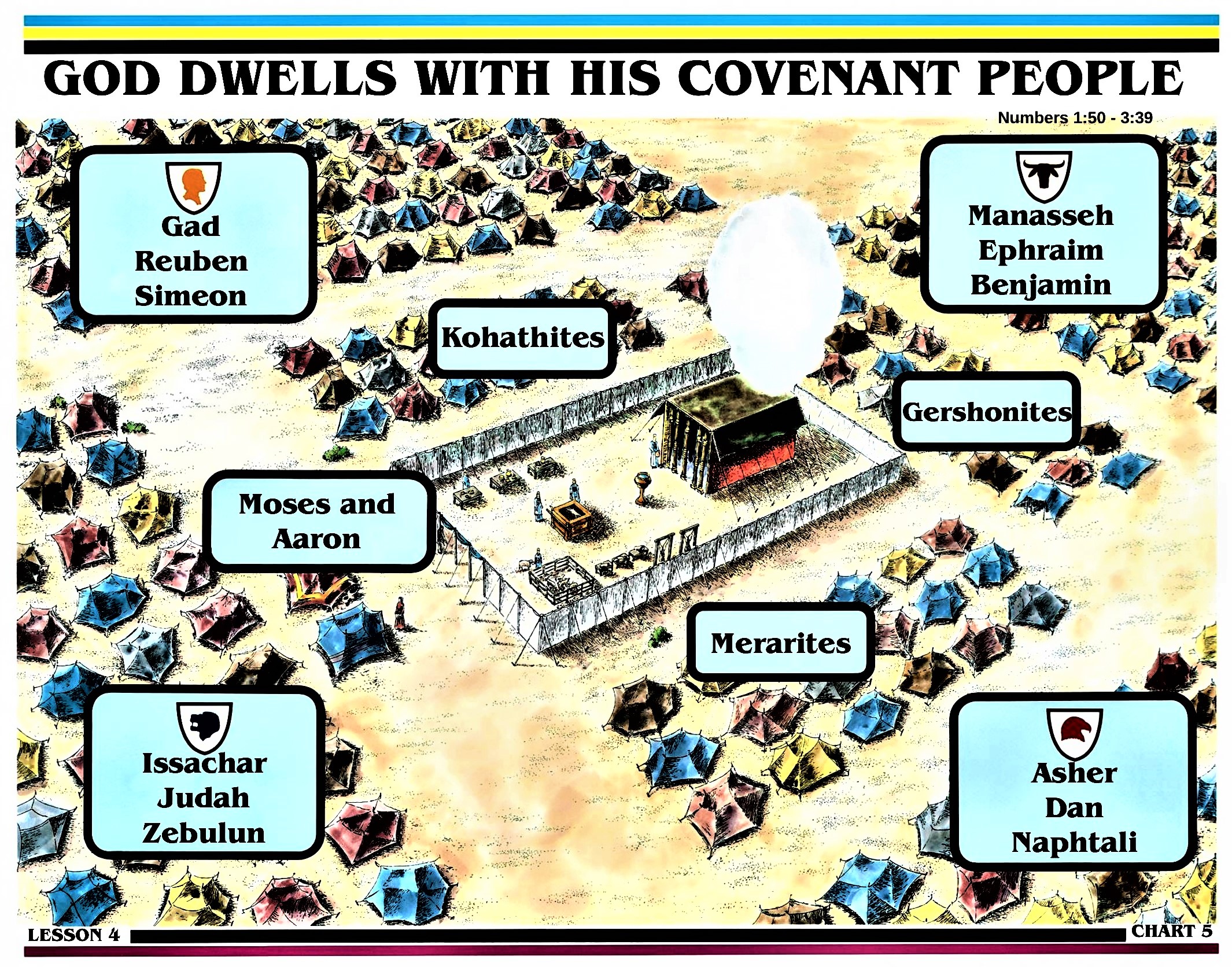
Chart Objective:
To examine the Tabernacle and its furnishings, which portrayed the future plan of redemption.
Chart Outline:
- A New Way of Worship
- Brazen Altar
- Brazen Laver
- Tabernacle coverings and frame
- Table of Shewbread
- Altar of Incense
- Golden Candlestick
- Ark of the Covenant
A. A New Way of Worship
Now let’s examine each piece of furniture in God’s dwelling place known as the “Tabernacle.” Since every detail had a special meaning, Moses was not allowed to alter the blueprints even slightly.
Two passages are the basis for interpreting persons, events and parts of the Old Testament Tabernacle as types of New Testament truths—I Corinthians 10:1-11 and Hebrews 8:1 to 10:18. The major items are explained in Hebrews, but additional applications and interpretations may be found in other epistles. (A panoramic view of the Tabernacle and outer court is given in Lesson 4, Chart 5. Shown there are the pens for sacrificial animals, tables and flesh hooks used by the priests for slaughtering sacrifices.)
The court of the Tabernacle was a large rectangle of 100 cubits north and south and 50 cubits east and west. The opening faced east- ward.
There was no actual gate. Worshipers entered the court by drawing aside the hanging of blue, scarlet and purple, similar to that in front of the Tabernacle. In contrast to the white linen surrounding the court, the multi-colored entrance clearly showed the opening.
Daily, weekly, monthly and annual sacrifices were offered. Continually the smoke of victims ascended to heaven. All Israel— young and old, rich and poor, priests and laymen—came into the court. But only the priests could enter into the Holy Place. The high priest alone could enter into the Holy of Holies and then only once a year.
B. Brazen Altar
Entering the courtyard of the Tabernacle, the first item was the altar of burnt offering, the place where God had declared He should record His name (Exodus 20:24). Built of acacia wood and overlaid with bronze, the altar was 5 x 5 and 3 cubits high. Horns pro- jected from the four top corners where animal victims were bound and attached.
The positioning of the altar denotes the absolute necessity for blood atonement before fellowshiping with an infinitely holy God. Man’s first need is to have his sins and impurities purged by blood. There must be an altar of death, a sacrifice of the flesh, a surrendering of self, an offering on the blazing altar. God’s message has always begun with blood!
C. Brazen Laver
Located between the brazen altar and door to the Tabernacle was the brazen laver. According to Exodus 38:8, the Hebrew women contributed their looking-glasses to construct it. They had received gifts of circular or oval bronze plates used by Egyptian women as mirrors before they left Egypt. Freely they were donated.
The laver was strictly for ceremonial washing of the priests prior to entering the Holy Place. It was adequately supplied with water for a priest to wash both hands and feet. This law was to be “a statute for ever” (Exodus 30:18-21) and its violation punishable by death. Failure to wash implied contempt of purity—a great offense to God.
D. Tabernacle coverings and frame
Ten curtains of fine linen dyed blue, purple and scarlet with figures of cherubim woven into the material constituted the ceiling or inner covering of the Tabernacle. Fifty golden clasps held them together. Only from the inside could the beauty of the inner covering be viewed.
Over the linen curtains was stretched a curtain of goats’ hair. Arabs still use goats’ hair similarly in weaving tents to provide strength and protection from wet, stormy weather.
Two additional coverings were spread over the curtain of goats’ hair. One consisted of rams’ skins dyed red and the other of badgers’ skins. From the outside, the Tabernacle could never be considered an object of beauty. Only those inside worshiping could fully appreciate its beauty, just as the royal priesthood of Christ alone fully appreciates our lovely Lord. The Tabernacle frame consisted of forty gold-covered boards 10 cubits long and set in forty sockets (holders) of silver. Five gold bars held the boards in place.
Separating the Holy Place from the Holy of Holies hung a veil of the same material and workmanship as the ten inner curtains. Only the high priest bearing sacrificial blood could enter this section.
Supported by five pillars, a curtain that could be raised and lowered formed the entrance to the Tabernacle. When raised, one could see into the Holy Place. When lowered, it covered the entire eastern side or front of the Tabernacle.
Likewise, the curtain dividing the church from the world may be lifted at times, revealing glimpses of the real inner life of God’s people. But no one understands the true life of worship, prayer and praise until he enters it.
E. Table of Shewbread
Upon entering the Holy Place, to the right was a table measuring 2 x 1 x 1-1/2 cubits made of gold-lined acacia wood. The twelve loaves of bread were surrounded by a gold rim. It was transported by staves placed through rings on the bottom corner.
Loaves of bread (sprinkled with frankincense), dishes, spoons, and incense cups and bowls for drink offerings were placed on the table. All utensils were made of pure gold. Each Sabbath, the loaves were replaced with fresh ones and eaten by the priests while in the Holy Place. Loaves and wine constituted a continual thank offering to God from the twelve tribes of Israel.
Showbread, or “bread of presence” was set before the “face” or presence of God dwelling behind the veil in the Holy of Holies. The loaves symbolized Jesus Christ, our Bread of Life, or Word of God. As the bread supplied nourishment for the priests, so Christ meets the needs of His children today. However, under the new covenant, we look to the Lord’s table. It reminds us of His broken body and shed blood for the healing of our bodies and salvation of our souls. At His table, we renew our covenant vows.
F. Altar of Incense
In many respects the altar of incense is similar to the altar of burnt offering. Both were square and made of acacia wood with horns and rings provided for staves. However, the altar of incense measured 1 x 1 x 2 cubits and was covered with gold.
Situated in the center of the Holy Place, it provided an offering of incense to God. Twice a day, a priest offered incense (made from an exact prescription), with the morning and evening sacrifices.
The offering of incense was to be perpetual, meaning that as long as the Hebrew religion lasted, the ritual would continue.
Incense symbolizes prayer and communion with God. The “continual” burning shows the necessity for continuous and persistent prayer (I Thessalonians 5:17-18).
G. Golden Candlestick
The golden candlestick was the most ornate object in the Holy Place. It provided light for the priests to daily perform their duties. Made of pure gold, it was decorated with almond-shaped bowls or cups, although no dimensions are given. It resembled an upright shaft with three curved branches extending upward in pairs from each side.
The lamps burned from sunset each evening until morning when the high priest extinguished and “dressed” them. Tongs, or pincers for trimming the wicks, and snuff dishes used for burnt wick fragments were made of pure gold. Estimated to be worth $33,804, a talent of gold was used to make the candlestick, tongs and snuff dishes (John J. Davis, Moses and the Gods of Egypt, page 257).
The candlestick typifies Jesus Christ, the true Light of the World (John 1:6-9; 8:12). However, those who believe in Him are also “the light of the world” (Matthew 5:14). Illuminating the dark places of the world, the Holy Spirit shines forth from the lives He has filled.
H. Ark of the Covenant
Here, in the Holiest of Holies was the most essential part of the Tabernacle. It was never exhibited or displayed. The priests carried it on their shoulders until they reached a fixed location in Canaan.
Made of acacia wood, the ark was a chest 2-1/2 x 1-1/2 x 1-1/2 cubits, covered with gold and carried on poles inserted through rings at the four lower corners. While in transit, no part of the chest was to touch the priests. Once the staves were inserted into the rings of the ark, they were never to be removed.
Inside this gold-covered wooden box was kept the law written on two tables of stone by the finger of God, a pot of manna, and Aaron’s rod which budded and blossomed.
The ark’s lid, known as the “mercy seat” was made of solid gold. On either end was a cherub with wings extended, facing the other, looking downward to the mercy seat. Apparently the figures were guardian angels watching over the precious deposit below—the two tables of law.
The mercy seat might appropriately be called the “throne of God.” It was here He manifested Himself to Moses and his successors. There was to be constant communing between God and the earthly ruler of the nation, for God said, “There I will meet with thee” (Exodus 25:22). God’s divine presence occupied the space above the mercy seat between the two cherubim and above the ark of the covenant.
Made of gold, the most precious metal, the mercy seat represented God’s most precious attribute—mercy. It covered the law as He “covers” the sins and offenses of His people.
This was where the high priest sprinkled blood, typifying the sacrifice of Christ.
The ark of the covenant with its mercy seat was the most important object in the whole Tabernacle and the focal point of attention—especially on the annual Day of Atonement.
What the mercy seat symbolized for Israel and typified for us, Christ has fully accomplished for both.