A Holy People, Separated Unto God
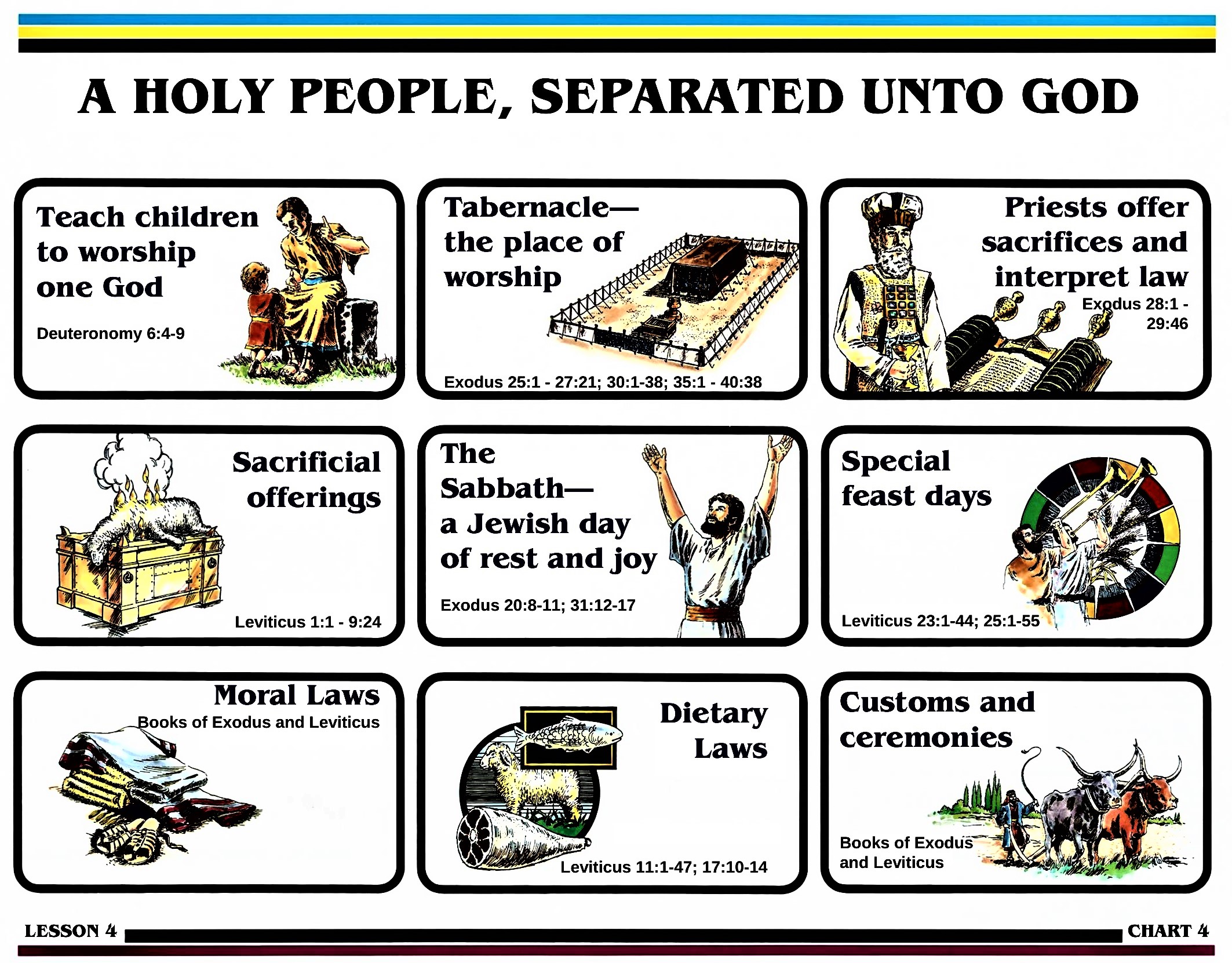
Chart Objective:
To emphasize the reasons why God purposely marks His covenant people. A separate lifestyle has always been a mark of distinction among His chosen ones.
Chart Outline:
- A Holy People, Separated Unto God
- Teach children to worship one God
- Tabernacle—the place of worship
- Priests offer sacrifices and interpret law
- Sacrificial offerings
- The Sabbath—a Jewish day of rest and joy
- Special feast days
- Moral laws
- Dietary laws
- Customs and ceremonies
A. A Holy People, Separated Unto God
Throughout the ages, God has diligently searched and longed for individuals who delighted to think and talk about Him (Malachi 3:16-17). Such choice people have always been His pride and joy! He treasures them as we would the rarest of gems!
Eden’s very beauty had been blighted when Adam, God’s highest creation, had chosen to follow his own will above that of His Maker. But with tender love, plans were immediately initiated to cover the shame until God would Himself come to pay the penalty and redeem man from sin.
Can you imagine His grief when men first shaped idols and bowed to them in worship?
Then God found Abraham. Here was a man who believed everything God told him! He was the kind with whom God could enter into covenant. God had abundantly blessed His covenant partner and multiplied his descendants into a mighty nation.
But having one nation in covenant was not sufficient. The whole world must learn the joy of serving the one true God. Israel must introduce the Lord to idol worshipers and heathen nations.
God designed that Israel be a holy people,
teaching every other nation how to please the Lord. Hence, they became a model for others to emulate. Their Promised Land was strategically situated so that travelers to and from African and Asian continents passed through their territory.
The word “holy” means “separated and set apart,” “splendid,” “beautiful,” “pure,” “uncontaminated.” What better way to describe God’s covenant partners? He wanted Israel’s lifestyle to be totally opposite from ungodly nations under Satan’s dominion. God’s chosen ones should worship, live, act, talk, eat, and dress differently from them.
So intimate was the relationship between Yahweh and His covenant people, He referred to Israel as His “wife.” She may have been regarded by her idolatrous neighbors as odd or different, but those uncommon characteristics were His marks of distinction.
God declares Himself to be a jealous God. Once He enters into covenant—with a nation or an individual—God claims them as His own. To flirt with other “gods” infuriates Him! When we ask Him to be our Lord and Savior, He wants first place in our lives.
Were God’s laws and commandments meant to be a burden to Israel? Did the Lord want to oppress them with strict rules and regulations? Oh, no! Each segment of the law was a protection and benefit. The Creator does all things well for His creation.
Covenant people are purposely marked. Why? Because they represent Deity. They are God’s holy, righteous people—separated from all the rest of the world!
Now, let’s examine the various ways God intended to make Israel different.
B. Teach children to worship one God Deuteronomy 6:4-9
The underlying faith of Israel is summed up:
“Hear, O Israel: The LORD our God is one LORD: and thou shalt love the LORD thy God with all thine heart, and with all thy soul, and with all thy might” (Deuteronomy 6:4-5).
Abraham is credited with being the founder of the world’s first “monotheistic” faith (belief in one God). In a world dominated by gross idolatry, this one man firmly believed that “the Lord our God is one Lord.” Moses echoed that strong conviction by commanding that every Israelite indelibly etch these words in the minds of their children. They would learn by the method of repetition:
“And thou shalt teach them diligently unto thy children, and shalt talk of them when thou sittest in thine house, and when thou walkest by the way, and when thou liest down, and when thou risest up. And thou shalt bind them for a sign upon thine hand, and they shall be as frontlets between thine eyes. And thou shalt write them upon the posts of thy house, and on thy gates” (Deuteronomy 6:7-9).
“The Lord our God is one Lord” was writ- ten and spoken throughout the camp of Israel. When they finally entered the land of Canaan inhabited by grossly idolatrous people, God’s covenant people would be fully trained in monotheism.
C. Tabernacle—the place of worship Exodus 25:1 – 27:21; 30:1-38; 35:1 – 40:38
Another special mark of separation was Israel’s place of worship. Because God desired to dwell among His people, He instructed that worship would be in a centralized tent structure. At this Tabernacle, people would learn the means of approaching God and the manner in which He would manifest Himself to them.
A visible Tabernacle was Israel’s constant reminder that only the one true God must be worshiped. Like the law, the Tabernacle was a protection against idolatry.
The Tabernacle is one of the greatest prophetic types in God’s redemptive plan. His Spirit abode in this material structure. Fifteen hundred years later, He dwelled among men in a house of flesh and bones—the body of Jesus Christ.
To some, the Tabernacle remains merely a Jewish ritual without significance today. An in-depth study, however, reveals it to be the foreshadowing of God’s plan of redemption through Jesus Christ.
D. Priests offer sacrifices and interpret law Exodus 28:1 – 29:46
Before Moses’ day, the head of each family and the first-born son exercised both spiritual and political forms of government. They were both ruler and priest. However, when Israel left Egypt, God declared that all the first-born sons belonged to Him! Because of the mercy shown them on the Passover night, they became sanctified as God’s possession.
But when Levi’s tribe responded to Moses’ call for allegiance to God at the episode of the golden calf, Levites assumed the position of honor. Rather than the first- born of Israel being the sanctified ones, the Levites became the chosen ones to serve Israel’s invisible King in the Tabernacle. Aaron and his four sons were specially selected to be priests for Israel.
Levi’s whole tribe was set apart for a holy calling, but there were three branches. Upon Aaron was conferred the chief office of high priest, then passed to his son Eleazar and his descendants. Since the high priest represented Israel before God and brought messages to them, greater purity and virtue were required of him than other priests. Even his official dress distinguished his role.
Only the four sons of Aaron and their descendants could be priests, and each man had to qualify before being consecrated to this holy office.
Among the priests’ many sacred duties were teaching statutes of the Lord and acting as judges of the law.
A third branch of Levites assisted the priests. The Levites were not permitted to offer sacrifices, burn incense or handle the holy vessels of the Sanctuary until the priests had concealed the vessels from view (Numbers 4:15).
Levites were categorized according to Levi’s three sons: Kohath, Gershon and Merari. Because Aaron belonged to the family of Kohath, the Kohathites held first rank. Their duty was to carry the sacred vessels, including the ark itself, while Israel was journeying. Still, every furnishing had to be concealed with a blue covering before the trip.
The Gershonites removed the curtains, veils and tent-hangings. The Merarites were entrusted with the heavier parts, such as boards, pillars and bars.
The Levites did not receive a specified section of Canaan’s land. Instead, forty-eight cities among all the tribal territories were appointed them. Their support came through a system called “tithing,” meaning “one-tenth.” Each Israelite tithed their produce and cattle. One-tenth of the Levites’ tithe was given to the priests for their support.
Besides assisting the priests, the Levites participated in all festivals, preserved and transcribed the law and read it publicly at some of the feasts.
E. Sacrificial offerings Leviticus 1:1 – 9:24
From ancient times, the rite of sacrifice had been practiced. Cain, Abel, Noah, Abraham, Isaac and Jacob had offered sacrifices to God. But when the Tabernacle was introduced, the sacrificial offerings became regulated.
All sacrifices were to be offered on the brazen altar in the court of the Tabernacle. After the place of worship, a priesthood, and Levitical order had been established, Israel was instructed how to express religious devotion to God in an orderly, ritualistic fashion.
When men “sacrificed” or surrendered to God their possessions, they expressed their devotion, thanksgiving and love. Sacrificial offerings represented an “atonement” or “covering” for their sins, awaiting the day when Christ’s blood would erase and dismiss all transgressions.
Two types of sacrifices were offered: those without blood and those with blood. Bloodless sacrifices were: firstfruits and tithes, meat and drink offerings and incense. Every Israelite presented tithes to the Levites and priests in gratitude to Yahweh. These consisted of grain, fruit, grapes, wool, meal, oil, or new wine.
Blood sacrifices were of domestic animals or clean birds. All wild and unclean beasts were strictly excluded. Every victim had to be unblemished and perfect.
Four types of blood sacrifices were offered:
- Sin offerings atoned for ignorantly sinning against God and man, or sins arising from human weakness. Willful, deliberate sin was punished with death. God was teaching Israel that His anger against sin is severe!
- Trespass offerings were offered for some specific act of violating the law through Restitution was required. If the transgression was against the Lord, payment was made to the priests; if against man, payment was to the injured person.
- Burnt offerings denoted complete self-surrender to Yahweh. The whole idea of sacrifice was self-dedication to God.
- Peace offerings were unique in that the offerer enjoyed the feast himself by eating a portion of the flesh. These offerings signified communing with God and included fellowship and
The entire system of sacrifices and offerings symbolized the day when men would present themselves as a “living sacrifice” unto God (Romans 12:1), and would offer the “sacrifice of praise to God” with their lips (Hebrews 13:15).
F. The Sabbath—
a Jewish day of rest and joy Exodus 20:8-11; 31:12-17
The seventh day of the week was established as a day of rest and delight to bless and refresh man. Special clothes were worn and the choicest food eaten. Neither man nor beast could perform any work on this day.
G. Special feast days Leviticus 23:1-44; 25:1-55
Every male Jew was required to attend three festivals each year: the Passover (Feast of Unleavened Bread), the Feast of Weeks (Pentecost), and the Feast of Tabernacles (Booths). Each symbolized some unique, historical event.
Two other feast days were: the Feast of Trumpets (announcing the beginning of the civil Jewish New Year) and the Day of Atonement (a blood sacrifice was offered by the high priest for the sins of the people).
Besides these five feast days, every seventh year was declared a “Sabbatical year.” The fields were not planted. Every fiftieth year was the “year of Jubilee” during which all property reverted to the original owner.
H. Moral laws
Books of Exodus and Leviticus
These laws describe right conduct for God’s people, proper treatment of other people, honest principles of life, how to be sexually virtuous, restrictions for choosing marriage partners, sexual rights in marriage, responsibilities and treatment of husbands and wives, divorce and remarriage, and God’s judgment of homosexuality, sexual perversion, idolatry and witchcraft. Nine of the Ten Commandments are moral laws.
God demonstrates intense displeasure toward certain actions. Usually these sins are labeled as an “abomination,” meaning extreme disgust, loathsome, hateful, shamefully vile. At times, God said, “This is an abomination to you” (Leviticus 11:20). However, seven times in the Book of Deuteronomy, the Lord said, “This is an abomination to me.” Always these are gross moral sins, equally condemned in the New Testament. In the Book of Deuteronomy are such abominations:
- Graven images (7:25).
- Human sacrifices (12:31).
- A defective animal sacrifice (17:1).
- Witchcraft and spiritism (18:10-12).
- Religious prostitution (23:18).
- Remarrying a defiled woman (24:4).
- Interchange of apparel between sexes (22:5).
Other abominations toward God are pride, lying, murder, sowing discord, and a froward heart (Proverbs 6:16-19; 11:20; 12:22).
I. Dietary laws
Leviticus 11:1-47; 17:10-14
While in Egypt, apparently the Israelites had no scruples about which foods should be eaten. But now they were to observe which meats should be avoided. Their meat diet was largely restricted to domestic animals used in sacrifice.
Any animal that divides the hoof and chews the cud may be eaten, such as the cow, sheep, oxen, and deer. But those that chew the cud with an undivided hoof, such as the camel, horse, or rabbit, shall not be eaten. Because the pig divides the hoof but does not chew the cud, its flesh is also unclean.
All seafood with fins and scales may be eaten. But shellfish—shrimp, lobsters, crabs and oysters—are unclean.
God’s dietary law also specified that neither fat nor blood were to be eaten (Leviticus 3:17). Medical science now agrees that cholesterol in fat is responsible for high blood pressure, resulting in heart attacks, cerebral hemorrhage, or stroke.
Why should blood be refused? God said, “the blood is the life” (Deuteronomy 12:23-25). The blood also assimilates what- ever is in the stomach—whether nutritious or poisonous—and distributes it to the various
parts of the body. Therefore, disease germs are first carried in the bloodstream before affecting the flesh of an animal.
What was the purpose of the Jewish dietary laws?
“That ye may live, and that it may be well with you, and that ye may prolong your days” (Deuteronomy 5:33).
As the moral law directed the morals of the people, so the dietary law protected their physical health. God designed proper eating habits as insurance against poor health and disease.
The wonderful benefits of God’s healing covenant with Israel were dependent upon obeying the dietary laws. A word to the wise is sufficient!
J. Customs and ceremonies Books of Exodus and Leviticus
Incorporated into the personal lives and habits of the people were religious overtones. Hygienic rules and regulations were given for purification of women, washing of hands, detecting and treatment of diseases and uncleanness in general.
Also included in this category were: Sabbath customs; feast days; naming children; circumcision of males; education of children; recital of mealtime blessings; dedication of new homes; memorials for deceased relatives; farming procedures; types of cloth to be worn; and mourning for the dead.
Constantly, the Israelites were reminded that God had separated them from all other people in the world to be holy and dedicated unto Him.