God Makes a Covenant With Israel Fifth Dispensation—“Law”
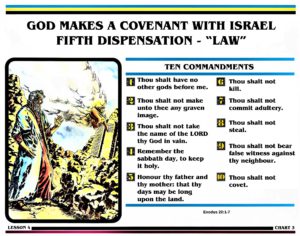
Chart Objective:
To describe the agreement God made with Israel known as the Old Covenant (Testament). The basis of this covenant is the Ten Commandments.
Chart Outline:
- Fifth Dispensation—“Law”
- Ten Commandments
A. Fifth Dispensation—“Law”
Let’s return to Mount Sinai, Israel’s temporary schoolhouse.
Israel arrived there “in the third month,” or about six weeks after leaving Egypt. Jews have traditionally observed the anniversary of the giving of law with the Feast of Pentecost. On that same holy day hundreds of years later, the gift of the Holy Spirit was given, marking the church’s origin and the fulfillment of Jeremiah’s prophecy:
“Behold, the days come, saith the LORD, that I will make a new covenant with the house of Israel . . . After those days, saith the LORD,I will put my law in their inward parts, and write it in their hearts; and will be their God, and they shall be my people” (Jeremiah 31:31-33).
Sinai set the scene of the Mosaic covenant; the new covenant was instituted at Jerusalem on the Day of Pentecost.
From the day Moses first received his call from God, he knew that Israel would serve God on Mount Sinai (Exodus 3:12). Naturally he was eager to ascend its jagged peaks. Three times in a single chapter, we read an account of Moses climbing this mount for a rendezvous with God and then returning with a message for the people (Exodus 19:3, 8, 20).
On Moses’ first trip, God disclosed His intention of renewing the Abrahamic covenant. The Israelites were spiritually dead. No one had regained the quality of life which Adam at first had experienced. Their dead spirits had never been quickened (brought to life) by God’s Spirit. No knowledge existed regarding a “new birth.”
Therefore, Moses’ law could govern only the soul (mind, will and emotions) and body (physical senses). Israel must be legislated in detail what would please God and what would not.
Christ’s new covenant laws differ greatly. Because life is promised to all who believe the “gospel” (Jesus’ death, burial and resurrection), His commands can be spiritually understood. Christ’s laws were written in the “heart” after communion was restored with man’s spirit.
Covenant? They must obey the voice of the Lord, accept and keep His covenant. Then they would be to Him a special treasure above all others. Furthermore, the Lord would make them a kingdom of priests; a holy nation; examples; instructors; and prophets to the heathen world.
The outward sign of this consecration remained as circumcision. Inwardly, they were to be pure and holy, preserving the knowledge of the one true God.
Would they accept this covenant? Moses took God’s gracious proposal to the elders and people. Eagerly they agreed to obey the new commands without fully understanding the responsibilities. They were only interested in securing the promised blessings for themselves and their posterity.
Acting as mediator for both sides, Moses enumerated the preparations for receiving God’s law. For the next three days the people must abstain from all sensual pleasure, wash their bodies and clothes. A fence must be erected around the mountain, separating it from the people. Should man or beast touch the mountain, they would die. Such strict punishments exemplified reverence for a holy God.
On the third day, the congregation stood before the mount, expectantly. Suddenly the silence was shattered by peals of thunder and lightning flashes. A cloud of thick blackness descended on the mountain, followed by an earthquake, whereby Sinai trembled from crest to base.
A voice like a trumpet sounded while the whole mountain smoked and burned with fire (Deuteronomy 4:11-12). The splendor over- whelmed the people with respect for the law’s authority and the greatness of the Lawgiver. No sweet angelic music was heard on that occasion!
Again the Lord warned Moses against the people touching the mountain. How different is the privilege of Christians! We are encouraged to boldly enter the holiest of all places— the throne of grace (Hebrews 4:14-16; 10:19-23)!
While the mountain smoked and quaked, a voice like that of a man distinctly pronounced the “ten words” of God’s law.
Here are the three divisions of the law:
- Moral law. Relates to rules of right con- duct. The moral law is basically found in the Ten Commandments (Exodus 20:1-17).
- Civil law. Relates to the rights and duties of citizens of a community (Exodus, chapters 21-23).
- Ceremonial law. Relates to religious ceremonies or rituals, principally in the Book of
Moses then ascended the mount. There he received ordinances for the completion of the covenant and precise details of the principles contained in the Ten Commandments. Beginning with Exodus 20:22 through chapter 23, various civil, social and religious laws were spoken privately to Moses.
The principles for Israel’s civil society were superior to any other. In fact, the Mosaic ordinances have remained the grand model of all civil society.
God commanded Moses to write the covenant laws in a book known as the book of the covenant. The book was read to all the people for them to respond to Yahweh’s offer. They agreed to obey.
To formally ratify the covenant, burnt sacrifices were offered on an altar. Half the blood was sprinkled on the altar and book of the covenant, and the other half on the people. The ceremony was similar to ratification of other important contracts of that day.
Then Moses, Aaron, Joshua, and seventy elders of the people ascended the mountain. At the halfway point, they saw the glory of the God of Israel and “did eat and drink” in His presence. Moses was commanded to proceed to the mountaintop while the elders waited with the people below.
For forty days, Moses communed with God, receiving the moral, civil, political and social laws that would govern God’s covenant people.
B. Ten Commandments Exodus 20:1-17
The Ten Commandments are the basis of the divine law which Israel accepted as the charter of their constitution. The remainder of the law was communicated privately to Moses and later delivered to the people.
These commandments were engraved on both sides of two tables of stone, “written with the finger of God,” and kept for centuries in the ark of the covenant. These commandments have guided the majority of civilized societies since that time.
Four commandments relate to our attitude toward God. The other six deal with our attitudes toward other people. Jesus condensed them into two commandments: “Thou shalt love the Lord thy God with all thy heart, and with all thy soul, and with all thy strength, and with all thy mind; and thy neighbour as thyself’ (Luke 10:25-28).
Here is a summary of the Ten Commandments:
“Thou shalt have no other gods before me.” This emphasizes man’s first duty. Money, pleasure, fashion, fame, gluttony or any other “god” must never replace the true God. Every man, woman, boy, and girl must be committed to love and obey Him.
“Thou shalt not make unto thee any graven image.” No visible representations of Deity are to be made or worshiped. The Lord is “a jealous God, visiting the iniquity of the
fathers upon the children unto the third and fourth generation of them that hate me; and shewing mercy unto thousands of them that love me, and keep my commandments” (Exodus 20:5-6).
“Thou shalt not take the name of the LORD thy God in vain.” The irreverent use of God’s name by false or profane swearing is forbidden. His name is to be esteemed absolutely sacred and must never be used casually or lightheartedly.
“Remember the sabbath day, to keep it holy.” Both man and beasts should work six days and rest one day. The Jewish Sabbath was designed as a day for family members and servants to worship and praise the Lord. The early church observed the first day of the week for worship and rest and called it the “Lord’s Day.”
The ceremonial Sabbath is no longer in effect (Colossians 2:16-17; Romans 14:5). Under the new covenant, Jesus provides a “spiritual” Sabbath of rest when we are baptized in the Holy Ghost (Matthew 11:28-30; Isaiah 28:11-12).
“Honour thy father and thy mother: that thy days may be long upon the land.” Children must reverence and obey their parents. Juvenile delinquency was intolerable under the law. To “honor” means: to obey; to give the place of superiority; to hold in high esteem; to reverence. The responsibility rests with the parents to train their children morally and spiritually to obey this commandment.
“Thou shalt not kill.” Because man was made “in the image of God,” human life is considered sacred. Both suicide and the murder of a fellow man are prohibited. However, capital punishment is scriptural since the guilty murderer has destroyed one made in God’s image (James 3:9).
“Thou shalt not commit adultery.” Marriage, the highest and most sacred of human relations, is not to be violated by infidelity. A man is responsible to love and care for his wife more than his parents.
“Thou shalt not steal.” Every person has a right to the ownership of private property. Any act, directly or indirectly, whereby we wrongfully acquire something belonging to another person is forbidden. Our dealings with men are to be honest.
“Thou shalt not bear false witness against thy neighbour.” Failing to protect the truth is the command most frequently and
unconsciously broken. This includes slander, gossip, talebearing without careful investigation, leaving a false impression, exaggeration, flattery, or failure to defend one who is unjustly criticized.
“Thou shalt not covet.” We are not forbidden to desire houses, spouses, cattle or property, but we must not desire what is already possessed by another. This command reveals the hidden depths of an evil heart and exposes the root from which many other sins grow.
God had approached Israel as closely as possible, yet nearer than they could tolerate. His presence struck terror in their hearts and they pled with Moses to mediate for them. God granted their wish, then foretold the coming of a Prophet greater than Moses:
“I will raise them up a Prophet from among their brethren, like unto thee, and will put my words in his mouth; and he shall speak unto them all that I shall command him” (Deuteronomy 18:18).
While Moses was basking in God’s presence on the mountaintop, a disgusting scene unfolded below. After only a few weeks, the people became impatient. Where was their leader?
Demanding a visible replica of the Lord, they persuaded Aaron to make an image of gold. Like many leaders today, Aaron pleased the people rather than God.
The women’s golden ornaments were melted and molded to form a calf. Eagerly the people offered sacrifices to their new idol. They also “rose up to play”—meaning immoral sexual activity found among the Canaanite worship of Baal.
So quickly had their covenant been broken!
As Moses was preparing to descend the mountain with the tables of stone and God’s exciting plans for the new Tabernacle, he heard loud celebrating below. Moses alone stood between God’s fiery wrath and the rebels. Like a true intercessor, he pled, “Turn from thy fierce wrath, and repent of this evil against thy people. Remember Abraham, Isaac, and Israel, thy servants, to whom thou swarest by thine own self” (Exodus 32:12-13).
So deeply was God moved by Moses’ intercession, He “repented of the evil which he thought to do unto his people.”
The word “repent” denotes a change in God’s actions. They would be punished, but their lives were to be spared.
When Moses saw the disorderly, immodest crowd singing and dancing around the golden image, he dashed the two holy tablets into fragments upon the ground. Boldly he commanded the idol to be ground into powder and then cast into Israel’s drinking water.
A second set of tablets were later given to Moses by God. It remained in the ark of the covenant for many centuries.
Standing at the main gate of the camp, Moses demanded, “Who is on the LORD’S side? let him come unto me.” Immediately the sons of Levi responded. They were sent through the camp and slew three thousand who were still revelling in idolatry. Because of their zeal on this and other occasions, Levi’s tribe was greatly honored and blessed.
While the nation of Israel was still in its spiritual infancy, they followed the Lord’s commands chiefly through fear. However, ter- ror is a very ineffective method of conversion. Devils and sinful men may “believe and tremble,” but without love, they do not serve God. It was impossible to obey these exalted commands—with unregenerate spirits.
The law is like a thermometer. It indicates fever in the body, but cannot administer a cure. Like a mirror, it clearly reveals the dirt and blemishes—but cannot cleanse.
Only the new covenant of grace could restore man’s sinful condition. Jesus’ blood provided the remedy for what the law diagnosed!
As John Bunyan observed,
“‘Run, John, run,’ the Law commands, But gives me neither legs nor hands. Far grander news the Gospel brings; It bids me fly, and gives me wings.”