Israel Leaves Egypt
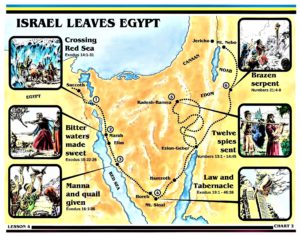
Chart Objective:
To trace the journey of Israel in the Sinai Wilderness. Because of unbelief, a trip that should have been completed in two years, extended to forty years.
Lesson Outline:
- Israel Leaves Egypt
- Crossing Red Sea
- Bitter waters made sweet
- Manna and quail given
- Law and Tabernacle
- Twelve spies sent
- Brazen serpent
A. Israel Leaves Egypt
After spending more than four hundred years in Egypt, the Israelites were headed toward their Promised Land! However, they faced future troubles. Many more obstacles must be conquered before stepping on Canaan’s soil.
The morning after the tenth judgment, the Israelites began emerging from all parts of Goshen towards Succoth, their first meeting place. Each group had its own herds and flocks. Because there were no roads, each company spread out and traveled at its own pace.
No exact census was available for those participating in the exodus. Only the 600,000 men over twenty years of age are mentioned. Knowing that the people had rapidly multiplied, they may have numbered from three to five million.
Another feature is noted about this long, marching procession: “There was not one feeble person among their tribes” (Psalm 105:37). Imagine that host of ex-slaves—all in perfect health!
Included in their ranks, Moses recorded, was a “mixed multitude” (Exodus 12:38). Perhaps they were other enslaved Semites living in Egypt or native Egyptians wishing to escape Pharaoh’s tyranny. Or they may have been descendants of intermarried Egyptians and Hebrews.
Later, this “mixed multitude” created seri- ous problems by expressing regret for leaving Egypt. Satan seized the opportunity of sending people of mixed principles—partly on the Lord’s side and partly on the Egyptians’ side. Church troublemakers are usually discontented members of the “mixed multitude” who draw from her resources but contribute nothing in return.
Most travelers to Canaan took the route along the Mediterranean coast and arrived in a few days. But they would have encountered the Philistines, a warlike, powerful nation feared even by the Egyptians. Since the Hebrews were not equipped for battle, they could not afford to encounter a well-prepared enemy.
Before becoming God’s peculiar treasure and model to all nations, Israel had to learn about laws for holy living, acceptable worship, how to get along with one another, discipline, obedience to Moses, and military training.
Once released from sin’s bondage, we too become Christ’s representatives in the world. This is why we must sit at Jesus’ feet and learn of His plan for our life, of the vast work yet to be completed, and about our fierce enemy. No one can successfully live for God without spending much time in Bible study and prayer.
Notice that God selected Israel’s route. The normal choice would have proven disastrous. As they left Succoth headed toward Etham, a cloudy pillar ascending from earth to heaven led the host. When it stopped moving, so must they. When it moved forward, they followed.
The pillar of cloud shielded the blistering desert sun. When darkness fell, it became a brilliant column of fire, providing warmth from the chilling winds.
At the edge of the wilderness, directions were suddenly changed. They turned south toward a very unproductive region of the African continent. In this setting, God demonstrated His sovereignty to the Egyptians and His ability to care for Israel. An unforgettable day was just ahead!
B. Crossing Red Sea Exodus 14:1-31
Though the exact place where Israel crossed the Red Sea is unknown, most Bible scholars now agree that the region known as the “Bitter Lakes” better fits Moses’ description (John J. Davis, Moses and the Gods of Egypt).
Now the scene shifts back to Egypt. Once the initial shock of the midnight slaughter had subsided, Pharaoh again changed his mind. Why had he freed those laborers and highly skilled craftsmen?
When news came of Israel’s move south, he assumed they were confused and “entangled in the land.” Thus the order was given for six hundred royal chariots to pursue and return them to Egypt!
Meanwhile, Israel was enjoying their new encampment by the sea. But this playground would become a prison wall surrounded by mountains.
As the sun was setting, war chariots were seen coming from the north. Escape was impossible! The sea was on the east, mountains were on the south and west, and Israel was unarmed.
Immediately, everyone began crying to God and complaining to Moses for this dangerous predicament. Why had he led them into this trap?
Moses’ instructions were superb! “Don’t be afraid! Stand still and see what the Lord will do for you. He will fight this battle. Those advancing Egyptians will never again be seen after this night!”
After preparing the people to march in numbered companies, Moses lifted his mira- cle-working rod over the sea. As he did, a strong east wind divided the waters into walls on either side and dried the seabed.
As darkness fell, the pillar of cloud slowly moved from the head of the procession to a point between the camps. Its bright flame provided light for Israel, but left the Egyptians in darkness, preventing them from advancing.
About midnight, the seabed was sufficiently dry and the people moved forward in an orderly fashion until all were safe on the other side. As the cloud moved along, Pharaoh’s army pressed forward. In the morning watch, from 3 A.M. until sunrise, the horsemen entered the seabed.
Then the Lord troubled the Egyptians with a sudden cloudburst, thunder, and lightning (Psalm 77:17-19). He “took off their chariot wheels,” possibly allowing them to sink deep into the drenched sand. Panic-stricken, they were unable to go forward or backward.
Again, Moses’ hand was uplifted and the congealed wall of water on either side (Exodus 15:8) descended. As the sea returned to its bed, the waves engulfed the struggling Egyptians and horses. They sank into the mighty waters!
For the first time, Israel stood as a redeemed nation, completely separated from Egypt! What was the point of division? The Red Sea! Apostle Paul compared it to water baptism:
“All our fathers were under the cloud, and all passed through the sea; and were all baptized unto Moses in the cloud and in the sea” (I Corinthians 10:1-2).
Israel’s deliverance also illustrates our redemption from sin through Jesus’ death, burial and resurrection. At the Passover, Israel was spared from death by the blood of a lamb; they were separated from the old life by passing through the Red Sea; stepping on the shore marked entry into new territory of God’s promised blessings.
Calling upon the Lord, repenting and committing our lives to His control is the first step of redemption. Water baptism separates us from the old life of sin. As we enter the new life of salvation, many promised spiritual gifts and blessings are available—but we must claim them!
When upon the other shore, Moses and his people viewed the strewn debris and corpses of their enemy. What a mighty God they served!
Spontaneously, the redeemed nation sang praises unto the Lord! Moses recorded the first Jewish song in the Bible, perhaps the root of all Hebrew psalms.
Miriam, Moses’ ninety-year-old sister, led the women with dancing, singing, and playing tambourines. What a joyful chorus! God’s covenant people were free at last!
C. Bitter waters made sweet Exodus 15:22-26
Israel stood on a new continent with God as their King.
Because the covenant people’s spiritual life was undeveloped, God manifested Himself through their physical senses. Until dead spirits are quickened, or made alive, they cannot understand spiritual concepts.
Repeatedly, the children of Israel murmured, complained and rebelled against the lofty principles God desired to teach. But His mercy and love recurred as He continually taught the same lessons.
Then occurred a water shortage in the camp. Triumphant praise to God was fol- lowed by painful privation. We may also expect our faith to be tested after leaving the life of sin.
Water was found, but it tasted bitter. Why would God permit Israel to suffer such hard- ships? “There he proved them” (Exodus 15:25). Would they be patient and obedient or would they murmur and complain? Of course, “we do not murmur against God, we murmur against Moses.” Most problems are merely God’s teaching tools.
God instructed Moses to cast a certain tree into the water and it would become sweet. The healing of these bitter waters was a “sign” to Israel that God was also able and willing to heal their bodies:
“There he made for them a statute and an ordinance, and there he proved them, and said, If thou wilt diligently hearken to the voice of the LORD thy God, and wilt do that which is right in his sight, and wilt give ear to his commandments, and keep all his statutes, I will put none of these diseases upon thee, which I have brought upon the Egyptians: for I am the LORD that healeth thee” (Exodus 15:25-26).
A close examination of Israel’s covenant of healing reveals that God was actually offering them immunity from sickness. But notice a special condition. It applied only for those who diligently listened and obeyed the Lord’s commandments and statutes.
Immunity from disease was linked to personal responsibility. Only days later at Sinai, God gave instructions regarding a day of rest, health habits, diet, cleanliness, and quarantining homes. All these rules were vital for preventing sickness.
Many people do not consider the relation- ship between proper health and healing. If healing does not occur, they conclude that healing is not to be theirs. How sad that they do not realize why—or who is to blame!
To emphasize the importance of healthy bodies, God mentioned again at Sinai:
“And ye shall serve the LORD your God, and he shall bless thy bread, and thy water; and I will take sickness away from the midst of thee. There shall nothing cast their young, nor be barren, in thy land: the number of thy days I will fulfil” (Exodus 23:25-26).
Healthy, strong bodies are intended for God’s chosen people. And the promise of healing is based upon conditions.
D. Manna and quail given Exodus 16:1-36
Traveling on through the dry wilderness, Israel found twelve bubbling wells of water surrounded by groves of palm trees. Elim pro- vided a season of calm and contentment. Remember that persecutions and troubles also are seasonal. They won’t last forever!
After a month, they marched toward Sinai. In this barren desert, all provisions brought from Egypt were depleted. Starvation seemed certain. Again, their faith failed and the Hebrews complained against Moses and Aaron.
“Would that God had smitten us with a painless death as He did the first-born of the Egyptians rather than this awful, lingering death from starvation,” they moaned.
That evening, the sky darkened and an enormous flight of quail fell to the ground about their tents. The following morning, they received bread.
Until they reached Canaan forty years later, for six days every week, Israel received daily bread. The people called it “manna,” meaning “it is a gift” from heaven.
Early in the morning, each person was instructed to gather an omer (about two quarts) of manna per day. It could be ground or beaten. Their diet was supplemented from their large flocks and herds.
Not only was God supplying their food, but He was also training them to depend upon Him. Each morning they gathered the small white seed-like substance. On the sixth day, two omers were to be gathered because the
seventh day was a holy Sabbath, or rest, unto the Lord.
Having been slaves many years, now each week they experienced a day of rest. This special day was to be observed throughout their generations. The Jewish Sabbath was an absolute day of holy rest, while the Christian Sunday, or Lord’s Day, is a day of holy activity. On this day we gather to sing, worship and study the Scripture.
Before reaching Mount Sinai, the people again clamored for water. This time Moses was told to strike a certain rock with his miracle-producing rod. Water gushed forth as if a hidden reservoir had suddenly been tapped.
E. Law and Tabernacle Exodus 19:1 – 40:38
In the third month, or about six weeks after leaving Egypt, they reached the Sinai Peninsula, the familiar country where Moses had lived for forty years. Surrounded by majestic cliffs, this two-mile-wide, well-irrigated plain became Israel’s camping ground and schoolhouse for the next year. Here God gave His laws, ratified a covenant, and provided blueprints for the Tabernacle, including a unique way to worship.
This special covenant will be discussed in more detail later.
F. Twelve spies sent Numbers 13:1 – 14:45
Israel left Sinai an organized host, prepared for victory. Preceded by the Tabernacle, they marched tribe by tribe, to their next encampment.
Within three days, the complaining resumed. God’s displeasure was shown by an outbreak of fire on the outskirts of the camp. Moses’ prayer quenched the fire.
But still they complained. They wanted a menu change. When quail was provided, their over-indulgence caused sickness. God had granted their request, but “sent leanness into their soul” (Psalm 106:15). Large numbers died from a plague.
Had they expressed gratitude for their miraculous blessings, how different Israel’s history would have been.
Finally, the complaining spirit was dis- played by Moses’ own sister and brother. Miriam became leprous for criticizing Moses’ superior position. But when her brother humbly begged for God’s mercy, she was healed.
About sixteen months after leaving Egypt, the tribes stood on the threshold of Canaan. Soon they would possess their long expected inheritance.
At Kadesh-Barnea, twelve spies, or scouts, were appointed—a man from each tribe—to closely examine the territory. Forty days later they returned with tales of a highly advanced civilization, fertile land, beauty, and fruitfulness. Two men brought a large cluster of grapes on a pole to prove the land’s fertility.
Had the report ended there, all would have been well. But ten of the men began to enumerate every discouragement they had seen. There were walled cities and GIANTS in the land! “We were in our own sight as grasshoppers, and so we were in their sight,” they rationalized (Numbers 13:33).
Vainly Caleb and Joshua, the other two spies, tried to encourage the panic-stricken people. “Let us go up at once, and possess it; for we are well able to overcome it” (Numbers 13:30).
Unbelief’s shortsightedness always sees the difficulties while faith looks past them and sees God. Ten spies never thought of nor saw God. The dismal tidings spread swiftly through the tents. By nightfall, the whole congregation was weeping like children. As word spread of appointing a new captain to lead them back to Egypt, Joshua and Caleb tried to calm them. But it was impossible. Just as they were ready to stone Moses, Aaron, Joshua and Caleb, suddenly the glory of God appeared before the Tabernacle.
In this most crucial hour, God offered to make of Moses a new nation and destroy the others. But their leader stood in the gap and prayed for his people. Because of his intercessory prayer, God forgave the people, but none above the age of twenty would enter the Promised Land. According to the number of days in which the spies searched the land—a year for a day—they would wander in the wilderness and finally die.
Then with no warning, the ten unbelieving spies died by a plague. This act of God so moved the people, they decided it would be wise to go forward and possess the land. Defiantly, a small group tried to enter without Moses’ help or the ark to lead them. But the battle was doomed to failure. The Amalekites crushed them to defeat.
Wandering in the wilderness the rest of their lives was the punishment for unbelief.
G. Brazen serpent Numbers 21:4-9
Kadesh-Barnea was probably Israel’s headquarters for quite some time. However, little is known about events of the next thirty- eight years. One occurrence was an organized conspiracy of leaders with a group of rebels led by Korah and another by Dathan and Abiram. Both groups complained about Moses’ and Aaron’s leadership. Why should they exercise so much authority over the other Levites and chiefs of the congregation? The dispute soon spread throughout the camp of Israel.
Their stubborn rebellion was punished in a most unusual way. The earth gaped open beneath the tents of Korah, Dathan and Abiram, devouring their entire families and goods.
Shrieks sounded throughout the camp as people fled for their lives. Simultaneously, the fire of God from the Sanctuary flashed like lightning, killing 250 other rebels.
The day following, when the people blamed Moses and Aaron for the rebels’ deaths, another 14,700 were slain by a plague!
Shortly before the forty years had expired, the people begged again for water. The new generation seemed as faithless as their fathers.
Irritated and exhausted with their unbelief, Moses prostrated himself before the Lord. He was told to gather the congregation and speak to the same rock that had previously flowed. Instead, Moses struck the rock as he had done previously and water gushed out. But he had disobeyed the command.
Tenderly God dealt with His disobedient servant. Publicly Moses was honored before the people when the water gushed forth, but was privately rebuked. Because of his unbelief and disobedience, he was prohibited from entering Canaan.
Shortly after Aaron died, the people again tired of the heavenly manna, wishing instead for Egypt’s fare. This time there was no miraculous supply fulfilling their request. Instead, they were punished with “fiery” serpents. When people began dying from the bites, they repented and urged Moses to pray for them.
In response to Moses’ prayer, a unique healing plan was revealed to cure the bites. A brass replica of a serpent was to be mounted
on a pole in the middle of the camp. By looking at the brass serpent, anyone who had been bitten would be healed.
Healing power was not in the brass serpent itself, but in obeying God’s plan. Jesus used the story of the brazen serpent to illustrate His future death (John 3:14-17). By looking to our crucified Savior on the cross, we can obtain both healing for the body and salvation for the soul.