Abraham—“Father of the Faithful”
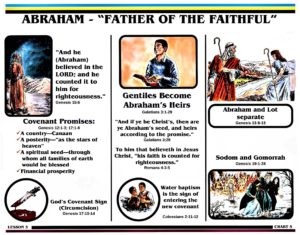
Chart Objective:
To reveal how God singled out one man, one family, and one nation to be a depository for His truth. Because Abraham believed in and pledged his very life to God, he was called “righteous.” The blood covenant agreement made with Abraham foreshadowed the new covenant which we enjoy today.
Chart Outline:
A. Abraham – “Father of the Faithful”
B. Covenant Promises
C. God’s Covenant Sign (Circumcision)
D. Gentiles Become Abraham’s Heirs
E. Abram and Lot separate
F. Sodom and Gommorah
A. Abraham —“Father of the Faithful”
The chapter describing the dispersion of the world’s population is the last mention of God’s dealings with the entire human race. At Babel, all mankind had seemingly rebelled against Him. The knowledge of the true God was apparently so limited that not one believer is mentioned until Abram. Then a new dispensation began—one of promises to Abram and to his special, holy nation of posterity.
Why would God withdraw from the human race in general to deal with merely one person? Here are three reasons:
• Depository of Truth. God designed the Hebrew nation to be a vault of safekeeping for His Word and His holy oracles.
• Channel. The Hebrew nation would provide a channel through which the Redeemer would come to earth. Through Christ, God’s blessings would flow to all the world.
•Witness. Israel was appointed to witness to all nations about the beautiful life God had intended for them. Israel was to exemplify an ideal nation of happy, healthy, prosperous, peaceful people. They would testify to the fact that sin, sickness, poverty, hunger, and discord are from Satan—not from God.
After the Flood, men sought explanations for the source of life. Therefore, they experimented with worshiping the powers of nature—sun, moon, stars, rain, fire, and animals. Gradually, images of these gods emerged to make them more real. Because sex was the means through which life came, descriptions of perverted sexual acts between gods and goddesses also became an integral part of heathen religion.
God trusted in Abram to remain separate and apart from such idolatrous practices. To represent Yahweh to all nations and prepare the way for the coming Redeemer, Abram and his descendants were commanded to separate from idolatry and wickedness.
The term “patriarch” expresses the social structure of the early Israelites. Those who founded the Hebrew nation are given this title.
In the patriarchal system of government, a clan was governed by the oldest man. The father was both legal and spiritual head of the family. Wives, children, and slaves were subject to the patriarch, who represented the sole authority under God. In the absence of a formal government, the patriarch ruled absolutely.
However, true love existed among patriarchal family groups as expressed in the Mosaic law.
The first eleven chapters of Genesis cover about 2,000 years—half the duration of the whole Old Testament time frame. By comparison, the preceding events from the time of Creation were less detailed in Scripture. Through the lineage of Shem, the Spirit singled out one man and devoted fourteen chapters to him.
Abram lived in Ur of the Chaldees around 2000 B.C. Though highly civilized and industrially prominent, the city was pagan and idolatrous. Four hundred years after the Flood, God called Abram to travel, by faith, to an undisclosed, distant land.
Abram’s call was a personal summons for separation. In a grossly idolatrous world, Abram must teach his family, who in turn would teach their families about the one true God.
Separation from familiar surroundings meant leaving his own parents. Often we must also separate ourselves from the plans and wishes of our loved ones and friends. Like Abram, we must walk by faith, guided by God.
B. Covenant Promises – Genesis 12:1-3; 15:6; 17:1-8
The Hebrew word for “covenant” comes from a verb signifying “to cut or divide,” suggesting the custom of making an incision where blood flows. In most scriptures, the Hebrew word implies: “to cut the covenant.”
For ages, primitive people have practiced this rite. In his book The Blood Covenant, Dr. H. Clay Trumbull has accumulated data from all parts of the world that reveal men entering into a binding agreement similar to the Genesis record.
A weak tribe living near a stronger one might cut the covenant for self-preservation. Or two businessmen might cut the covenant to ensure fairness.
The method depicted the arm of each man cut and the blood of both drawn. They rubbed their wrists together to mingle blood. Then the two officially became “blood brothers.”
So sacred was this covenant that it was never broken. Men became trusted friends as soon as the covenant was cut. If a man cut the covenant with his friend, the children of the two families were bound to observe it.
Covenants between men were common. But to cut a covenant with the Lord God was unprecedented! Because of their covenant of strong friendship, Abraham is the only person in the Old Testament called “the friend of God” (II Chronicles 20:7; Isaiah 41:8; James 2:23).
Before officially entering into covenant, Abram and Sarai received new names— Abraham and Sarah.
The charter sealed with Abraham was God’s first plan to bring man directly into a visible covenant relationship with Himself. This was the first prototype of a church (“called-out assembly”).
When Abraham pledged his very life to God, a threefold promise was his: financial blessings; physical blessings; and spiritual blessings. Genesis 17:6-8 and 22:17-18 list them:
• His descendants would inherit the country of Canaan as an everlasting possession.
• He would be given extensive posterity with descendants as numerous as the sand and stars.
• Through him would emerge a spiritual seed (Jesus Christ), through whom all families of earth would be blessed.
• He would have abundant financial prosperity.
The covenant between God and Abraham was mutual and reciprocal; all that both God and Abraham had belonged to the other.
This was God’s voluntary vow to Abraham: “By Myself have I sworn to be your Partner. If My promises fail, I become your slave; you own Me. I put Myself in bondage to you.”
Now we understand why the Scripture repeatedly affirms, “I am the Lord, who keepeth covenants.” He is the covenant-keeping God!
It is vital that we understand the significance of God’s covenant with Abraham since every believer in Jesus Christ also becomes His covenant partner!
C. God’s Covenant Sign—Circumcision – Genesis 17:10-14
Then God gave to Abraham the method of cutting the covenant (Genesis 17:10-14). Abraham was commanded to perform a ceremonial ritual called “circumcision.”
At the age of eight days, every male child must be circumcised to become part of this sacred agreement.
Circumcision was a visible mark and sign in a man’s flesh that he had been separated unto God. A cut was made and the foreskin of the male reproductive organ was removed.
Without circumcision, it was impossible to share the benefits of Abraham’s promises. This mark constantly reminded the Israelite of God’s promises to him and of his responsibilities to God. Even the lowliest Hebrew— including bond servants and strangers—were included.
Having joined the blood covenant community, it then was necessary to call upon the Lord and offer the blood of animals to remit sins.
For centuries, rivers of blood flowed from thousands of slain animals. But Abraham’s descendants continually anticipated the day when the “God-Man” would come to earth and redeem them from the bondage of sin and bring life to their dead spirits.
They could not have envisioned that despised Gentiles would one day become Abraham’s spiritual heirs.
D. Gentiles Become Abraham’s Heirs
Galatians 3:1-29; Romans 4:3-5;
Colossians 2:11-12
As we proceed through our lessons, we will notice various events in Old Testament days that had rich, multiple meanings. Scripture calls these “figures” or “shadows” of things which would later happen (Luke 24:44; Hebrews 8:5; 9:8-9).
Abraham’s covenant was one of those highly significant, dual-meaning incidents. Believers today can enter into covenant with God and become Abraham’s spiritual heirs.
The promises of Abraham’s covenant were fulfilled with the coming of his descendant, Jesus Christ. Blessings descend upon spiritual covenant members now that Jesus’ blood has cleansed our sins and restored life to our dead spirits. Every man, woman, boy and girl is eligible to enter the new covenant!
Just as God’s covenant with Abraham included many wonderful promises, Christ’s new covenant with His disciples embraced a “promise of the Father” (Acts 1:4). And what a tremendous gift it was!
If Abraham was immeasurably blessed with wealth, honor, and fruitfulness, think what awaits the new covenant members! Surpassing those natural blessings are spiritual ones.
When the Bible refers to the “children of Abraham,” it not only speaks of his fleshly descendants, but also those who walk in his “steps and faith”:
“Know ye therefore that they which are of faith, the same are the children of Abraham . . . And if ye be Christ’s, then are ye Abraham’s seed, and heirs according to the promise” (Galatians 3:7, 29).
“Therefore it is of faith, that it might be by grace; to the end the promise might be sure to all the seed; not to that only which is of the law, but to that also which is of the faith of Abraham; who is the father of us all” (Romans 4:16).
Abraham “believed in the LORD; and he counted it to him for righteousness” (Genesis 15:6). The Hebrew word translated “believed in” implies an unqualified committal of one’s self to another. So completely did Abraham trust the Lord that he was ready to totally commit himself to Yahweh.
Just as Abraham “believed”—absolutely committed himself—to God, we must also “believe” the gospel (the death, burial, and resurrection of Jesus Christ) and fully commit ourselves to Jesus. He then becomes the “Lord” or Ruler of our lives when we become His blood-covenant partners.
The sign of entering the new covenant is no longer circumcision of the flesh, but of the heart (Colossians 2:11-12). The initiation rite of water baptism has replaced circumcision.
E. Abram and Lot separate – Genesis 13:8-13
When Abram left his home in Ur, his wife and nephew, Lot, accompanied him. Lot had shared the great wealth God had given Abram.
When their flocks and herds rapidly multiplied, a quarrel developed between the herdsmen. It was time to part ways.
With characteristic generosity, Abram offered Lot the first choice of land. Standing on a ridge, the two men evaluated the possibilities. To the east lay the wide, well-watered plain of the Jordan River. The valley was rich with luxuriant tropical vegetation. To the west was the hill country.
In the coveted possession to the east dwelled Canaan’s wicked descendants in the five cities of the plain.
Selfishly Lot chose the good land on the plains of Jordan near the immoral cities of Sodom and Gommorah. That was a mistake.
In almost every respect, Lot compares unfavorably with his uncle. Abram walked by faith; Lot walked by sight. Abram was an “altar-builder”; no record relates Lot making sacrifices to God. Abram was generous; Lot was greedy. Abram looked for a city built by God; Lot chose a home in a city built by man.
The covenant was officially established between God and Abram after this important separation from Lot (Genesis 13:14-17).
F. Sodom and Gommorah Genesis 19:1-28
Several years had passed since Lot had made his choice. When he discovered the gross iniquity of Sodom, he should have moved, rather than expose his family to its evil environment. Or he could have preached righteousness to the Sodomites. Instead, Lot became a prominent leader and allowed his daughters to marry ungodly men.
Paul said that Old Testament events are examples to us:
“Now all these things happened unto them for ensamples: and they are written for our admonition, upon whom the ends of the world are come” (I Corinthians 10:11).
Therefore, if exposing family members to an evil environment proved to be tragic for Lot, his example should alert every parent in our day.
Finally, three angelic visitors came to Abraham’s tent bringing some glad and some sad news. First there was a renewal of the promise for the long-awaited son. Then came the doomsday declaration that the cities of the plain would be destroyed because of wickedness.
Immediately Abraham began to plead for Sodom to be spared. If fifty righteous souls could be identified, would God delay the punishment Yes. But there were not fifty, . . .forty . . . thirty—not even ten righteous. And God would have spared the city for only ten righteous persons.
God sent His angels to rescue one man and his family because of Abraham’s intercessory prayer.
Why did God inform Abraham of His intentions to destroy Sodom? Because they were blood-covenant partners. Judgment was withheld from Abraham’s kinsman until he had been informed. What a wonderful privilege to be in covenant with the Lord!
The two angels went to Sodom and found Lot sitting at the city gate, the customary place for settling disputes or transacting business. Lot was possibly a city judge or ruler.
Hospitably, Lot offered overnight sleeping accommodations in his home. But during the night, homosexual men surrounded the house and demanded to “know” Lot’s visitors. To protect themselves, the angels temporarily blinded the men.
The term “sodomy” derives its meaning from the gross perversion of this city.
After Lot had been warned of the imminent destruction, he was still reluctant to leave. The angels seized him, his wife and their two daughters and forcefully escorted them from the city, forbidding them to even look back.
Once the family was safely outside Sodom, God rained fire and brimstone, destroying all the inhabitants of four cities.
How were the cities destroyed? Merrill Unger says that the region is known to have numerous slime (asphalt) pits. Petroleum deposits can still be found there. The entire region is on a long fault line forming the Jordan Valley and the Dead Sea. Throughout history, it has been the scene of earthquakes. Although the biblical account records only the miraculous elements, geological activity was probably the force.
The salt and free sulphur in this area, now a burnt-out region of oil and asphalt, could have mingled by an earthquake, resulting in a violent explosion. The salt and sulphur were carried red hot into the sky, therefore raining fire and brimstone over the whole plain (Unger, Archaeology and the Old Testament, page 115)!
Evidently, Lot’s wife disobeyed the angels’ command by not only looking back, but going back (Luke 17:28-32). Caught in the aftermath of the volcanic upheaval, she was probably killed by the fiery and sulphuric vapor which impregnated the atmosphere.
Afterward she became encrusted with a nitrous and saline substance that temporarily preserved her body from decay. A similar fate trapped refugees at Pompeii.
Several pillars of salt at the south end of the Dead Sea are named “Lot’s Wife.” Josephus claimed to have seen her pillar of salt in his day.
Having escaped to the city of Zoar, Lot and his two daughters then fled to mountain caves overlooking the horrible scene of destruction below.
While in this primitive dwelling, the girls conspired to make their father drunk, then committed incest with him so as to perpetuate the human race. Such perversion would have been punished by death under the Mosaic law (Leviticus 18:9; 20:12). But the childless daughters, influenced by life in Sodom, felt justified for their actions.
Each daughter gave birth to a son by her own father. These boys later founded two nations—Moab and Ammon—both hostile enemies of God’s chosen people (Genesis 19:30-38).