
Kindly CLICK HERE for the Quiz
LESSON TWO
In the Beginning
This lesson is a study of “beginnings” from the Book of Genesis.
In every age of history, man has sought to discover what God is like and the reason for his own existence.
The first book of the Bible reveals that a master Designer wanted to provide a suitable environment for man. Thus, the universe and its fixed
laws were created to sustain and govern the earth. In turn, the earth was stored with treasures and resources to sustain life for mankind. Of all God’s creatures, man alone is capable of enjoying earth’s beauty and using those resources.
Having completed His elaborate preparations for his home, our loving Father created man in His image, as nearly like deity as possible. He wanted fellowship and communion with sons and daughters who would be His heirs and have dominion over the earth.
But when man chose to be like God, rather than remaining under His sovereignty, his sin resulted in spiritual death. Eventually he forfeited his rulership and Satan became god of this world.
The remainder of the Bible is the intriguing story of what God did to redeem man from Satan’s slavery and unite him with his Maker.
When completed, students should be aware of the following concepts:
1. The one true God is best described as a loving Father who enjoys doing good things for His creation.
2. Angels were created to worship and serve God and to minister to the heirs of salvation.
3. Man was created for the express purpose of giving pleasure to God. He yearns for a close, voluntary relationship with us, His choice creatures.
4. Man is a spirit-being, made to walk in fellowship with God. Man’s spirit was made to rule his soul (mind, will, emotions) and the subjected soul would rule the body. The body is merely a house in which the spirit and soul dwell.
5. Through Adam’s willful disobedience, mankind became spiritually dead and separated from God.
6. From the time of the Fall, God gave the promise of a Redeemer, through Whom His relationship with man would be restored.
Books for additional reading:
1. Harry Rimmer, Modern Science and the Genesis Record, Grand Rapids: Wm. B. Eerdmans Publishing Co., 1937.
2. Thomas F. Heinze, The Creation Vs. Evolution Handbook, Grand Rapids: Baker Book House, 1972.
3. Henry M. Morris, Studies in the Bible and Science, Grand Rapids: Baker Book House, 1966.
4. E. W. Kenyon, The Bible in the Light of Our Redemption, Lynnwood,WA: Kenyon’s Gospel Publishing Society, P. O. Box 973, Lynnwood,WA 98036, 1969.
5. Pat Robertson, The Secret Kingdom, Nashville: Thomas Nelson Publishers, 1982.
Lesson 2 – Chart 1
In The Beginning . . .
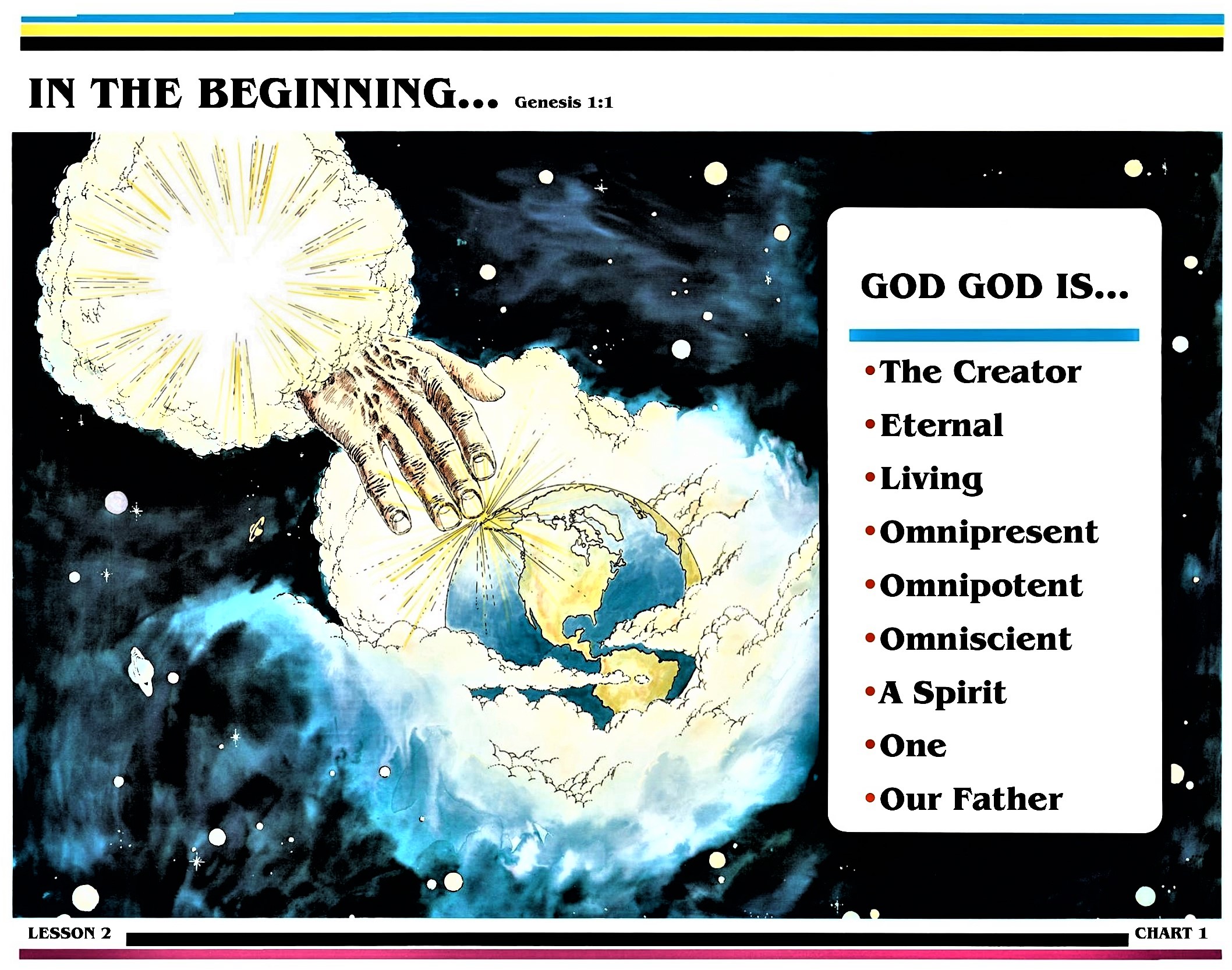
Chart Objective:
To explain the attributes of the one God revealed in our Bible. He is almighty, yet a loving Father concerned with the needs of His creation.
Chart Outline:
A. God is . . .
B. The Creator
C. Eternal
D. Living
E. Omnipresent
F. Omnipotent
G. Omniscient
H. A Spirit
I. One
J. Our Father
A. God is . . .
Appropriately, the Bible is called God’s Book, or the Word of God. It begins with God and ends with God. All its contents concern Him.
True, we find no exact portrait of God that could be copied on canvas or stone. Any attempt to describe Him with ordinary, common terms is futile. The longest, most descriptive word in our dictionary could never depict His wonder and majesty. God simply cannot be described with words from any language!
However, our Bible does offer insights that help us comprehend what God is like.
B. The Creator
The very first verse of our Bible declares an important fact about God. Let’s read it together.
“In the beginning God created the heaven and the earth” (Genesis 1:1).
With no existing material or substance, He creates and brings into being things that are not.
“He stretcheth out the north over the empty place, and hangeth the earth upon nothing” (Job 26:7).
C. Eternal
Creation is God’s first recorded act, but that did not mark His beginning. He existed long before that!
God is eternal. He endures. He is not here today and gone tomorrow. God has neither beginning nor ending.
“I am Alpha and Omega, the beginning and the ending, saith the Lord, which is, and which was, and which is to come, the Almighty” (Revelation 1:8).
God has always existed.
“Before the mountains were brought forth, or ever thou hadst formed the earth and the world, even from everlasting to everlasting, thou art God” (Psalm 90:2).
Another word to describe eternal is “infinite,” or without limitations of time or space. There never was a time when God did not exist.
D. Living
God is alive! He is not an idea, concept or figment of the imagination. He is real!
“He is the living God, and stedfast for ever” (Daniel 6:26).
Being alive, God has all the characteristics of a living being. He can see and hear; He thinks and remembers:
“For the eyes of the Lord are over the righteous, and his ears are open unto their prayers” (I Peter 3:12).
“For he knoweth our frame; he remembereth that we are dust” (Psalm 103:14).
God is generous and good to all His creation:
“No good thing will he withhold from them that walk uprightly” (Psalm 84:11).
Because He is a living being, God has an official residence:
“Hear thou in heaven thy dwelling place” (I Kings 8:39).E. Omnipresent God is omnipresent. Since “omni” means “all,” He is everywhere present at the same time. He is both far and near. His size is beyond comprehension. Jeremiah advised,
“Can any hide himself in secret places that I shall not see him? saith the LORD. Do not I fill heaven and earth? saith the LORD” (Jeremiah 23:24).
David’s psalm expressed this fact so beautifully. There is no place anywhere in the universe where God is not present. If David could take the wings of the morning and fly farther than any bird, God would be there. Should he go to the highest part of heaven or the deepest part of hell, God would still be there! He is everywhere! (Psalm 139:7-11).
F. Omnipotent
God is omnipotent; He has all power at His command. He is the Almighty, the Ruler of all!
“The Lord God omnipotent reigneth” (Revelation 19:6).
“In thine hand is power and might; and in thine hand it is to make great, and to give strength unto all” (I Chronicles 29:12).
Having all power, God has the ability to do all things without limitations:
“Ah Lord GOD! behold, thou hast made the heaven and the earth by thy great power and stretched out arm, and there is nothing too hard for thee” (Jeremiah 32:17).
“With men this is impossible; but with God all things are possible” (Matthew 19:26).
We humans have many limitations, but God has none. He has power to do anything. However, He only performs actions in harmony with His own nature or Word.
G. Omniscient
God is omniscient, or “all-knowing.” Nothing is hidden from Him. He sees and hears everything:
“For his eyes are upon the ways of man, and he seeth all his goings” (Job 34:21).
“For there is not a word in my tongue, but, lo, O LORD, thou knowest it altogether” (Psalm 139:4).
Being omniscient, He is the source and origin of all knowledge and wisdom.
“O the depth of the riches both of the wisdom and knowledge of God! how unsearchable are his judgments, and his ways past finding out!” (Romans 11:33).
H. A Spirit
The Bible clearly states that God is a Spirit.
“God is a Spirit: and they that worship him must worship him in spirit and in truth” (John 4:24).
But what is a “spirit”? That is like asking “What is the wind?”We know when wind fills the sails and drives our boat. But we cannot see it.
The story of a boy whose kite had soared out of sight explains this. When asked how he knew the kite was still aloft, he answered, “Because I can feel it tugging at the string, pulling at me.”
Like the wind, God’s Spirit is invisible and non-material—yet powerful. Our Bible emphatically states that God cannot be seen with human eyes, just as the human spirit cannot be seen or touched.
“Now unto the King eternal, immortal, invisible, the only wise God, be honour and glory for ever and ever. Amen” (I Timothy 1:17).
“No man hath seen God at any time” (I John 4:12).
Although no man has actually seen God, yet every man, woman and child can feel the pull of the divine Spirit and know that God lives!
I. One
Throughout the Bible, this message resounds: “God is one“. First of all the commandments in the Bible is:
“Hear, O Israel: The LORD our God is one LORD” (Deuteronomy 6:4).
Established in the Old Testament and echoed in the New Testament by Christ Himself, this commandment is the fundamental doctrine of the Christian religion. There is only one God, the Lord Yahweh.
“The LORD he is God; there is none else beside him” (Deuteronomy 4:35).
“Have we not all one father? hath not one God created us?” (Malachi 2:10).
“One God and Father of all, who is above all, and through all, and in you all” (Ephesians 4:6).
Although the central thought in the Bible specifies that God is one, various interpretations have developed among men.
Centuries ago, the thought erupted that man needs no assistance from God. Human intelligence and achievement had advanced to the point that men felt capable of functioning independently.
This humanistic theory, originating in ancient Greece and Rome, places its central importance and value in man—his abilities and achievements. Humanists assert that man is evolving to a utopia without the aid of God’s supernatural intervention.
However, Bible-believers recognize that God is in control of the world, and all things operate according to His divine plan and will.
Other strange philosophies concerning God have developed as man’s intellect tries to interpret the Word of God. A large percentage of the world’s population is involved in polytheism— the belief in a plurality of two or more gods, such as mythology and pagan religions, with visible objects of worship.
Ancient Jews, who are responsible for preserving God’s Word, propagated their literal interpretation that He is “one” Lord (Deuteronomy 6:4). Repeatedly, the Scriptures emphasize “one.” To the Jew, there could never be a plurality of Deity. There is only one God!
Christians can agree with the Jews that there is only one God. But this one God of the Old Testament Scriptures emerges in the form of the Messiah, Jesus Christ.
Later lessons will explore this concept of one God in greater detail.
J. Our Father
Perhaps the best description of God is that of a loving Father. He enjoys doing good things for His creation.
“If ye then, being evil, know how to give good gifts unto your children, how much more shall your Father which is in heaven give good things to them that ask him?” (Matthew 7:11).
Because He desired fellowship and worship, God prepared delightful blessings for the multitudes who would someday populate the earth. Never picture God as an austere Judge, peering down, waiting for some excuse to pounce upon men with severe punishments. He is a warm, compassionate, caring Father who delights in showering mankind with good gifts.
The reason for the ignorance and misery of heathen nations lies in their unenlightened conception of God. He has been portrayed as weird, cruel, immoral, aloof, and impersonal. But never do they identify Him as a loving Father.
Even Israel, the nation possessing as clear a revelation as could be given to man, could not clearly conceive His warmth and compassion. This is why they failed to recognize Him when He stood among them.
Jesus Christ revealed the Creator to be a God of love, concerned about the sick and suffering, the blind and deaf. He portrayed a holy God who was approachable. Even the most sinful of men were drawn to Him. Children sat upon His knees. Jesus was the first person of importance to appreciate childhood.
Nor had women been shown attention. The privileges, freedom and blessings enjoyed by women today are due to His life and teachings.
No other religion claimed a deity with “fatherly” attributes. By His life and words, Jesus revealed what man’s imagination could not grasp. Because He dwelt among us as a man, He has been revealed as a God of love who tenderly cares for us like a Father.