The Bible: Unique and Wonderful!
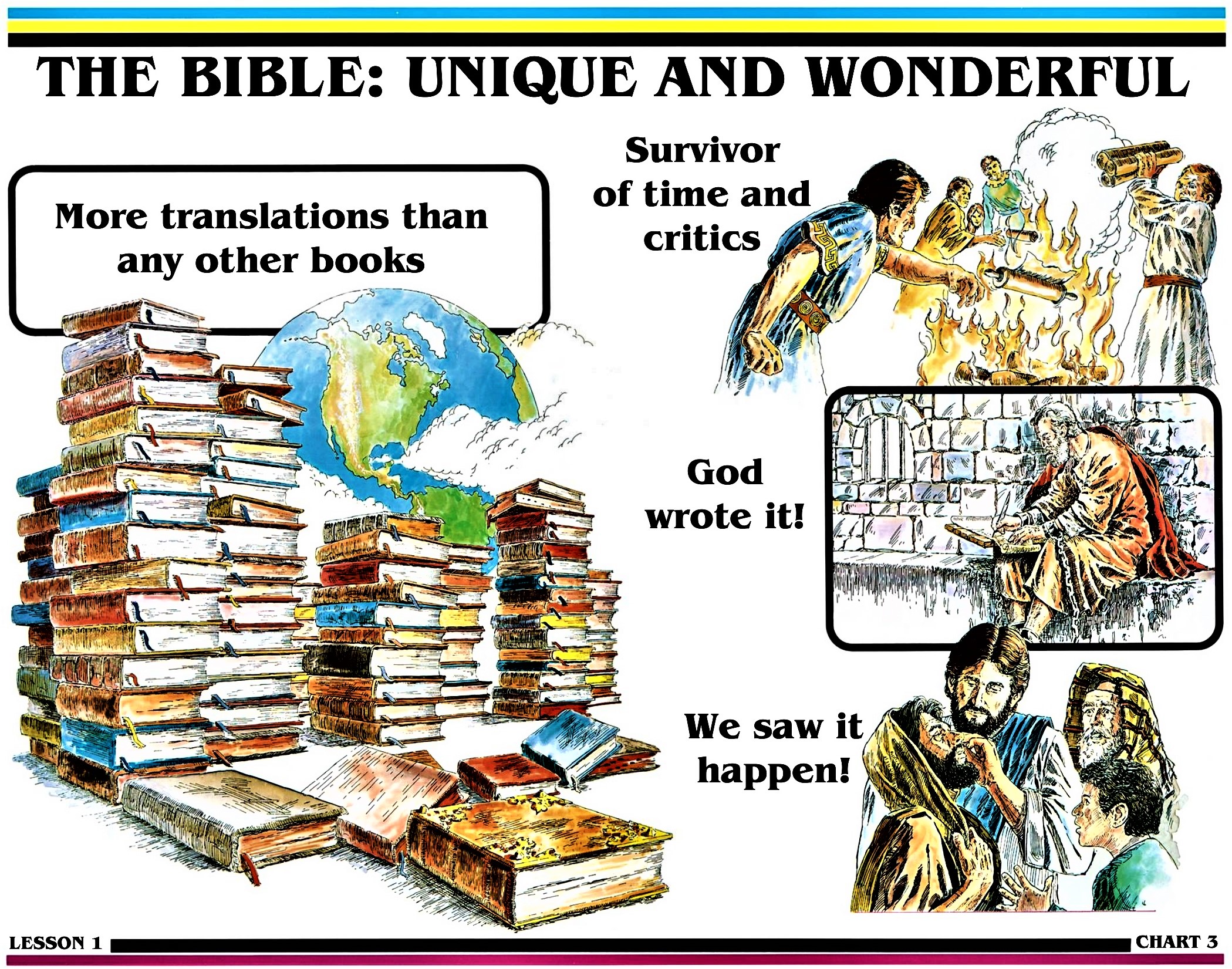
Chart Objective:
To discover the many ways in which the Bible is unique. No other book has equaled the number of translations, the circulation, or survived critics’ attacks like this Book. The Bible alone is accredited to God’s authorship with many eyewitness accounts of events described in Scripture.
Chart Outline:
A. More translations than any other book
B. Survivor of time and critics
C. God wrote it!
D. We saw it happen!
A. More translations than any other book
Why is the Bible a miracle Book? Why is it so special?
Our Bible is indeed uniquely different from all other books. It has been read by more people and published in more languages than any other book. More copies of it have been produced than of any other book in history. No book could remotely compare with the circulation of the Scriptures. Nor has any other attained its constant circulation.
The Bible’s translation is also unmatched. It has been rendered and paraphrased into more languages than any other book. By 1966, the entire Bible appeared in 240 languages and dialects. One or more books of the Bible was translated in an additional 739 languages for a total publication of 1,280 languages (Encyclopaedia Britannica, Vol. 3, page 588)!
B. Survivor of time and critics
The Bible is unequalled in its survival of time. Having first been written on perishable materials, then copied and recopied for hundreds of years before the invention of the printing press, still its style and accuracy have never diminished.
Compared with other ancient writings, the Bible has more manuscript evidence than any other classical literature.
The Bible is remarkable in its survival of criticism. It has withstood vicious attacks from enemies as has no other book. Voltaire, the French infidel who died in 1778, said that in one hundred years, Christianity would be erased from history. But what has happened? Only fifty years after his death, the Geneva Bible Society used Voltaire’s own printing press and house to produce hundreds of Bibles (Norman Geisler and William Nix, A General Introduction to the Bible, pages 123-124)!
The Bible is the first religious book to be taken into outer space. From Genesis 1:1, the astronauts read, “In the beginning God.” And Voltaire said it would be forgotten by 1850?
Christ’s own claims assure us that His Word could never be forgotten:
“Heaven and earth shall pass away, but my words shall not pass away” (Matthew 24:35).
While these qualities do not alone prove the Bible is the Word of God, they do signify that it has no equal. Every intelligent person should want to read the one Book that has drawn more attention than any other. And every person who is searching for truth will surely want to carefully examine its unique qualities.
C. God wrote it!
There is another amazing difference between the Bible and all other books. Authors may pray for God’s help and guidance— which God provides. Certainly many good books have been written with God’s help. Still, even the most saintly writer would hardly claim for his book: “God wrote it!”
But that is claimed for the Bible. Both Old and New Testament writers claim to write the very words of God. The Bible is filled with expressions such as, “God said,” “the Lord spake saying,” “the Lord commanded,” “the Word of the Lord came unto me.” Such
phrases appear more than 3,800 times.
Paul, writer of more than half the New Testament, attributed that his writings were from God. “The things that I write unto you are the commandments of the Lord” (I Corinthians 14:37).
Satan has bitterly and subtly fought God’s Word. Why? Because God works through the power of His spoken Word!
How were the worlds created? By the Word of God (Hebrews 11:3).
How is every child of God begotten, or born again? By the Word (James 1:18).
After spiritual birth, how does God’s child derive the sustenance and maintenance of that existence? Through the Word of God (Matthew 4:4).
Therefore, the Bible is either what the writers attest—God’s Word to man—or it is not. There is no middle ground concerning inspiration of Scripture. Either it is God’s Word or it is only man’s word.
D. We saw it happen!
New Testament writers were eyewitnesses of the events they described or wrote from firsthand accounts. Peter, one New Testament writer, assured us: “We’re not writing fiction. We saw it happen!”
“For we have not followed cunningly devised fables, when we made known unto
you the power and coming of our Lord Jesus Christ, but were eyewitnesses of his majesty” (II Peter 1:16).
Bible writers earned the right to tell their story. Their firsthand knowledge of facts and evidence about Christ still appeals to readers and listeners.
They not only said, “Look, we saw this happen,” but their statements warned their most adverse critics, “You also know about these things. You saw them, too!”
“Ye men of Israel, hear these words; Jesus of Nazareth, a man approved of God among you by miracles and wonders and signs, which God did by him in the midst of you, as ye yourselves also know” (Acts 2:22).
Such tactics would be used only by one who was positive of his position. To tell an opponent, “You know about this, too,” would challenge him to refute incorrect statements.
The writers of Scripture were sure -very sure! They were convinced that the actual, direct words of God were being relayed. Having been eyewitnesses, they were positive of the truthfulness of their statements.
They were sure, but how can we be sure?