Have You Received the Holy Ghost Since You Believed?
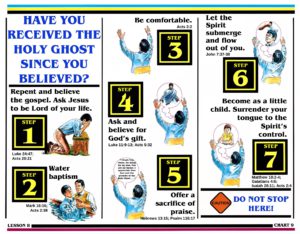
Chart Objective:
To explain in seven easy steps how to receive the gift of the Holy Spirit. Each step is substantiated scripturally and will bring the promised results—the Holy Spirit baptism!
Chart Outline:
A. Step 1—Repent and believe the gospel
B. Step 2—Water baptism
C. Step 3—Be comfortable
D. Step 4—Ask and believe for God’s gift
E. Step 5—Offer a sacrifice of praise
F. Step 6—Let the Spirit submerge and flow out of you
G. Step 7—Become as a little child. Surrender your tongue to the Spirit’s control.
A. Step 1—Repent and believe the gospel. Ask Jesus to be Lord of your life. – Luke 24:47; Acts 20:21
Would you like to receive this beautiful gift of the Spirit? These simple suggestions will prepare you in a matter of minutes to receive a gift that will be yours to enjoy for a lifetime!
The first step of repentance is not just an emotion that we feel, but a decision to turn away from sinful actions. At the altar we call upon the Lord, confess our sins and commit our lives to His control. Promising to love, serve and obey Him is the basis for entering into covenant with Christ.
The beautiful story of the gospel becomes so real, we are anxious to identify with Christ’s death (repentance), burial (water baptism), and resurrection (walking in the new life of the Spirit).
B. Step 2—Water baptism
Mark 16:16; Acts 2:38
As God designed a new covenant, He also designed a new rite of initiation. Circumcision of the flesh is replaced with a circumcision of the heart. The “old man” who died at the altar of repentance must now be buried. Water baptism is for the remission of sins. We identify with Christ’s burial and resurrection in water baptism.
A close examination of the great commission reveals that baptism must be administered— not in the descriptive titles—but by calling the actual name—“Jesus Christ” (Acts 2:38). Further proof is given in the Book of Acts and the epistles that the apostles baptized “in the name.”
C. Step 3—Be comfortable
Acts 2:2
God is not particular about our posture when He baptizes us. At the initial outpouring on the Day of Pentecost, a rushing mighty wind “filled all the house where they were sitting” (Acts 2:2).
Kneeling in an uncomfortable position is not a prerequisite for receiving the Spirit. Cramped legs and tired arms and backs are unnecessary. Choose a suitable, comfortable position.
While repenting, a kneeling position may be desirable. But when it is time for the Holy Spirit to baptize us, choose a more relaxed position.
Some have been awakened during the night and baptized by the Spirit in the privacy of their bedroom. Others have felt the overwhelming power of God while washing dishes or riding in an automobile. We have already learned that the Spirit especially enjoys baptizing believers in homes—the upper room and Cornelius’ home. So wherever we meet the conditions, God is ready to fill us.
D. Step 4—Ask and believe for God’s gift
Luke 11:9-13; Acts 5:32
Now you must believe that God has a very special and wonderful gift for you. Although mankind could never be worthy of or deserve this special honor, Jesus wants you to have this overflowing experience.
True faith is always demonstrated by obedience. Those who carefully obey instructions can be assured of receiving the Spirit.
Perhaps you would like a mental picture of Jesus facing you with outstretched hands. Keep this image in your thoughts as you proceed closer toward Him in faith and praise.
Remember, too, that this gift is not forcibly pried from the hands of a reluctant God. Neither are you trying to earn the Holy Ghost by your determination. As a loving parent would extend a promised gift in his hand, Jesus offers the gift of His Spirit. At this moment He is waiting for you to move toward Him in faith. Jesus told us to:
“Ask, and it shall be given you; seek, and ye shall find; knock, and it shall be opened unto you. For every one that asketh receiveth: and he that seeketh findeth; and to him that knocketh it shall be opened. If a son shall ask bread of any of you that is a father, will he give him a stone? or if he ask a fish, will he for a fish give him a serpent? Or if he shall ask an egg, will he offer him a scorpion? If ye then, being evil, know how to give good gifts unto your children: how much more shall your heavenly Father give the Holy Spirit to them that ask him?” (Luke 11:9-13).
E. Step 5—Offer a sacrifice of praise
Hebrews 13:15; Psalm 116:17
Nothing pleases our Father more than worship and praise. What better way could we demonstrate our faith in His promises than to begin thanking and worshiping Him—before the gift is given? Paul instructed:
“Let us offer the sacrifice of praise to God continually, that is, the fruit of our lips giving thanks to his name” (Hebrews 13:15).
Why was David called “a man after God’s own heart”? He had learned the secret of being grateful and appreciative of God’s blessings!
“I will offer to thee the sacrifice of thanksgiving, and will call upon the name of the LORD” (Psalm 116:17).
Some children are quite gifted with an ability to extract favors from their parents. How could a mother or father resist hugs and kisses and—“You’re the sweetest mom in the whole world! I’m so glad you’re going to buy me that new bike I’ve been telling you about. That’s the neatest bike I’ve ever seen! I sure do love you for being so good to me!”
Could a parent say, “No!” with a build-up like that?
Being made in God’s image, even after the Fall, we have retained sufficient God-like characteristics to know what pleases and displeases Him. When petitions are offered in a manner appealing to us, the answer is assured!
Talk to God as if He were your best Friend. Avoid stilted, cold phrases, such as— “Our Father, we thank Thee for Thy many blessings. Grant unto us Thy children that we may partake of Thy favors . . .”
He responds best when we talk to Him right out of our hearts with warmth, love, and feeling. Why not approach Him something like this:
“Dear Jesus, I just want to thank You for the wonderful privilege I have just discovered in Your Word of being baptized into Your Holy Spirit. You have already shown me such love by forgiving my sins and cleansing me with Your blood. Just to think that I could be a covenant partner with the God of heaven makes me feel so small and unworthy.
“But now, Jesus, I’ve heard that You have a unique gift that will saturate me with power and love and joy and all sorts of wonderful blessings! Lord, I wouldn’t think of asking You for something so fantastic—except that Your Word declares that You want me to have it!
“So here I am in Your presence, like a little child, asking and believing that rivers of living water will begin to flow out of my innermost being.”
This is just a sample prayer. Talk to God in your own words. Those are the ones He wants to hear. An expression of genuine gratitude and faith always merits a divine response!
God’s love “shed abroad in our hearts by the Holy Ghost” (Romans 5:5) describes the submerging of the human spirit. His “baptism” plunges a person’s inner self into the ocean of His life-giving love. This is the most intimate and personal experience imaginable! It is God’s response to sincere trust and appreciation unashamedly offered to Him. It is His acknowledgment of our sacrifice of praise!
F. Step 6—Let the Spirit submerge and flow out of you.
John 7:37-38
As we continue talking with God in the same affectionate way, we must leave the realm of human thought and understanding and enter the dimension of the Spirit.
This route is not an easy “1-2-3” plan with speedy results. Instead, we are suggesting guidelines for developing an intimate, continuing relationship which we call “prayer.” Do not allow some well-meaning helper to “teach” you to speak with other tongues, thereby reducing the experience to a brief, meaningless encounter with God.
The baptism of the Holy Spirit was never intended to be an abstract, passionless experience. It is powerful—but very personal! For your experience to remain fresh and meaningful, its roots must be imbedded in a scriptural, tangible meeting with Jesus.
How do we abandon the realm of human understanding and enter the realm of the Spirit? No, we do not leave our bodies. We merely bypass human reasoning and intellect, then ascend into God’s “higher ways”:
“For as the heavens are higher than the earth, so are my ways higher than your ways, and my thoughts than your thoughts” (Isaiah 55:9).
Human reasoning is filled with pride and self-exaltation. To forsake that realm demands that we renounce our rights and humbly accept God’s will—no matter how ridiculous it may seem.
Forget accepted human behavior standards (if they are contrary to God’s intent for you). Pious worship habits must be abandoned if they conflict with the heartfelt worship of believers in the Book of Acts.
Jesus explained the baptism of the Spirit like this:
“If any man thirst, let him come unto me, and drink. He that believeth on me, as the scripture hath said, out of his belly shall flow rivers of living water” (John 7:37-38).
We begin by “drinking” of the Spirit. But no one can drink with his mouth closed. The Lord said, “Open thy mouth wide, and I will fill it” (Psalm 81:10).
God cannot fill a closed mouth. Some seekers fail to receive the Spirit’s fullness simply by closing their mouths.
For some, the process may be slower than others. But it should occur momentarily, as in Acts, chapter 10:
“While Peter yet spake these words, the Holy Ghost fell on all them which heard the word” (Acts 10:44).
Remember that speaking in tongues is from the human spirit—not the emotions (the soul). The Greek phrase lalein glossais simply means, “to speak in languages.” True, the emotions may be stirred, but you do not have to become emotional to speak in tongues. Nothing in the original Greek implies that speaking in tongues is connected with frenzy, excitement, hysteria, ecstasy, or trances. Emotion is not a cause; it is a response or an expression of what is happening in the spirit.
Admittedly, nothing could be more emotionally stirring than feeling God’s presence. Therefore, the baptism may be accompanied with joyful laughter, weeping, or dancing. But speaking in tongues is your spirit speaking, inspired by the Holy Spirit.
As proof that speaking in tongues is from the spirit, deaf mutes who have never spoken a word will fluently speak in tongues when receiving the Holy Spirit!
Jesus said: “out of his belly shall flow rivers of living water.” The Spirit wants to be poured out of you.
The word “belly” comes from the Greek koilia meaning “the entire physical body.” Through the body’s speech and actions, we contact other human beings. How can our world be helped or challenged until it sees, hears, and experiences Jesus’ life flowing from us?
Compare this flowing with an irrigation canal in arid parts of the country. When all the fields and vegetation are dried and parched, the reservoir gates are opened and the canal begins to fill with water. First to be refreshed is the canal itself as the cool, rippling water flushes away the debris.
Next to be irrigated are the grass and trees on either side of the canal. Then farmers all along the way open their gates to receive life-giving water for their dried and thirsty crops.
Likewise, our spirit is refreshed first. Afterward, the baptism flows through the soul and body, gushing forth to bless those around us, then to everyone else we meet!
Twice Jesus talked about the water He would give to believers. To the Samaritan woman He spoke about a well: “The water that I shall give him shall be in him a well of water springing up into everlasting life” (John 4:14).
G. Step 7—Become as a little child. Surrender your tongue to the Spirit’s control.
Matthew 18:2-4; Galatians 4:6; Isaiah 28:11; Acts 2:4
As a little child freely believes and obeys, so we yield ourselves to the Spirit’s control. However, the first surrendering of ourselves may be difficult. But after the initial filling, yielding the will becomes easier.
Learning to surrender is much like diving into water. That first plunge is the hardest.
Sometimes a single word of praise leads the seeker away from the realm of human understanding into the realm of the Spirit. As you move into this heavenly dimension, praise words will become unintelligible. However, these babbling sounds do not really matter since they will soon be exchanged for a brand-new language of the Spirit.
Surrendering your language also indicates surrender elsewhere. It means the believer is mastering a major feat—learning to talk!
Speaking the Father’s language sometimes resembles the babblings of a baby:
“And because ye are sons, God hath sent forth the Spirit of his Son into your hearts, crying, Abba, Father” (Galatians 4:6).
And when God’s Spirit is sent into our hearts, it may sound like the jabber of an infant. But He interprets these first simple words as love and confidence directed toward Him, our heavenly Father.
So happy and joyous is the spiritual newborn infant, he is oblivious to how he sounds, how he looks, or what he is saying. He is privately visiting with the King of kings and nothing else matters!
Those first unintelligible sounds mean you have broken the “sound barrier.” Keep speaking those little joyful noises. Soon they will be fully articulated as the Spirit completely fills and gives the expressions He wants spoken.
One note of caution: it is impossible for God to fill people with His Spirit when they refuse to yield. No one can be filled with self and God simultaneously. Neither can two languages be spoken at once. Since God will not take your vocabulary away, you must voluntarily yield to His control.
God does not speak in tongues—people speak in tongues as the Spirit gives the words. On the Day of Pentecost, they began to speak in other languages as the Spirit gave them utterance (Acts 2:4). So you must begin to speak in other languages (not your own), as the Spirit prompts you.
The Spirit will not compel anyone to speak with tongues or forcefully stifle ordinary speech, but what sheer joy it is to surrender our words to Him!
During this process we reach up in faith, believing that this is the Holy Spirit submerging and filling us. Through faith, we deliberately abandon our own language.
Emotions often become affected by what is happening in the spirit. You may express the blessedness of this moment in a variety of ways. But you will be in control at all times; Paul said,
“The spirits of the prophets are subject to the prophets” (I Corinthians 14:32).
This means that if you wish to stop speaking, you can. But the Spirit cannot be fully enjoyed until you drink long and deeply!
This is a free gift—never to be snatched away or retrieved. How we handle and preserve it is up to us. This is the blessed promise of the Father!
But DO NOT STOP HERE! When a person is baptized with the Spirit, he has not “arrived” spiritually. God has many more gifts. He wants to lead and guide you into all truth. This is merely the “beginning” of a new dimension of Christian living. Do not be satisfied with the least amount of salvation, but seek to know the complete plan for your life. You alone can decide whether to grow or regress.
Our next lesson details the basics for kingdom living—the most wonderful life on earth!