The First Evidence of Being Baptized in the Holy Spirit—Speaking With Other Tongues
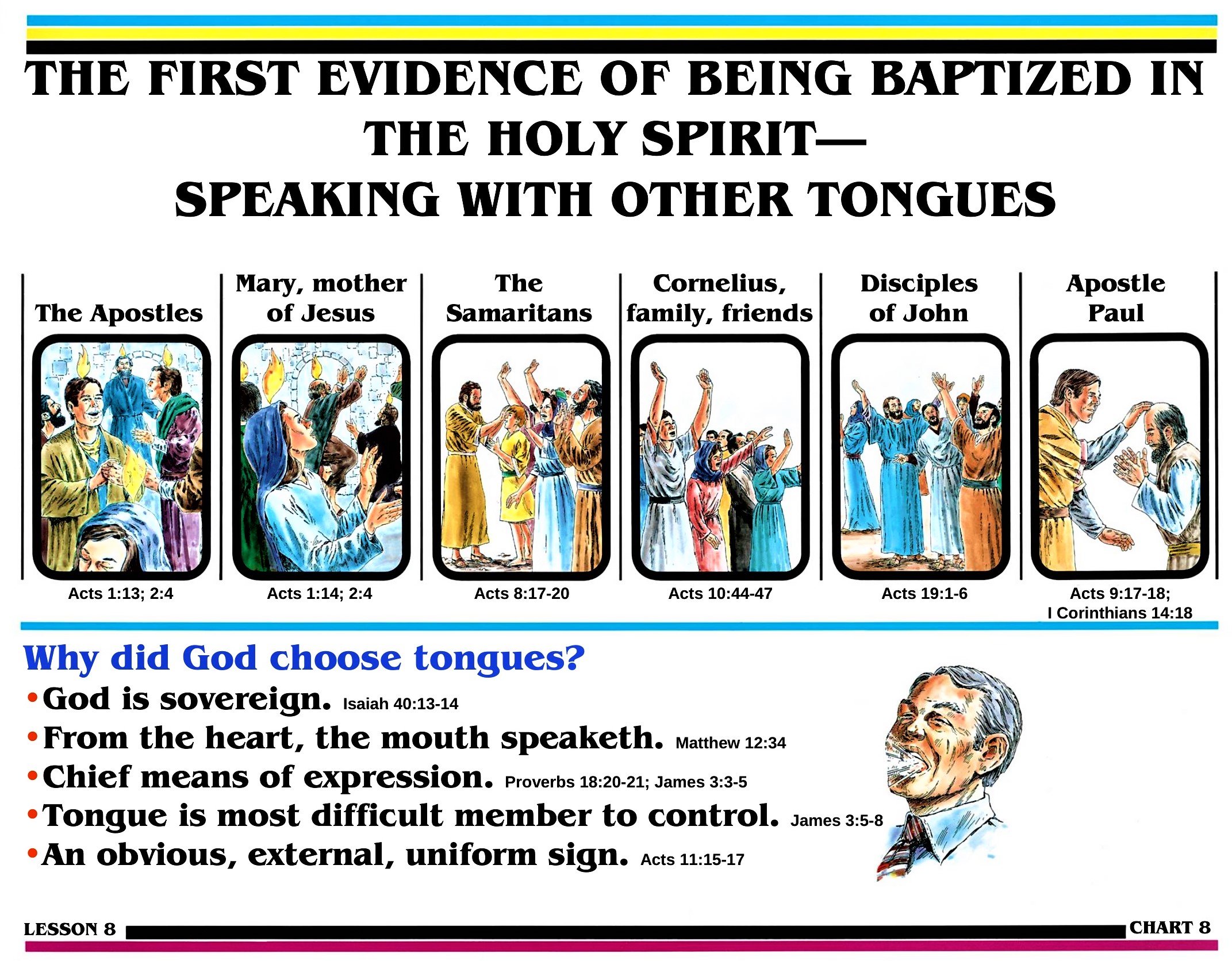
Chart Objective:
To examine the initial evidence of the Holy Spirit baptism that can be seen and heard. Speaking with unknown tongues is the outward sign chosen by God to announce what has happened within the spirit.
Chart Outline:
A. The First Evidence—Speaking With Other Tongues
B. Biblical examples of speaking with tongues
C. Why did God choose tongues?
A. The First Evidence— Speaking With Other Tongues
When the Holy Spirit made His grand entrance on the Day of Pentecost, a visible sign was used—tongues, or flames of fire. This reminds us of a similar demonstration centuries earlier at the giving of the law.
When God gave Israel the Ten Commandments on Mount Sinai, He added a visible exhibition of thunder, lightning, smoke, fire, quaking and a piercing trumpet blast (Exodus 19:18-19). However, that dramatic manifestation was not visible in subsequent readings of the law to the congregation.
Since the Feast of Pentecost celebrated the original giving of the law, we suppose that a majestic demonstration of the new era was fitting.
Besides the wind and tongues of fire in the upper room, another “sign” was observed that day. It has consistently remained when believers are Spirit-filled. Speaking with other tongues is a “sign” both to the believer himself as well as to observers. In His great commission, Jesus said:
“And these signs shall follow them that believe; In my name . . . they shall speak with new tongues” (Mark 16:17).
“And they went forth, and preached every where, the Lord working with them, and confirming the word with signs following” (Mark 16:20).
Paul also declared speaking in tongues to be a sign:
“In the law it is written,With men of other tongues and other lips will I speak unto this people; and yet for all that will they not hear me, saith the Lord. Wherefore tongues are for a sign, not to them that believe, but to them that believe not” (I Corinthians 14:21-22).
Does the sign of speaking with other tongues or languages always accompany the baptism of the Spirit? Let’s examine what the Scriptures say about this unusual phenomenon.
B. Biblical examples of speaking with tongues
Acts 1:13-14; 2:4; 8:17-20; 10:44-47;
19:1-6; 9:17-18; I Corinthians 14:18
Only three instances in the New Testament actually explain what happened when people were baptized in the Holy Spirit. On the Day of Pentecost:
“And suddenly there came a sound from heaven as of a rushing mighty wind, and it filled all the house where they were sitting. And there appeared unto them cloven tongues like as of fire, and it sat upon each of them. And they were all filled with the Holy Ghost, and began to speak with other tongues, as the Spirit gave them utterance” (Acts 2:2-4).
When Peter preached the gospel to Gentiles in Cornelius’ home: “While Peter yet spake these words, the Holy Ghost fell on all them which heard the word. And they of the circumcision which believed were astonished, as many as came with Peter, because that on the Gentiles also was poured out the gift of the Holy Ghost. For they heard them speak with tongues, and magnify God” (Acts 10:44-46).
When Paul preached to a group of John the Baptist’s disciples at Ephesus:
“And when Paul had laid his hands upon them, the Holy Ghost came on them; and they spake with tongues, and prophesied” (Acts 19:6).
In comparing these three passages, only one outward manifestation is identical. In each instance, they “spoke with tongues” or “spoke with other tongues.”
Other supernatural manifestations are mentioned—the sound of a rushing wind, visible tongues of fire, and at Ephesus, they also prophesied. But on all three occasions, they “spoke with tongues.”
Reluctantly Peter and other Jewish brethren obeyed God’s direction to visit a Gentile home. No one anticipated that Gentiles could also share this heavenly baptism.
But the moment that Peter and his companions heard them speak with tongues, they immediately understood and acknowledged that God had also given His Spirit to them. No other evidence was needed or desired. “For they heard them speak with tongues” and that was enough!
In relating this incident to other Jewish church leaders at Jerusalem, Peter defended his visiting and preaching to Gentiles:
“And as I began to speak, the Holy Ghost fell on them, as on us at the beginning. . . . Forasmuch then as God gave them the like gift as he did unto us, who believed on the Lord Jesus Christ; what was I, that I could withstand God?” (Acts 11:15, 17).
No wind, no tongues of fire. Yet the brethren were certain the Gentiles had also received the Holy Ghost! The outward manifestation of speaking with tongues (as the Spirit gives utterance) was the accepted New Testament evidence of a person receiving the Spirit baptism.
In Acts the eighth chapter, Philip preached to Samaritans. But they did not receive the Holy Ghost until Peter came (Acts 8:14-24). The Scripture implies that they spoke with tongues since Simon, the sorcerer, wanted to buy this gift. Had they sat there silently when Peter laid his hands upon them to receive the Holy Ghost, why would Simon wish to purchase such an ability? There must have been a visible, audible evidence!
Apostle Paul, writer of over half the New Testament, also spoke with other tongues. The account of his conversion (Acts 9:17-18) omits the mention of tongues, but Paul later explained:
“I thank my God, I speak with tongues more than ye all” (I Corinthians 14:18).
We notice that Paul later imitated the procedure whereby he had been Spirit-filled when he laid his hands on Gentile believers to receive the Spirit. Would anyone presume that Paul would lay hands on converts to transmit some experience he had never received himself?
Examining every biblical instance of the Holy Ghost outpouring, we may conclude that:
• The apostles themselves received this evidence of tongues.
• The apostles accepted tongues as evidence to validate the experience of others.
• No alternative evidence was acceptable or necessary.
• Nowhere in the New Testament is any other evidence provided.
C. Why did God choose tongues? – Isaiah 40:13-14; Matthew 12:34; Proverbs 18:20-21; James 3:3-8; Acts 11:15-17
Why would God choose speaking with tongues as the first evidence of the Holy Ghost? Surely a more rational sign would be used than unintelligible sounds! Why tongues?
Here are some logical reasons why tongues would become the sign of receiving the Holy Spirit:
• God is sovereign. He may choose indiscriminately without consulting anyone (Isaiah 40:13-14).
• From the heart, the mouth speaketh. God has chosen that speaking with other tongues is the best evidence of being filled with His Spirit since “out of the abundance of the heart the mouth speaketh” (Matthew 12:34). When the spirit overflows with God’s Spirit, the result is speaking a supernatural language neither learned nor understood.
• Chief means of expression. The Bible labels the voice or speech as the “tongue.” Talking is our chief means of expression. Since the speech centers dominate the brain, naturally God would want to control our speech. The Holy Spirit has chosen to flow out through the voice. James compared the tongue to the small rudder that controls with little movement the mighty ship or the bit in the horse’s mouth that restrains the whole animal (James 3:3-4). Why shouldn’t the Spirit inspire and rule the major means of expression—the ability to speak?
• Tongue is most difficult member to control. James also informed that the tongue “is set on fire of hell . . . the tongue can no man tame; it is an unruly evil, full of deadly poison” (James 3:6-8). Strangely, the same powerful speech faculty also presents a great difficulty. The tongue is extremely troublesome for the Spirit to control. Understandably, the Spirit would want to tame and purify the member with which we sin the most—the lawless tongue! When the most unruly member is surrendered, the body is completely yielded.
• An obvious, external, uniform sign. Speaking in tongues is a uniform sign in every nation, every culture, every language around the world. Peter and the Jewish brethren were certain what had transpired in the Gentiles’ hearts when they heard this uniform sign (Acts 11:15-17).
Perhaps speaking with other tongues makes sense, after all!