Water Baptism—Sign of New Covenant
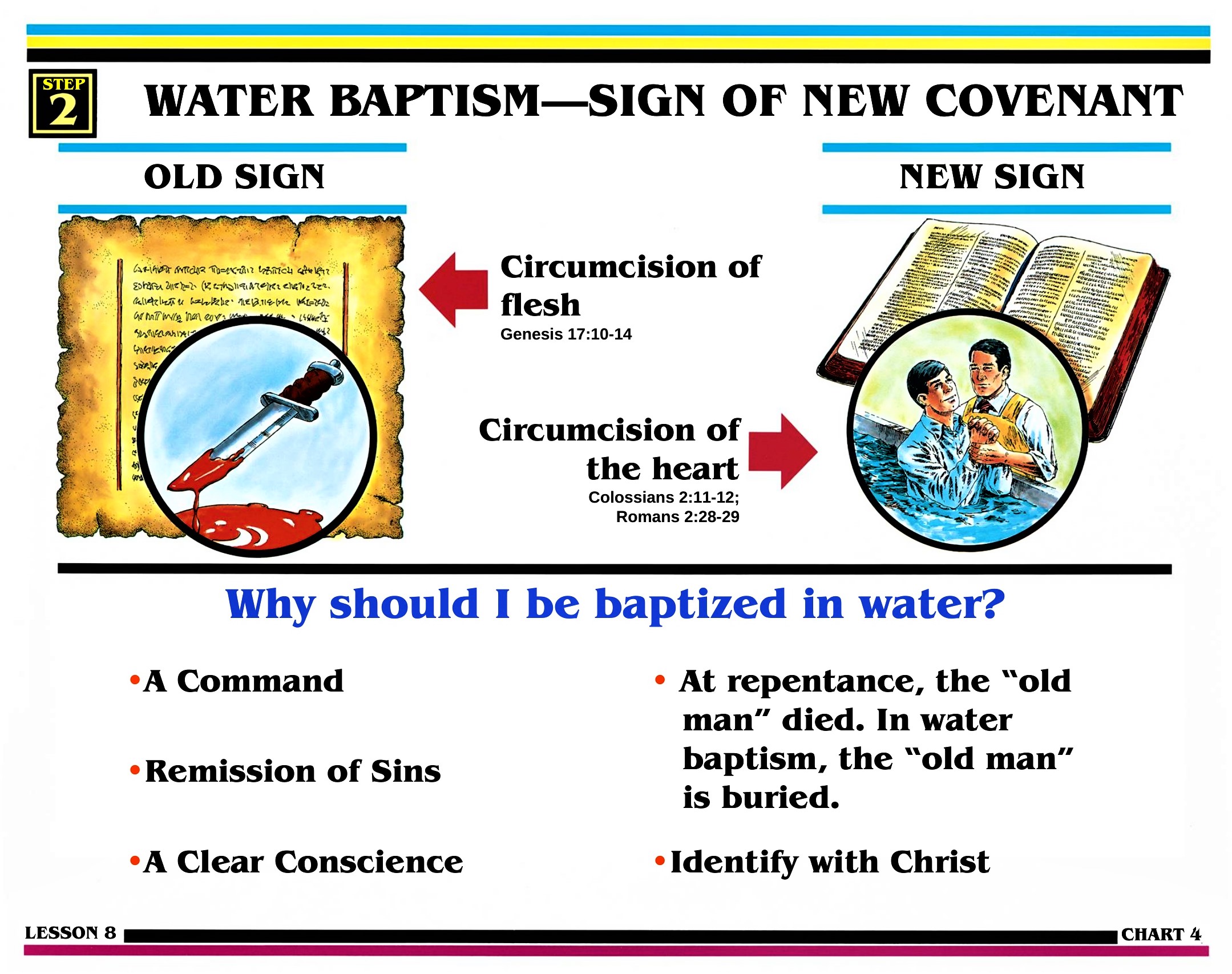
Chart Objective:
To examine the rite of initiation for God’s new covenant. Circumcision of the flesh is replaced with a circumcision of the heart. The “old man” that died at the altar of repentance must now be buried.
Chart Outline:
A. Old sign—circumcision of flesh
B. New sign—circumcision of the heart
C. Why should I be baptized in water?
A. Old sign—circumcision of flesh
Genesis 17:10-14
Of all the covenants between God and men, the one most highly honored by the Jews was that made with Abraham. Why do you suppose this is true? Primarily because this covenant required implicit faith and belief in God’s Word.
Accompanying this covenant was a very specific ritual:
“He that is born in thy house, and he that is bought with thy money, must needs be circumcised: and my covenant shall be in your flesh for an everlasting covenant” (Genesis 17:13).
Circumcision was a visible mark in the male reproductive organ that a Jewish male had been separated unto God. Unless this ceremony were performed, men could not become part of the covenant community. Without circumcision it was impossible to enjoy Abraham’s blessings.
However, on the Day of Pentecost, the sign that one had entered into covenant was replaced with a new identification mark.
B. New sign—circumcision of the heart
Romans 2:28-29; Colossians 2:11-12
While natural Israelites were circumcised in the flesh, spiritual Israelites are circumcised “in the heart”:
“In whom also ye are circumcised with the circumcision made without hands, in putting off the body of the sins of the flesh by the circumcision of Christ: buried with him in baptism, wherein also ye are risen with him through the faith of the operation of God, who hath raised him from the dead” (Colossians 2:11-12).
“For he is not a Jew, which is one outwardly; neither is that circumcision, which is outward in the flesh; but he is a Jew, which is one inwardly; and circumcision is that of the heart, in the spirit” (Romans 2:28-29).
Most of Peter’s audience at Pentecost were familiar with John’s preparatory water baptism in the Jordan River. But this “new” baptism was to be the initiating rite of Christ’s new covenant.
Nowhere in the New Testament do we find a ceremony conducted that would make God and man blood-covenant partners—except for water baptism.
Stressing the importance of quickly being baptized correlates with the command of circumcision under the Old Covenant. Abraham circumcised the men of his household—the same day (Genesis 17:23)!
In Mark’s recording of the great commission, Jesus commanded:
“He that believeth and is baptized shall be saved” (Mark 16:16).
In Samaria, Philip baptized men and women as soon as they became believers (Acts 8:12). The Ethiopian eunuch requested baptism as soon as he believed the gospel (Acts 8:36-38).
Saul of Tarsus complied with baptism following Ananias’ instructions (Acts 9:18).
Peter commanded the Gentile believers at Cornelius’ home to be baptized (Acts 10:48).
When the Philippian jailer inquired about salvation, Paul and Silas baptized his entire family that same night (Acts 16:30-33).
Prompt baptismal practices are clearly illustrated in at least nine instances in the Book of Acts. As soon as believers responded to the gospel message, instruction was given and baptism followed within a few hours of conversion—never more than a few days.
Such expressions as “that same day,” “why tarriest thou?” “the same hour of the night,” and “straightway” describe the urgency of this ceremonial induction. The New Covenant initiating rite seemed no less important than the Old Covenant rite of circumcision!
The specific mode of baptism was always immersion. It was described: a “burial” (Colossians 2:12); they “went down into the water” and came “up out of the water” (Acts 8:38-39); and “went up straightway out of the water” (Matthew 3:16).
Even the Greek word baptize means “to dip something into a fluid and then take it out again.”
“Sprinkling” began in ancient church history for the purpose of baptizing infants. However, all the prerequisites for baptism exclude babies. A person must acknowledge and confess his sins and understand the message of Jesus’ death, burial and resurrection to be eligible for salvation. Since infants are incapable of being taught, repenting or believing, they could not qualify for baptism.
C. Why should I be baptized in water?
Water baptism has a most important part in the plan of salvation. Jesus commanded His disciples to baptize all converts (Matthew 28:19; Mark 16:16). On the Day of Pentecost, Peter told the multitude that after they repented they were to be baptized (Acts 2:38). Wherever the disciples preached, they obeyed the command of the Lord Jesus by baptizing those who believed the gospel and repented of their sins (Acts 2:41; 8:12, 16, 36-39; 9:18; 10:47-48; 16:15, 33; 19:3-5; 22:16). Peter commanded the Gentiles in Caesarea to be baptized (Acts 10:48), as well as the Jews in Jerusalem (Acts 2:38).
Since God has included water baptism in the plan of salvation, every believer must be baptized. To say that baptism is not necessary for salvation is to speak against God’s plan and command. Disobedience will bring destruction (II Thessalonians 1:8).
Remission of sins comes from faith in Jesus Christ, repentance, and water baptism. John the Baptist preached repentance and he baptized converts for the remission of sins (Mark 1:4; Luke 3:3). Jesus told His disciples that “Whose soever sins ye remit, they are remitted unto them; and whose soever sins ye retain, they are retained” (John 20:23). He did not mean that the disciples could forgive sins, but that they could effect forgiveness in repentant sinners. On the Day of Pentecost, Peter said, “Repent, and be baptized every one of you in the name of Jesus Christ for the remission of sins” (Acts 2:38).
Moreover, repentance is necessary to effect remission. It should be noted that repentance and water baptism are inseparable companions, each depending upon the other to bring a sinner to God. John the Baptist baptized “with water unto repentance” (Matthew 3:11; Mark 1:4; Luke 3:3). Jesus connected repentance with remission of sins in His final instructions to His disciples (Luke 24:47) and His instructions were echoed by Peter on the Day of Pentecost (Acts 2:38). Without repentance, water baptism is merely an empty symbol. But with repentance, water baptism remits sins.
The apostle Peter mentioned another reason for water baptism—to attain a clear conscience (I Peter 3:21). When we are baptized, we are buried with Christ (Romans 6:3-4), from which we are to rise to walk in resurrection life (the Spirit). In this way, baptism is the means by which we leave our sins behind, thus removing any condemnation. (See Romans 8:1.) “For as many of you as have been baptized into Christ have put on Christ” (Galatians 3:27). At Paul’s baptism, Ananias asked this question: “And now why tarriest thou? arise, and be baptized, and wash away thy sins, calling on the name of the Lord” (Acts 22:16)
Jesus’ blood alone cleanses from sin, and water baptism is for the remission of sin. The blood and the water agree (I John 5:8).
“Unto him that loved us, and washed us from our sins in his own blood” (Revelation 1:5
When we are baptized we identify with the death, burial, and resurrection of Jesus Christ.
“Therefore we are buried with him by baptism into death: that like as Christ was raised up from the dead by the glory of the Father, even so we also should walk in newness of life. For if we have been planted together in the likeness of his death, we shall be also in the likeness of his resurrection” (Romans 6:4-5).
What a blessing that we can be baptized into Jesus Christ! Our sins are forgiven, condemnation is removed, and we are identified with our Savior, the Lord Jesus Christ!