The Mission of Jesus Christ, The Son of God
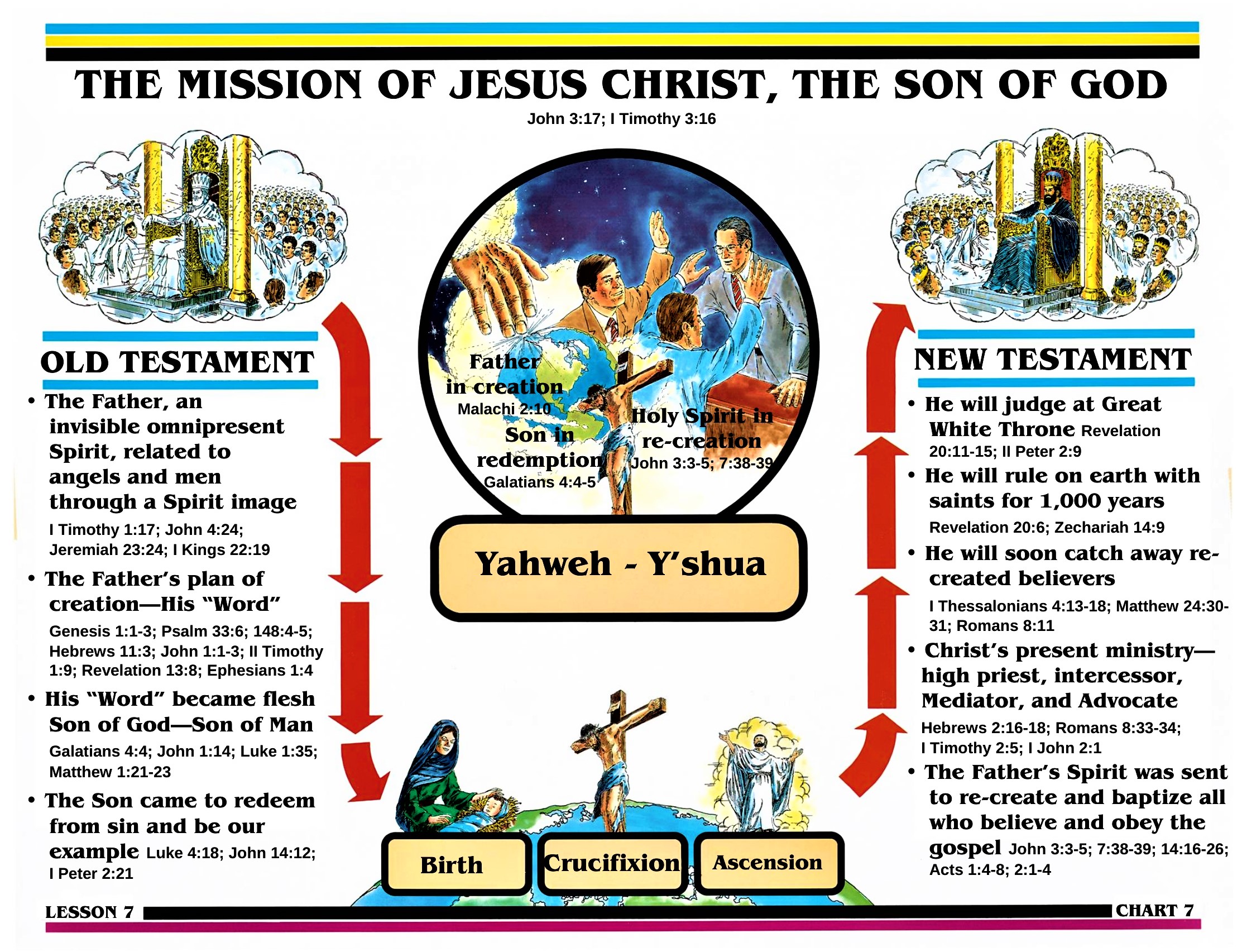
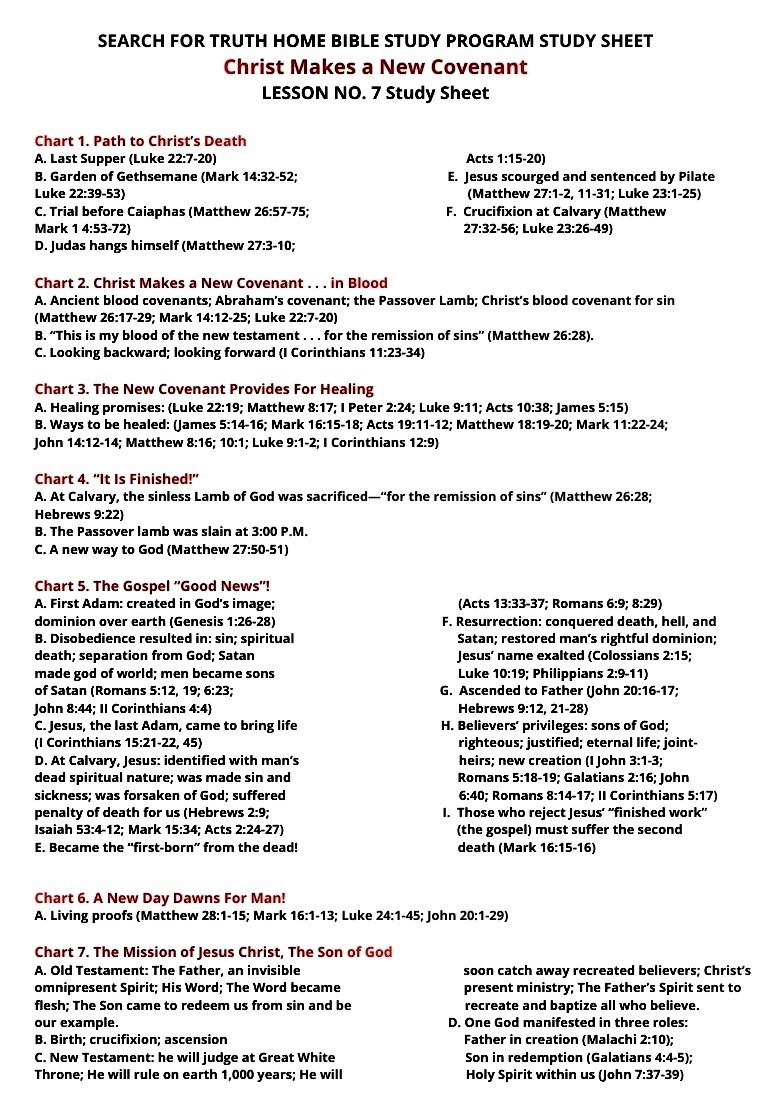
Chart Objective:
To explain that Jesus Christ is the fleshly body God made for Himself to fulfill the redemptive plan. One God has unveiled Himself in three distinct roles—as Father in creation, Son in redemption, and the Holy Spirit dwelling in the hearts of believers.
Chart Outline:
A. Old Testament
B. Birth—Crucifixion—Ascension
C. New Testament
D. One God manifested in three roles
A. Old Testament
Who was Jesus Christ? This question still puzzles as many today as during the time of His earthly ministry. Many still believe He was only a great teacher. Some consider Him a prophet of God, while others believe He was a mere man. Truthfully, He was both God and man.
“In the beginning was the Word, and the Word was with God, and the Word was God” (John 1:1).
On numerous occasions throughout the Bible, God would appear to man. The Old Testament saints could actually see God in visible form. This form was the Word in John 1. Sometimes when the Word appeared, the Scripture would call Him the “angel of the Lord.” On several occasions, it called Him a man, which is no surprise, being man was made in His image. Many people call these appearances “theophanies,” but when the fullness of time had come, God needed a body with flesh and blood to redeem mankind. It was here the Holy Ghost overshadowed Mary, placing seed within her womb. The results: a child was born, and because the Holy Spirit was His Father, He was the Son of God, and because Mary was His mother, He was the Son of Man.
“And the Word was made flesh, and dwelt among us” (John 1:14).
The God of heaven came to live in a human body on earth!
“Who, being in the form of God, thought it not robbery to be equal with God: but made himself of no reputation, and took upon him the form of a servant, and was made in the likeness of men: and being found in fashion as a man, he humbled himself, and became obedient unto death, even the death of the cross” (Philippians 2:6-8).
“For in him dwelleth all the fulness of the Godhead bodily. And ye are complete in him, which is the head of all principality and power” (Colossians 2:9-10).
B. Birth . . . Crucifixion . . . Ascension
God came to earth in a human body! The “Incarnation” (God clothing Himself with flesh) was a totally new and different manifestation of God. Humanity had mingled with divinity in the womb of Mary to produce a man, truly human, yet truly God. With His divine nature, Jesus could say, “I am God!” and be absolutely correct.
Jesus’ human body was of created matter from His mother. But from His Father’s side, He was God Himself. This merger of the Word and humanity produced the Son of God-Son of Man.
As the Son of God, Jesus was without the sinful nature of Adam. At the same time, He was subject to the same temptation as others. However, He lived a sinless life.
The key to understanding God is the fact that divinity and humanity are united in the person of Jesus Christ, making Him both God and man. This newborn Son was actually “God with us”!
“Behold, a virgin shall conceive, and bear a son, and shall call his name Immanuel” (Isaiah 7:14).
“And they shall call his name Emmanuel, which being interpreted is, God with us” (Matthew 1:23).
Jesus is all the fullness of the Godhead
bodily. But His invisible Spirit could not be
quantitatively contained in a small body.
The Spirit Who was in Christ was also the
Spirit Who filled the universe.
Being both God and man, Jesus is composed of divine and human natures and is an offspring of each. When we speak of Him as God, we refer to His divine manifestation. When we speak of the Son of Man, we refer to His human manifestation. Not two persons, but two natures—humanity and divinity— dwelled in Jesus side by side.
As man, He was born as an infant (Matthew 1:23-25); yet He was the mighty God (Isaiah 9:6).
As man, He increased in wisdom (Luke 2:52); but as God, He knew all things (John 21:17).
As man, He grew hungry (Matthew 4:2); but as God, He fed the multitudes (Matthew 14:19-21).
As man, He became a servant (Philippians 2:7); but as God, He is the King of kings (Revelation 19:16).
As man, He came to live on earth (John 1:14); as God, He created the earth (Colossians 1:16-17).
As man, He prayed (Luke 22:44); as God, He answers prayers (John 14:13-14).
As man, He became the sacrifice for sin (Hebrews 9:26); as God, He forgave sin (Mark 2:5-7).
As man, He suffered and died (John 19:30); as God, He emerged from the grave victorious (Luke 24:1-6)!
Isaiah’s description clearly explains the dual nature of God:
“Unto us a child [Humanity] is born, unto us a son [Humanity] is given . . . and his name shall be called . . . The mighty God [Divinity], The everlasting Father [Divinity]” (Isaiah 9:6).
To accomplish redemption, the man,
Jesus, became sin and sickness when He
assumed man’s dead spiritual (sinful)
nature (Isaiah 53:4-7; II Corinthians 5:21).
Having satisfied the claims of justice, He arose triumphantly to conquer Satan, death, and hell (Colossians 2:15; Hebrews 2:14)!However, His ascension back to heaven did not end Jesus’ work. He performs an equally great ministry at the throne of God!
C. New Testament
Having completed redemption, Christ
ascended to heaven’s throne in His glorified
body. Paul clearly summed up God’s
earthly mission in one brief verse:
“And without controversy great is the mystery of godliness: God was manifest in the flesh, justified in the Spirit, seen of angels, preached unto the Gentiles, believed on in the world, received up into glory” (I Timothy 3:16).
Before He left, Christ spoke of another divine manifestation that would shortly be introduced to His waiting disciples. This manifestation would replace His earthly presence.The Holy Spirit returned to indwell believers. The baptism of the Holy Spirit was the long-awaited promise God had especially designed to equip and empower all who believed and trusted in Him. But this powerful new manifestation could not begin until Jesus had been glorified and ascended to heaven.
“(But this spake he of the Spirit, which they that believe on him should receive: for the Holy Ghost was not yet given; because that Jesus was not yet glorified.)” (John 7:39).
Because Christ emphasized that “I will come to you” (John 14:18), we know that the Holy Spirit, or Comforter, is the same Spirit Who dwelled in Jesus.
In man’s mortal “death-bound” condition, the future was hopeless. But we were not left comfortless. The Holy Spirit has come to permanently reside in men’s spirits!
“And I will pray the Father, and he shall give you another Comforter, that he may abide with you for ever; . . . I will not leave you comfortless: I will come to you” (John 14:16, 18).
“But the Comforter, which is the Holy Ghost, whom the Father will send in my name, he shall teach you all things, and bring all things to your remembrance, whatsoever I have said unto you” (John 14:26).
What is the present ministry of Christ? What has He been doing the past two thousand years? When He returned to heaven’s throne, He began to live for us as surely as He had died for us! Few believers have a clear concept of Jesus’ present ministry.
He is now on the throne as our high priest to minister in heaven’s sanctuary:
“We have such an high priest, who is set on the right hand of the throne of the Majesty in the heavens; a minister of the sanctuary, and of the true tabernacle, which the Lord pitched, and not man” (Hebrews 8:1-2).
“Sanctuary” in the Greek means “holy things.” In which “holy things” does Christ minister? Our prayers and worship. We do not know how to pray as we should (Romans 8:26), so He transforms our crude petitions and makes them beautiful to the Father. Every prayer and worship is accepted when presented in the name of Jesus.
To sit at the Father’s “right hand,” or the place of power and authority, refers to Jesus’ role as the “Mediator” between God and man. Jesus fills this office because of His unique role—the union of God and man. Who could better represent humanity before God?
“For there is one God, and one mediator between God and men, the man Christ Jesus” (I Timothy 2:5).
A mediator is one who negotiates between two opposing persons to peacefully settle their differences. Jesus is the Mediator between sinful men and a holy God. His task is to make men holy and without blemish so they can approach God.
Since the fall of man, no one had approached God without a bleeding sacrifice. But since Jesus has sacrificed His righteous blood, those who believe in Him and enter into His covenant are legally declared righteous and given eternal life.
As Mediator, Jesus introduces the unsaved person to God. But for the believer, He becomes our “intercessor”—one who pleads in favor of another.
Why should God’s child need an intercessor? Because our minds must be renewed. Before the new birth, we lived under Satan’s rule; our minds must be transformed to comprehend our privileges and responsibilities as sons of God.
While the new birth is instantaneous, renewing of the mind is a gradual growth that comes by studying and meditating on the Word.
Through ignorance, we often say and do things that are displeasing to the Father. When attacked by demon spirits, we need an ally. Until we fully learn our authority, the enemy may cause us to stumble. These situations call for Christ’s intercession!
“Christ . . . who is . . . at the right hand of God, who also maketh intercession for us” (Romans 8:34).
No one can condemn or lay anything to the charge of God’s child. He has been declared righteous! Jesus is making intercession for him!
We come to the Father through Christ, our Mediator. We enjoy the sweet fellowship of our intercessor. But we also need an “Advocate”—One who defends or gives legal counsel in a court of justice.
Many believers would be victorious Christians today had they known of Christ’s role as Advocate. At times we break fellowship with God. Perhaps we yield to one of Satan’s temptations. Or our unrenewed minds may prompt us to disobey or become impatient. How shall we handle the condemnation that results from our failures? What a sad plight if we had no advocate!
John wrote,
“My little children, these things write I unto you, that ye sin not. And if any man sin, we have an advocate with the Father, Jesus Christ the righteous” (I John 2:1).
God’s method for maintaining fellowship when we sin is to confess:
“If we confess our sins, he is faithful and just to forgive us our sins, and to cleanse us from all unrighteousness” (I John 1:9).
His ministry as Advocate is effective only when we are willing to repent. The moment we confess, He takes our case before the Father. Then we are forgiven and cleansed— as though we had never sinned.
Sacrificial animal blood under the Old Covenant merely “covered” man’s sin. Jesus’ blood totally eradicates it. Once cleansed by His blood, every stain is removed.
Knowing Christ as an Advocate, or legal counsel, is absolutely essential to maintaining our relationship with God. Broken fellowship should last no longer than the time it takes to ask forgiveness and make restitution.
Never forget that we always have a “man” at the throne, representing us before the Father. Because Jesus is there, we are safe and secure!
At the end of this age, Christ will catch away saints and give rewards at His judgment seat.
As King of kings He returns with saints and the armies of heaven. Then we will enjoy a 1,000-year rule on earth with Jesus.
From the Great White Throne, Christ will then judge the wicked dead. Finally, His throne will be transferred to headquarters in the New Jerusalem, with a new heaven and new earth (Revelation 21 and 22).
D. One God manifested in three roles
Malachi 2:10; Galatians 4:4-5;
John 7:37-39
By examining the Scriptures on the chart, we understand that one God has manifested Himself to angels and men since the beginning of time. Different forms and roles, yet the same one God!
Confusion is dispelled when we understand that there are three manifestations of one God. The “Father,” an invisible Spirit, is a holy, righteous, loving, all-powerful God Who loves and cares for His creation.
The role of the “Son” is the God-Man Who redeemed us from sin. In His foreknowledge, God knew about the fall of man. Before Adam sinned, He had planned a second manifestation of Himself for the purpose of redemption (II Timothy 1:9-10; I Peter 1:20; Revelation 13:8). His is the only body that can be seen.
The “Holy Spirit” is the same invisible Spirit Who manifested Himself in the human body of Jesus, and now lives within believers. This manifestation equips and empowers saints for service.
There have never been three persons, but three roles performed by one God. The invisible Father has always manifested one visible form. He expressed Himself in temporary “theophanies” in Old Testament times. But when it was time to redeem man’s sins, “the Word was made flesh, and dwelt among us” (John 1:14), in the body of Jesus Christ.
Our next lesson details how God finally was united with His highest and most beloved created being—man! Because of Calvary, all the necessary arrangements had been made for man to really live!