The Gospel—“Good News”!
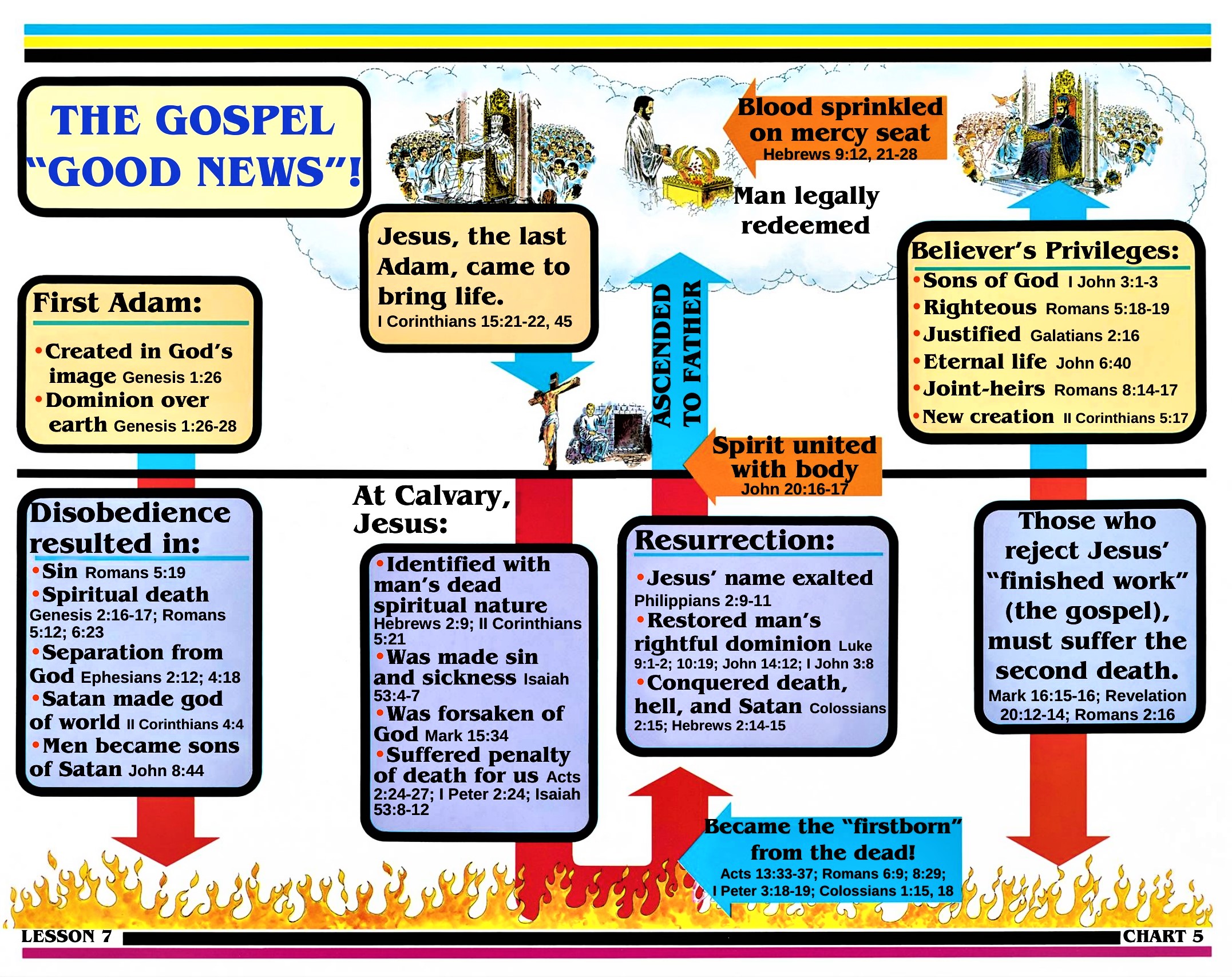
Chart Objective:
To explain how the “good news” of Jesus’ death, burial and resurrection, when received by faith, has power to bring salvation. The basis for understanding the gospel is identifying ourselves with the first Adam, then with Christ, the last Adam.
Chart Outline:
A. First Adam
B. Disobedience resulted in:
C. Jesus, the last Adam, came to bring life
D. At Calvary, Jesus:
E. Became the “first-born” from the dead!
F. Resurrection
G. Ascended to Father
H. Believers’ privileges:
I. Those who reject Jesus’ “finished work”
must suffer the second death
A. First Adam
Genesis 1:26-28
The disciples saw the scourging of Christ, the nails driven into His hands and feet and heard His words, “My God, my God, why hast thou forsaken me?”
They saw the embalming, the burial, the resurrected body of Christ, and saw Him ascend into heaven. Yet they did not understand.
Only the Holy Spirit could reveal the complete redemption story of Jesus’ death, burial and resurrection. Not until Pentecost when the Holy Spirit came to guide them into all truth could they fully understand.
God gave to Paul the revelation of the finished work of redemption and the present ministry of Christ in heaven. Unknown to other generations, Paul called this mystery of Christ “my gospel” (Romans 16:25-26; Ephesians 3:1-12). Paul explained this “mystery” by comparing the first Adam with Jesus, the “last Adam.”
The first Adam, created in God’s image, was given authority and dominion over the earth (Genesis 1:26-28). The original purpose was that God’s world should be governed and subdued by those who themselves were governed by God.
B. Disobedience resulted in:
Romans 5:12, 19; 6:23; Genesis 2:16-17;
Ephesians 2:12; 4:18; II Corinthians 4:4;
John 8:44
When Adam chose to be like God rather than remaining under His sovereignty, his sin resulted in spiritual death (Romans 5:12, 19; 6:23; Colossians 1:21).
God did not actually abolish man’s dominion. However, when separated from God, man lost the ability and understanding to properly exercise dominion over the earth. Eventually he forfeited his rulership and Satan became “god of this world” (II Corinthians 4:4).
By removing himself from God’s authority, man also lost control over himself. Soon he became captive by what God’s Word calls “the world, the flesh, and the devil.”
Worse still, when Adam sinned, he became a partaker of Satan’s nature and joined his family. Men became sons of Satan and like their new father, the devil (John 8:44).
Now a spirit criminal, the penalty of man’s sin was hell. After physical death, he awaits the White Throne judgment. Hell was not prepared for man, but it became a necessary confinement for rebels.
Although not literally with Adam in the garden, legally we were there. The death nature thrust upon the first man was given to all:
“Wherefore, as by one man sin entered into the world, and death by sin; and so death passed upon all men, for that all have sinned . . . Death reigned . . . even over them that had not sinned after the similitude of Adam’s transgression . . . by the offence of one judgment came upon all men to condemnation” (Romans 5:12, 14, 18).
Man had a real problem. He needed to become righteous—to have a right relationship with God as if he had never sinned. Because God is just and fair, He could not overlook Adam’s transgression. Nor could He fail to treat Satan with justice. Since Adam had forfeited his rulership, Satan had been given a legal right to rule creation. Our enemy then must be stripped of that authority with fairness.
Since God’s standard of righteousness could not be lowered—even for His beloved humanity—those Who reject His plan of redemption must themselves suffer the death penalty of sin.
To redeem man and restore life, someone must pay his penalty. Then man must be given spiritual weapons of defense and offense against his enemy and acquire authority to conquer him in valid combat.
Because the death nature had afflicted man’s physical body with pain and disease, he needed authority to claim healing and health.
Redemption must also include a “new creation.” God’s life and righteousness must replace death, and man must feel at home with God once more.
What awesome conditions were required to free man from his painful bondage! Only God’s grace could provide a remedy!
C. Jesus, the last Adam, came to bring life
I Corinthians 15:21-22, 45
To legally redeem fallen man from the death nature and Satan’s dominion, Deity must join with humanity. A mediator, or “go-between,” fully God, yet fully man, must peacefully settle the conflict between man and God.
Had God come to earth as a child born of two human parents, He would have been a child of Satan with God dwelling in Him. The sin problem could only be settled by One over whom Satan had no legal authority.
Man’s Redeemer must be the “Incarnation” (the union of God and man) promised in Genesis 3:15. The seed of the woman (Jesus Christ) must bruise Satan’s head.
Jesus was man in the fullest sense, yet He differed from others. He did not belong to the realm of spiritual death:
“For as the Father hath life in himself; so hath he given to the Son to have life in himself” (John 5:26).
“The prince of this world cometh, and hath nothing in me” (John 14:30).
Christ was the first man after Adam’s transgression to possess God’s life. Consequently,Satan, disease, and death had no dominion over Him. Christ’s body was like that of Adam’s before his spirit died.
Satan was compelled to obey Christ’s every command. Demons, disease, and sickness fled at His Word. Therefore, it was not for Himself that Jesus conquered Satan, but for man!
Not once during His entire lifetime did Jesus commit a sin. Such authority and power over Satan was foreign to men. He walked as Adam should have walked, doing the will of the Father.
In a sense, Jesus had identified with men at birth—but not completely. Christ did not have our spiritually dead nature. But at Calvary, all was changed.
D. At Calvary, Jesus:
Hebrews 2:9; II Corinthians 5:21; Isaiah 53:4-7; Mark 15:34; Acts 2:24-27; I Peter 2:24; Isaiah 53:8-12 To fulfill the purpose for which He had come into the world, Jesus became sin:
“For he hath made him to be sin for us, who knew no sin; that we might be made the righteousness of God in him” (II Corinthians 5:21).
“That he by the grace of God should taste death for every man” (Hebrews 2:9). The sin nature was transferred to Him when Christ identified with man’s dead spiritual nature.
He was made sin and sickness for our sakes. In God’s mind, Christ was not hanging on the cross, but the human race! That’s why each of us may say with Paul, “I [was] crucified with Christ” (Galatians 2:20).
When the sentence of hell that had passed upon each of us came upon Jesus, He was forsaken of God. On the cross He cried,
“My God, my God, why hast thou forsaken me?” (Mark 15:34).
As our substitute, Jesus suffered the penalty of death for us.
E. Became the “first-born” from the dead!
Acts 13:33-37; Romans 6:9; 8:29;
I Peter 3:18-19; Colossians 1:15, 18
In hell, the One Who had been made sin for us passed from death into life! Because Jesus had acquired mankind’s death by taking his sin, His body had to be quickened, or brought to life.
Paul said that Christ became the “firstborn” of the dead:
“Thou art my Son, this day have I begotten thee” (Acts 13:33-37 and Hebrews 1:1-6). “That he might be the firstborn among many brethren” (Romans 8:29).
“Who is the image of the invisible God, the firstborn of every creature: . . . And he is the head of the body, the church: who is the beginning, the firstborn from the dead” (Colossians 1:15, 18).
Peter added this note:
“For Christ also hath once suffered for sins, the just for the unjust, that he might bring us to God, being put to death in the flesh, but quickened by the Spirit” (I Peter 3:18).
The man, Jesus Christ, was the first to be brought to life, the first to break death’s dominion. His victory was our victory. Because His Spirit was “reborn,” ours can be also!
Once Jesus explained the “new birth” of the human spirit to Nicodemus. But spiritual concepts seemed incredible to the Jewish ruler. Not until after Jesus’ resurrection could men experience a life-giving encounter with Deity!
F. Resurrection
Colossians 2:15; Hebrews 2:14-15;
Luke 9:1-2; 10:19; John 14:12; I John 3:8;
Philippians 2:9-11
Evidently, Satan and his demon hosts had rejoiced to see Jesus’ cold, lifeless body. How they must have danced with glee as they watched Him die on the cross in shame and agony.
But suddenly, a cry came forth from God’s throne: “It is enough! The demands of justice have been met! The sin problem is forever settled!”
When that cry echoed through the dark regions of the doomed, Jesus arose triumphantly to face Satan. Paul described the bitter combat:
“And having spoiled [disarmed] principalities and powers, he made a shew of them openly, triumphing over them in it” (Colossians 2:15).
“That through death he might destroy [paralyze] him that had the power of death, that is, the devil; and deliver them who through fear of death were all their lifetime subject to bondage” (Hebrews 2:14-15).
Satan was left paralyzed, whipped and defeated. What a stupendous victory! After conquering principalities and powers of darkness, Jesus stood an undisputed victor over three worlds: heaven, earth and hell!
Christ’s victory gave man complete freedom from Satan’s authority and restored man’s rightful dominion.
Jesus clearly stated what He had come to do for us:
“Then he called his twelve disciples together, and gave them power and authority over all devils, and to cure diseases. And he sent them to preach the kingdom of God, and to heal the sick” (Luke 9:1-2).
“Behold, I give unto you power to tread on serpents and scorpions, and over all the power of the enemy: and nothing shall by any means hurt you” (Luke 10:19).
“He that believeth on me, the works that I do shall he do also; and greater works than these shall he do; because I go unto my Father” (John 14:12).
“For this purpose the Son of God was manifested, that he might destroy the works of the devil” (I John 3:8).
No longer subject to bondage, we are now Christ’s “fellow workers.” He works along beside us as we proclaim the gospel (I Corinthians 3:9; II Corinthians 6:1). How else could we establish His kingdom and destroy Satan’s domain? Christ has truly come to restore to man what was lost in the Fall!
Because the man, Jesus Christ, was victorious over Satan, He was elevated to the loftiest possible position—“Lord” over all! Peter proclaimed,
“Therefore let all the house of Israel know assuredly, that God hath made that same Jesus, whom ye have crucified, both Lord and Christ” (Acts 2:36).
To announce the supreme authority and power invested in our Conqueror over Satan,
“God also hath highly exalted him, and given him a name which is above every name: that at the name of Jesus every knee should bow, of things in heaven, and things in earth, and things under the earth; and that every tongue should confess that Jesus Christ is Lord, to the glory of God the Father” (Philippians 2:9-11).
By conquering the principalities and powers of darkness, Jesus’ name has been exalted. His name is invested with the highest authority and power. Fresh from the grave, He announced,
“All power is given unto me in heaven and in earth” (Matthew 28:18).
Why was Jesus’ name highly exalted? For the church’s use! We can defeat our enemy by merely uttering His name! The name of Jesus is our power of attorney. When we invoke His name, Jesus goes into action for us—the same as if He were here personally.
G. Ascended to Father
John 20:16-17; Hebrews 9:12, 21-28
The last segment of redemption was a
legal formality. After Jesus’ Spirit reunited
with His body that had lain for three days
in the tomb, He was completing that mission
when He spoke to Mary Magdalene in
the garden. Jesus said to her,
“Touch me not; for I am not yet ascended to my Father: but go to my brethren, and say unto them, I ascend unto my Father, and your Father; and to my God, and your God” (John 20:16-17).
While performing the role of high priest, He could not be touched by human hands. But later that afternoon, the bewildered disciples were invited to handle Him and see that He had actually arisen from the dead (Luke 24:36-39).
The high priest of the Old Covenant went annually into the Tabernacle with the blood of bulls and goats to make an atonement for Israel’s sin. But when Jesus sprinkled His perfect, sinless blood on heaven’s mercy seat the claims of justice were fulfilled and man was legally redeemed!
Satan’s dominion had been broken, officially restoring man to fellowship with his Maker!
H. Believers’ privileges:
I John 3:1-3; Romans 5:18-19;
Galatians 2:16; John 6:40;
Romans 8:14-17; II Corinthians 5:17
Why does the natural man live in bondage to sin and rebellion toward God? Because Satan is his father and lord. All human suffering is the result of that dominion.
Therefore, man needs a new Father and a new Lord of love. Breaking Satan’s authority can only be accomplished by turning to a new Ruler.
In repentance, we turn from Satan’s
rule to the lordship of Christ. At an altar,
or place of commitment, we surrender our
independence and commit our lives to
Him.
As all mankind must identify with Adam’s transgression, so must we identify with the last Adam’s redemptive work. Every individual was legally redeemed by Jesus’ blood, but each person must understand and claim that privilege.
Paul taught that while we were not literally hanging on the cross with Christ, we legally were crucified, buried, and rose again with Him:
“We are buried with him by baptism into death . . . our old man is crucified with him . . . Now if we be dead with Christ, we believe that we shall also live with him . . . Likewise reckon ye also yourselves to be dead indeed unto sin, but alive unto God through Jesus Christ our Lord” (Romans 6:4, 6, 8, 11).
“And you, being dead in your sins . . . hath he quickened together with him” (Colossians 2:13).
“Even when we were dead in sins, hath quickened us together with Christ” (Ephesians 2:5).
What glorious privileges belong to those
who believe and obey the gospel message!
Having once been the sons of Satan, now
we can become sons of God (I John 3:1).
He makes us righteous (Romans
5:18-19); He justifies us (Galatians 2:16);
and He gives us eternal life (John 6:40).
We are made joint-heirs with Christ (Romans 8:14-17). Adam was God’s under-ruler, but the “new creation” shares the inheritance equally with Him. Old things are passed away and all things are become new (II Corinthians 5:17).
Redemption has been provided for all men—but someone must tell them. The same love that compelled Christ to go to Calvary must be demonstrated in His “new creation.” Because He laid down His life for us, we ought to lay down our lives for the brethren (I John 3:16).
Ambassadors of love will make us as anxious to win men as though we had personally died to provide redemption.
What a joyful message we have for an unsaved world! What “good news” is this story of redemption from death and Satan’s bondage!
I. Those who reject Jesus’ “finished work”
(the gospel) must suffer the second death
Mark 16:15-16; Revelation 20:12-14;
Romans 2:16
Identifying with the “last Adam” provides wonderful benefits on earth and eternal bliss in heaven. But rejecting Christ’s redemption
condemns us to an awful fate. The second death is eternal separation from God. Jesus revealed the importance of preaching and believing the gospel when He said:
“Go ye into all the world, and preach the gospel to every creature. He that believeth [the gospel] and is baptized shall be saved; but he that believeth not [the gospel] shall be damned” (Mark 16:15-16).
“In flaming fire taking vengeance on them that know not God, and that obey not the gospel of our Lord Jesus Christ: who shall be punished with everlasting destruction from the presence of the Lord” (II Thessalonians 1:8-9).
“What shall the end be of them that obey not the gospel of God? And if the righteous scarcely be saved, where shall the ungodly and the sinner appear?” (I Peter 4:17-18).
What power lies in this wonderful message! Captives can be set free by believing and obeying the “good news” of Jesus’ death, burial, and resurrection. But to reject or carelessly neglect it will bring certain judgment.