“It Is Finished!”
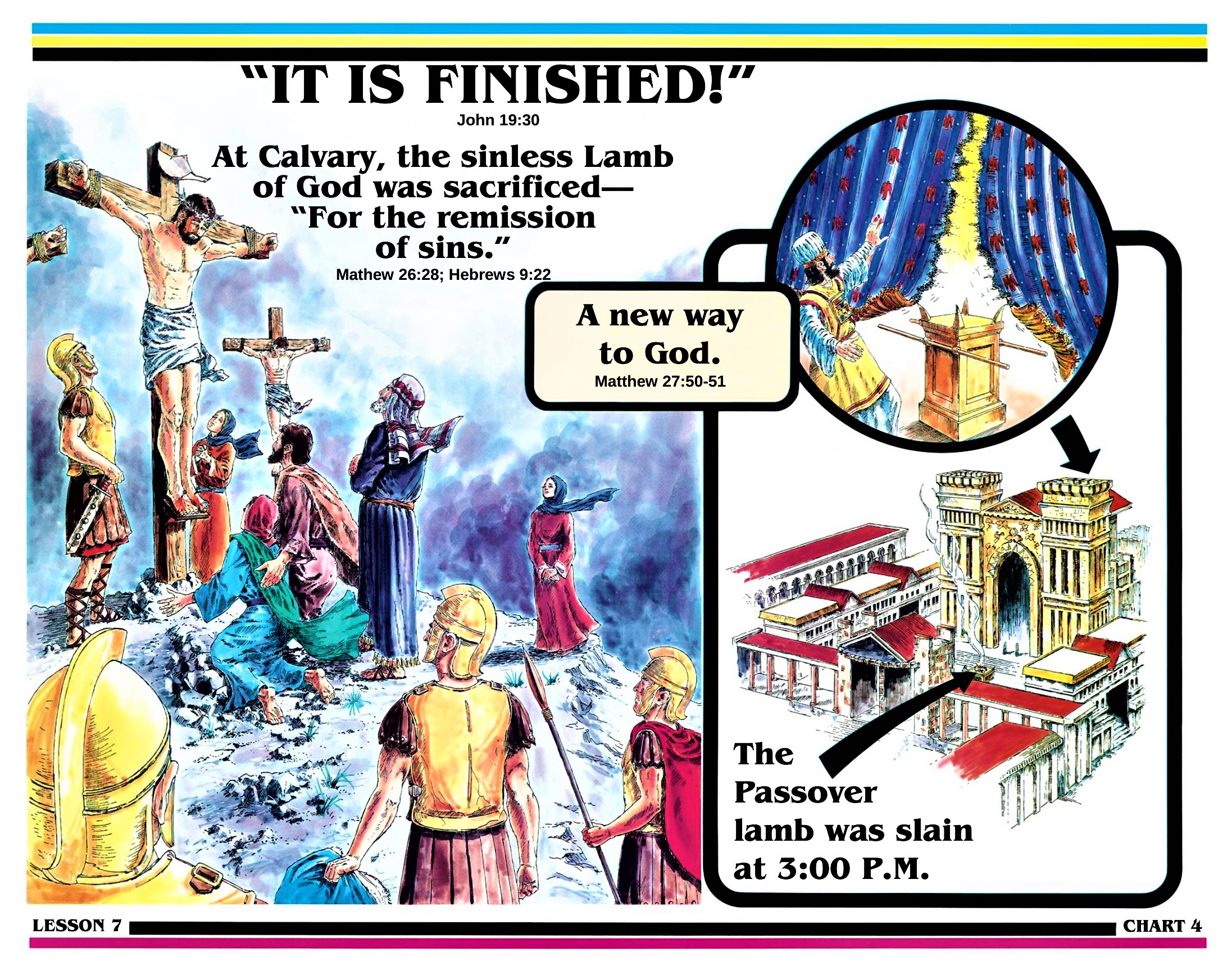
Chart Objective:
To study Calvary’s horrible torture and judgment which concluded the dispensation of law. At the precise moment the Passover lamb was slain in the Temple courtyard, our Lord, the perfect Lamb, offered His life! The torn Temple veil exposed a new and wonderful “direct” way into the presence of God!
Chart Outline:
A. “It Is Finished!”
B. The Passover lamb was slain at 3:00 P.M.
C. A new way to God
A. “It Is Finished!”
John 19:30
Both the wounds and the abnormal position of His body caused terrible pain. The slightest movement brought additional torture. High fever followed soon afterward.
Recent medical studies have found that when a person is suspended by his two hands, the blood sinks rapidly into the lower extremities. Within six to twelve minutes, blood pressure drops to fifty percent while the pulse rate doubles. As the heart is deprived of blood, fainting follows from poor circulation. Death by crucifixion is usually due to heart failure; however, victims often lingered for two to three days.
Dizziness, cramps, thirst, starvation, sleeplessness, raging fever and inflammation of untended wounds were part of the ghastly death (Keller, The Bible in History, pages 376-377).
From time to time, the misery could be eased by supporting oneself on the small rest attached to the vertical beam. This caused the blood to return to the upper half of the body.
When those in charge thought the victim had suffered sufficiently, the torture was ended by breaking the legs below the knees with a club. This meant that he could no longer ease his weight on the support and death came from heart failure.
At the top of Jesus’ cross a sign was posted. The same emblem hung on the criminal’s neck or the sign preceding him to the execution was affixed to the upper portion of the cross.
The title prepared by Pilate for Jesus’ cross was: “THIS IS JESUS THE KING OF THE JEWS.” It was written in three languages: Latin, the official language understood by soldiers and Romans; Greek, the current language of all classes; and Aramaic, the national language familiar to all Jews.
Soldiers gambled for His garments beneath the cross while Christ agonized in torment.
At first, the two criminals on either side joined the spectators in verbal abuse. But after a time, one rebuked the other for his revilings. They were suffering justly, but the Savior had done nothing wrong.
The more the repentant thief thought of the sinless One hanging beside him, the more he discerned that this was his Lord—the true King of the Jews. Turning, he said, “Lord, remember me when thou comest into thy kingdom.”
Jesus answered, “To day shalt thou be with me in paradise” (Luke 23:43).
By twelve noon, Jesus had been hanging on the cross for three hours. As nature mourned over the shameful scene, the taunts of Jesus’ enemies also ceased. For the next three hours they nervously watched without mocking.
Apparently John was the only disciple who witnessed the trial. When he heard Pilate’s final sentence, he must have hurried to tell the other disciples. As a final gesture of love, John came with Jesus’ mother and her friends just as they were crucifying the Lord.
When Jesus saw His grieving mother, He said, “Woman, behold thy son!” And to John, His dear friend, “Behold thy mother!” From that hour John cared for her.
In the last moments of the Savior’s suffering, He loudly cried, “Eli, Eli, lama sabachthani? that is to say, My God, my God, why hast thou forsaken me?” (Matthew 27:46). Why did He say those frightening words? The man, Christ Jesus, had become man’s substitute sin-offering and was being treated as if He had been guilty, though He had personally never sinned.
B. The Passover lamb was slain at 3:00 P.M.
At last the suffering was over. Jesus’ final words rang out, “It is finished! Father, into thy hands I commend my spirit.” And He bowed His head and died. What was finished? All the types, promises and prophecies of the Old Testament were now fully accomplished in Jesus Christ. Pilgrims were beginning to gather for evening prayers in the outer court. At three o’clock in the afternoon, at the very moment the Passover lamb was slain in the Temple courtyard, our Lord, the perfect Lamb, offered His life (Pax, In the Footsteps of Jesus, pages 208-209)! Animal sacrifices of the old Jewish law were now abolished—as well as explained. The true Passover Lamb had been slain! No longer would the blood of lambs be needed. The perfect sacrifice had been offered!
C. A new way to God
Matthew 27:50-51
While the paschal lambs were being killed in the Temple courts, the priests were offering incense in the Holy Place. The moment Jesus bowed His head and died, an awesome miracle occurred inside the Temple. The veil separating the Holy Place from the Holiest of Holies was suddenly ripped from top to bottom, exposing the sacred enclosure viewed only by the high priest once a year.
This veil was 60 feet long and 30 feet wide. Its thickness was the width of the palm of the hand. It was so heavy, not even an earthquake could have torn it apart. The direction of the tear showed that no human hand was responsible. This was an act of God, declaring that the legal dispensation was finished! The way into the glorious presence of the Most High was opened to all who would believe!
Only the priest offering the incense saw this comparatively private sign. But the next one was public! A mighty earthquake rum-bled its disapproval of the terrible crime committed.
When the Romans crucified a man, the body was left on the cross to rot. Sometimes birds swooped to pick at the flesh. Scavenger dogs often converged on the carcass. The body might end up in the smoldering fires of the city dump after days of exposure to the elements. But Jesus’ body was to be spared this barbarism. God was preparing people and events to express His love and meticulous plan!
Even God’s foes assisted with the preparations for Jesus’ burial. Scrupulous about their rituals, the Jewish religious leaders asked Pilate to allow the removal of the crucified men before the holy day celebrations began at dusk. Pilate granted their request, but to make certain the victims were dead before removal, their legs were to be broken.
Carrying out their orders, soldiers broke the legs of the thieves flanking Jesus, but they found the “King of the Jews” already dead. Thus, unwittingly, they fulfilled a prophecy by David that not one of Jesus’ bones would be broken (Psalm 34:20).
To make certain He was dead, a spear was thrust in Jesus’ side, from which flowed blood and water. What was the purpose of blood and water flowing from His wounded side? Zechariah had prophesied that He would be pierced:
“In that day there shall be a fountain opened to the house of David and to the inhabitants of Jerusalem for sin and for uncleanness” (Zechariah 13:1).
The fountain for sin was typified by Jesus’ blood; the fountain for uncleanness was typified by the water. Before the priest could offer a blood sacrifice, he must wash with water to remove all uncleanness. Christ’s death and the piercing of His side pointed toward the glorious day when our sins would be remitted— cleansed, sent away—by His blood and we would be baptized in water to effect that cleansing.