The New Covenant Provides For Healing
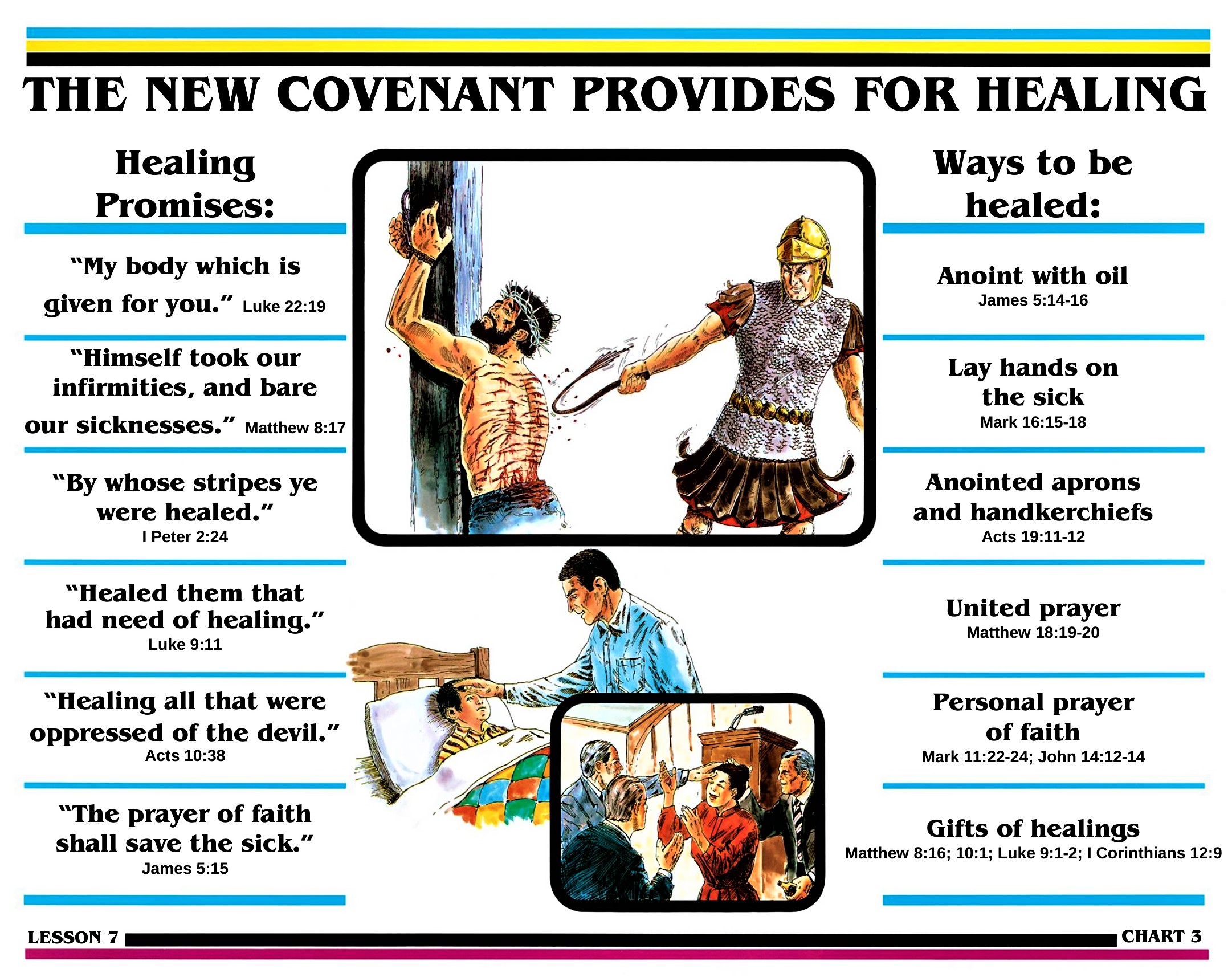
Chart Objective:
To examine the special privileges of healing available to every Christian believer because of the torturous, painful stripes of punishment Christ bore on His back.
Chart Outline:
A. The New Covenant Provides For Healing
B. Healing promises
C. Ways to be healed
A. The New Covenant Provides For Healing
Only one hope remained for Pilate to free himself from the responsibility of Christ’s death. Perhaps the inhuman Roman scourge would satisfy the people without a crucifixion
The order was given and apparently Pilate sat on the judgment seat while the command was executed.
Scourging Christ in hopes of pacifying the bloodthirsty mob was actually a double sentence! Jewish law specified that no “prolonged death” might be inflicted and that a criminal condemned to death must not also be scourged. But our Savior suffered both savage brutalities. Oh, what love!
Jewish law limited the stripes to forty (Deuteronomy 25:3). To prevent excessive punishment by a mistake in counting, the legal number was reduced by one (Freeman, Bible Manners and Customs, page 347).
However, the Roman scourging was more severe than the Jews’. There was no legal limit to the stripes a victim might endure.
The victim was tied to a post in front of the Praetorium and his bared back was flogged unmercifully. One particularly dreadful scourge made of cords and ox-hide leather was used to beat slaves. The whip was knotted with nails, sharp scraps of bone and heavy circles of bronze. Often the thongs ended with metal fish-hook spurs. Such an instrument of torture was called the “scorpion” (Freeman, Bible Manners and Customs, page 392).
Each lash cut deeper into the flesh as veins and entrails were laid open. Since there was no legal limit to the number of blows, death often resulted.
Dr. C. Truman Davis, who has studied crucifixion from a medical perspective, describes the Roman flagrum: “The heavy whip is brought down with full force again and again across the shoulders, back and legs. At first, the heavy thongs cut through the skin only. As the blows continue, they cut deeper into the subcutaneous tissues, producing first an oozing of blood from the capillaries and veins of the skin, and finally spurting arterial bleeding from vessels in the underlying muscles.
“The small balls of lead first produce large, deep bruises which are broken open by subsequent blows. Finally the skin of the back is hanging in long ribbons and the entire area is an unrecognizable mass of torn, bleeding tissue. When it is determined by the centurion in charge that the prisoner is near death, the beating is finally stopped” (McDowell, The Resurrection Factor, page 43).
We shudder from envisioning the inhuman torture inflicted upon our Savior. Yes, it is grisly, ghastly and nauseating. Yet we must never exclude the bloody details from this greatest love story. His blood purchased salvation and healing! Let us spare no details, gruesome as they are, lest it become less than real to us! We must be overwhelmed when contemplating God’s immeasurable love!
Looking back to the prophet Isaiah, we read his words with new wonder:
“But he was wounded for our transgressions, he was bruised for our iniquities: the chastisement of our peace was upon him; and with his stripes we are healed” (Isaiah 53:5).
Christ mentioned healing when instituting the new blood covenant the night of the Last Supper.
“Take, eat: this is my body, which is broken for you” (I Corinthians 11:24).
Isaiah tells us why His body was broken: By his stripes we are healed (Isaiah 53:5)!
As long as Israel kept her covenant terms, she prospered and enjoyed physical protection from pestilence and disease. Obedience to God’s law brought blessings—health, prosperity and success.
If the Old Covenant had such marvelous provisions for healing, what about the New Covenant? Its benefits are better!
“But now hath he obtained a more excellent ministry, by how much also he is the mediator of a better covenant, which was established upon better promises” (Hebrews 8:6).
The New Covenant exceeds the first one! If God wanted the children of Israel to be healthy, think what was planned for His “new creation”!
B. Healing promises
Luke 22:19; Matthew 8:17; I Peter 2:24;
Luke 9:11; Acts 10:38; James 5:15
The subject of healing has been quite controversial. Some teach that miracles were only for the apostolic era and are not for us today. Since healing is considered a miracle, it is not available.
However, a miracle is actually an intervention of God into the realm of natural laws or human activity. When God comes into immediate contact with men, a miracle is performed. Therefore, the new birth is a miracle; every answered prayer—regardless of its importance—is a miracle.
An act of healing whereby God contacts man’s physical body is no more a miracle than when God contacts man’s spirit to impart His own nature. To ask God to save the soul is a greater miracle than healing. Healing requires no more a miracle than the granting of a simple prayer request.
To believe that miracles belonged only to the early church means that God has become a mere spectator in world events from apostolic days until now. He no longer intervenes in the realm of human activity.
Another teaching about healing is that God heals today—but only by a special prayer or special act of faith—and only if it is according to His will. If that be true, healing does not legally belong to God’s people and was not included in redemption.
A third teaching is that healing for the body is the legal right of every child of God. We receive healing for the physical body the same as we receive remission of sins for the spirit. No special act of faith is required to obtain either.
There is no question as to whether it is God’s will to heal. If healing is included in our covenant and our redemption, it is His will!
To understand healing, we must grasp the origin of disease, sickness and death. Adam’s crime of treason resulted in spiritual death reigning in the human race. From the death in man’s spirit sprang the reign of sin, disease and pain in his physical body.
When Satan took control of mankind, the air was charged with disease germs too small to be seen with the naked eye. Disease has since been one of man’s greatest enemies.
Because of the presence of evil in the world, many sincere people have rejected belief in a God of love. They fail to understand that evil resulted from Satan’s reign over humanity.
Two divisions of evil are pain and sin. Pain has various causes, but the majority of pain is caused by disease. Sin and disease are twins—both the work of Satan. Sin affects the spirit; disease affects the physical body.
God looks upon disease as He does upon sin. Both have brought suffering to man, His beloved creation. Christ came to reveal the Father’s love and attitude toward sickness and disease.
Jesus’ ministry, from beginning to end, brought peace to the soul and healing to the body. He constantly delivered those whom Satan had oppressed.
To a man stricken with palsy, Jesus said, “Son, thy sins be forgiven thee.” When the scribes questioned that statement, Jesus asked,
“Whether is it easier to say to the sick of the palsy, Thy sins be forgiven thee; or to say, Arise, and take up thy bed, and walk?” (Mark 2:9).
In reality, Christ was asking, “Which is easier? To forgive sins caused by death in man’s spirit, or to heal diseases of the physical body—also caused by the same spiritual death?”
John told us, “For this purpose the Son of God was manifested, that he might destroy the works of the devil” (I John 3:8).
Jesus came to destroy all that Satan had inflicted upon humanity when he grasped world dominion from Adam. Christ came to completely redeem man and “destroy him that had the power of death, that is, the devil” (Hebrews 2:14).
Peter reminded us: “Who his own self bare our sins in his own body on the tree, that we, being dead to sins, should live unto righteousness: by whose stripes ye were healed” (I Peter 2:24).
When Christ was ready to depart, His disciples were to continue His ministry. They would do as He had done. Therefore, Mark wrote:
“Go ye into all the world, and preach the gospel to every creature. He that believeth and is baptized shall be saved; but he that believeth not shall be damned” (Mark 16:15-16).
Every child of God easily applies this portion of the commission to himself. It fulfills man’s spiritual need. Faith in Christ’s gospel brings salvation; rejection excludes us.
But then comes the second part of the commission:
“And these signs shall follow them that believe: In my name . . . they shall lay hands on the sick, and they shall recover” (Mark 16:17-18).
Would the first words have reference to all men and the second refer to early Christians only? Both promises are based on the word “believe.” The cluster of miraculous promises accompanying salvation belong to the “believing ones.”
We agree with the first promise because we have learned how to use it. But we shy away from the second because it is unfamiliar.
Just as the apostles preached a complete redemption—re-creation for the spirit and healing for the body, so should all believers. The right to healing is invested in the authority of Jesus’ name.
Healing was purchased at the same time and in the same manner as our spiritual freedom
by Jesus’ blood. Neither sin nor sickness should have dominion over us. Two thousand years ago we were healed! We must never hesitate to claim that promise and receive our healing privilege.
If you had $10,000 in a personal bank account, it would be senseless to plead with the teller to withdraw your funds. The money belongs to you and you have a right to claim it.
Likewise, the covenant promises belong to us and we have a right to claim them! When we remember healing’s expensive price—the beating of Christ’s back with a whip—how grateful we should be to use it! It’s mine! It’s yours! Claim your privilege!
C. Ways to be healed:
James 5:14-16; Mark 16:15-18;
Acts 19:11-12; Matthew 18:19-20; Mark
11:22-24; John 14:12-14; Matthew 8:16;
10:1; Luke 9:1-2; I Corinthians 12:9
So surely did Christ intend that our bodies be healed, no less than six methods can be found in Scripture. For those who must rely on the faith of others, James instructed:
“Call for the elders of the church; and let them pray over him, anointing him with oil in the name of the Lord: and the prayer of faith shall save the sick, and the Lord shall raise him up” (James 5:14-15).
Jesus said that believers everywhere should “lay hands on the sick, and they shall recover” (Mark 16:17).
Apostle Paul was so filled with Holy Ghost power and anointing, handkerchiefs or aprons that he had touched were sent to the sick—“and the diseases departed from them, and the evil spirits went out of them” (Acts 19:11-12).
If we will simply unite with one or more persons for physical, financial or spiritual needs, Jesus promised wonderful results!
“If two of you shall agree on earth as touching any thing that they shall ask, it shall be done for them” (Matthew 18:19-20).
But what if we are all alone and isolated from other believers? Can we still obtain healing benefits? Oh, yes! Each of us has equal rights at the throne. Jesus encouraged,
“What things soever YE desire, when YE pray, believe that YE receive them, and YE shall have them” (Mark 11:24; also John 14:12-14).
As a last resort, healing provisions were included in the nine spiritual gifts placed in the church. “Gifts of healing” are supernatural manifestations of healing power through one individual to another.
Jesus often used this type healing to attract large crowds. Through the word of authority, evil spirits must leave and bodies be healed when this supernatural gift is in action. Both the children and strangers to the covenant have been blessed and benefited from this miraculous manifestation of power.
The first healing covenant made with Israel was dependent upon obedience to God’s statutes and ordinances—which regulated the foods to be eaten, foods to avoid, and laws of cleanliness. Therefore, we should assume that He is still interested in our diet and health habits.
Could we demand healing with no thought for the source of our problem? Good nutrition, fasting, exercise, and cleanliness are still essential to good health. When we faithfully do our part, Christ will faithfully do His. God has made every provision for His blood covenant members to be healthy and strong!
It is God’s will to be in health. “Beloved, I wish above all things that thou mayest prosper and be in health, even as thy soul prospereth” (III John 2).
“Who his own self bare our sins in his own body on the tree, that we, being dead to sins, should live unto righteousness: by whose stripes ye were healed” (I Peter 2:24).