Lesson 7 – Chart 1
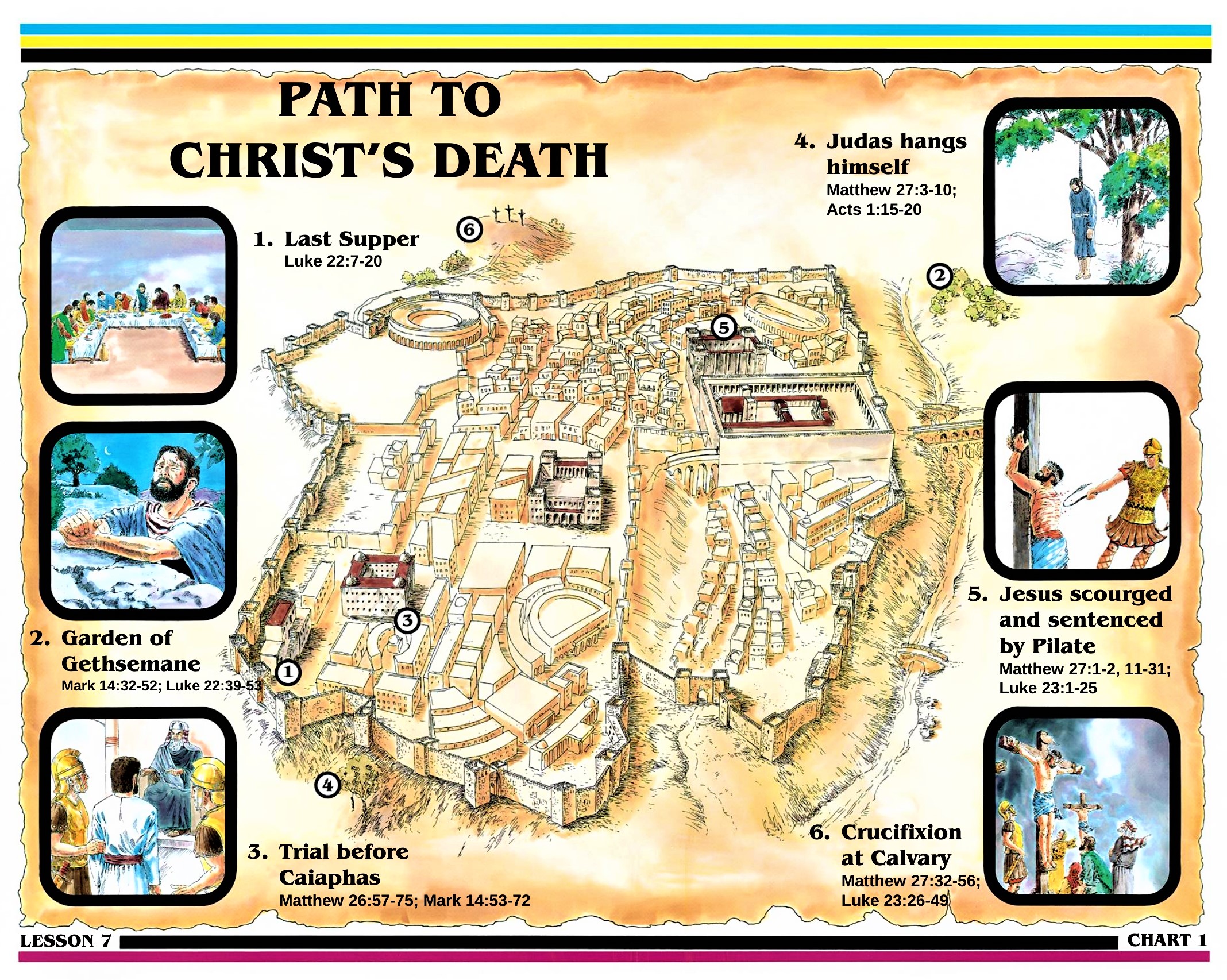
Chart Objective:
To relive the last painful hours of Christ’s
life. A triumphal entry culminated in His crucifixion.
Chart Outline:
A. Path to Christ’s death
B. The Last Supper
C. Garden of Gethsemane
D. Trial before Caiaphas
E. Judas hangs himself
F. Jesus scourged and sentenced by Pilate
G. Crucifixion at Calvary
A. Path to Christ’s Death
As Christ approached His final weeks on earth, His ministry seemed to intensify— more miracles, more healings, more reaction from His audience.
The whole country was astir after Lazarus had been raised from the dead. People were declaring that Jesus must truly be the Messiah after this undisputed miracle!
The high priest and religious officials were furious. Jesus must be stopped—He must be killed! Sinister plans were immediately drawn.
Christ had tried to prepare His disciples for the inevitable tragedy. His betrayal, death and burial had been indicated, but somehow they could not grasp His words. Still they envisioned holding regal positions in an earthly kingdom.
“Behold, we go up to Jerusalem,” Christ directed. Ordinarily this festivity was anticipated with great joy. Perhaps on this momentous occasion their Master would make His debut as King of the Jews! But it was not to be as they imagined.
Sensing the crisis at hand, the Master again confided the dreadful secret of a double betrayal—first to the chief priests and scribes, then by the chief priests. They would condemn Him, then secure permission from the Gentiles for His execution. Since Judas himself probably had no thought of such a crime, the first betrayer was not identified.
Excitement mounted on the road to Jerusalem. Christ and His disciples mingled with other pilgrim companies en route to the Passover at Jerusalem. When the throngs realized that Jesus was accompanying them, the atmosphere became positively festive!
However, Jesus was too preoccupied with approaching events to share their enthusiasm. His ministry continued as usual, healing blind Bartimaeus and visiting with a dishonest businessman, Zaccheus.
At Bethany, the Lord was a special guest at the home of Simon, a leper whom Jesus had healed. There, an unexpected act of adoration came from a loving disciple.
While Jesus visited with friends, Mary, the sister of Martha and Lazarus, silently knelt by the Master. With expensive ointment, she anointed His head and feet, then wiped His feet with her hair.
As the fragrant aroma filled the room, Judas complained, “Why was not this ointment sold for three hundred pence, and given to the poor?” But Jesus replied, “Let her alone; why trouble ye her? she hath wrought a good work on me. For ye have the poor with you always, . . . but me ye have not always. She hath done what she could: she is come aforehand to anoint my body to the burying. . . . Wheresoever this gospel shall be preached throughout the whole world, this also that she hath done shall be spoken of for a memorial of her” (Mark 14:6-9).
Don’t criticize her, unthoughtful disciples! Would you think it was wasteful on the day of His burial? Mary alone grasped the thought that Jesus’ earthly ministry was coming to a climax. Because she came beforehand with her offering, it was all the more precious!
On Sunday morning, the journey to the holy city began on foot, but Jesus would enter Jerusalem as the Messiah King. Until now, all public announcements of His office had been avoided. Since the hour for departure had come, Jesus must publicly assert His claims.
Although this demonstration would lead to death, through death would come the redemption, and finally the establishment of His spiritual kingdom in the hearts of men!
Unusual attention was given to His entry into Jerusalem. As the crowd was leaving Bethany, Jesus instructed two disciples to go to Bethphage, a nearby village, and fetch a donkey from an unnamed friend. Centuries before, the prophet Zechariah had predicted this particular detail of their mission (Zechariah 9:9).
Christ set the prediction in motion so that Israel, familiar with Old Testament scriptures, might recognize that her King had come! Riding in triumph on a donkey, He would publicly confess His messiahship, though it meant marching into the jaws of death!
Riding a donkey symbolized His peaceful, humble character. To have ridden a spirited warhorse would have indicated royalty obtained by force of conquest—which was quite different from His.
As the two disciples brought the colt, two streams of pilgrims met them—one coming from Jerusalem and one from Bethany. Visiting pilgrims from Jerusalem came to welcome Him while another crowd followed.
Jewish historian Josephus revealed that Passover pilgrims numbered nearly three million. Possibly a vast throng joined the spirited celebration to greet Christ.
Outer garments were placed on the colt that Jesus sat upon. This unspoken signal prompted the enthusiastic crowd to make a carpet of their outer coats for the rough path.
Intense excitement filled the air as children climbed trees and threw down branches. Parents began triumphantly waving palms in the path.
Perhaps someone recalled Zechariah’s prophecy. Like blazing fire the word passed from one to another as shouts rang out, “Hosanna to the Son of David: Blessed is he that cometh in the name of the Lord!”
The noise and excitement of recognizing Christ as King infuriated the proud Pharisees. Sternly they asked Jesus to quiet the shouting mob. But He replied, “If these should hold their peace, the stones would immediately cry out.”
Two distinct sights of Jerusalem are viewed on the route Jesus took. After the first glimpse, the city is temporarily hidden by the rough terrain. Then suddenly, the whole city bursts into view.
At this turn of the road, Jesus paused momentarily to behold its splendor. The festivity quietened as He loudly wept.
In a few years, the impressive Temple of white marble lavished with gold and costly stones would not have one stone remaining upon another. Roman armies would mercilessly besiege the city, leveling it to the ground and slaughtering its citizens.
In less than a week, Christ also knew He would die outside the gates of Jerusalem. But the flood of tears was not for Himself. He knew that Jerusalem would reject her Savior.
Jerusalem—the spiritual and religious center of the world! The home of religious officials schooled in the Old Testament law. Yet she failed to detect her Messiah as He walked her streets. She knew not the day of her visitation! The sobering picture moved the Master to tears.
So the procession inched toward the city of David with Jesus being praised and honored as King. Most of Jerusalem’s citizens bitterly opposed Christ’s teachings. But on this day, the chief priests and Pharisees could only watch. Everyone seemed to acclaim Him as King!
Jerusalem had been troubled once before when wise men inquired, “Where is he that is born King of the Jews?” But this tumult was far greater. The Romans feared a public uprising. The chief priests and Pharisees were seething with hatred. The Herodians dreaded a possible usurper to the throne. But the common people momentarily were certain that their long-awaited Messiah had finally appeared to do great things for them!
Yes, their King had appeared, but He would not fulfill their immediate expectations.
The impressive Golden Gate through which Christ entered Jerusalem on Palm Sunday was sealed after the time of the Crusades by the Turkish pashas. Because of His prophesied return to the Mount of Olives facing this eastern gate (Zechariah 14:4), Jews expect their Messiah to enter through the Golden Gate (Steckoll, The Gates of Jerusalem).
No prancing warhorses, no dignified officials, no pomp and ceremony accompanied the triumphal entry. Just an humble figure rode among the crowd of dusty pilgrims.
But why did Jesus reveal Himself as King? He knew His earthly mission had been completed and it was time for the cross. While an earthly kingdom was not planned at this time, Jesus had to be revealed as King. This was His final appeal. The Jews could never excuse themselves by saying they did not know He was the Messiah. On this day He was lauded as their King!
B. Last Supper
Luke 22:7-20
Two days before Passover, the chief priests and elders deliberated how to destroy Jesus. Caiaphas had been elevated to high priest by the Romans, but his deposed father-in-law, Annas, was still influential.
Immediately after Lazarus had been raised from the dead, a council was held to put the Lord to death (John 11:47-53). But the task was more difficult than supposed. Weeks had passed with no progress.
Imagine their delight when Judas presented his proposal. They would gladly give money if the disciple would watch for an appropriate opportunity for betrayal.
As the bargain neared completion, Judas asked, “What will you give me?” Unaware of their actions, prophecy was fulfilled as they literally weighed thirty pieces of silver (Zechariah 11:12).
Determining the Jerusalem shekel to be worth 72 cents, the sum paid was $21.60—the price demanded by Mosaic law should an ox gore a servant (Exodus 21:32). Our Lord, the sacrifice for all men, was bought with Temple money meant to purchase sacrifices. He who “took upon him the form of a servant” was sold at the legal price of a slave!
Sacrificial lambs were separated from the flock on the tenth and kept until the fourteenth to assure they were without blemish. So the true paschal Lamb was escorted to the only place where the Passover could be kept—Jerusalem—and kept four days.
On the thirteenth of Nisan, the preparation day for the feast, all leaven had to be removed from homes and a solemn search made by candlelight to find any hidden leaven. This was the first day of “Unleavened Bread.”
Since Jesus and His disciples were not citizens of Jerusalem, a room had to be secured and preparations made to celebrate Passover. Early Thursday morning arrangements were finished.
The last supper Jesus ate with His followers was not the ordinary Jewish Passover, but was in anticipation of the event. Peter and John had begun making preparations for the feast, but none of the Gospel writers mentioned a “lamb” or “feast.” Nor would the chief priests go into Pilate’s “Gentile” judgment hall on the fourteenth, “lest they should be defiled; but that they might eat the passover” (John 18:28).
After preparing the room, Peter and John provided wine (mixed with the customary two parts water), unleavened bread, bitter herbs, sauce and necessary dishes. Since they would not eat the paschal lamb at the legal time the following night, the Lord ordained a commemorative rite to replace the Jewish ceremony.
As the sun was setting, Jesus and the other ten disciples again descended over the Mount of Olives into the holy city. Entering the spacious upper room, the group took their places on pillows around the low table.
Incredibly, this last supper began with an argument about which disciple should be greatest. Who would occupy chief places at the table? Since the Pharisees seated people according to rank, a similar feeling must have arisen among the Twelve.
Only the day before, Judas had sold his Master to the chief priests. But it seems he not only claimed, but actually obtained a chief seat next to the Lord.
(Go to Chart 2—“Christ Makes a New Covenant . . . in Blood” and then return to this page.)
C. Garden of Gethsemane
Mark 14:32-52; Luke 22:39-53
As the Twelve left the upper room, Jesus announced that all would forsake Him that night. But Simon Peter confidently assured that though all his fellow-disciples should deny Jesus, he would remain steadfast. Peter could not bear to be included in the “all ye” of Jesus’ warning.
However, Peter’s boast received a crushing blow as the Lord foretold, “This night, before the cock crow, thou shalt deny me thrice.”
However, the Lord’s reply only gave birth to a more determined boast from Peter. “Though I should die with thee, yet will I not deny thee!
In full agreement, all the disciples pledged their loyalty. No further comment was made by the Lord. Time would tell.
Supper ended, Christ and His disciples sang a hymn and then left for a familiar spot. Beyond the brook Kidron at the foot of the Mount of Olives was a favorite place of prayer.
“Gethsemane” meaning “oil-press” was about three-quarters of a mile from the walls of Jerusalem. We know little about Gethsemane. Tradition has marked a certain spot with a shrine known as “The Chapel of the Sweat.” The garden encloses eight ancient olive trees more than a thousand years old, still fruit-bearing.
Jesus did not resort to His friend’s garden to hide from His enemies, for Judas knew the place well. Evidently it had become a regular meeting place for the Master and His followers.
Eight disciples remained at the entrance of Gethsemane and three—Peter, James and John—went farther with the Savior. These three had been privileged to behold His transfiguration, which strengthened them to bear a partial glimpse of Christ’s sufferings. The other eight were unable to observe any of His agony.
The three noticed that Jesus began to be “sorrowful and very heavy.” The Greek word refers to the “sore dismay” of an unexpected calamity, as though the knowledge of what was coming suddenly overwhelmed Him.
“My soul is exceeding sorrowful, even unto death,” He confided to the faithful three before going a few yards farther to pray alone.
Ravaged with grief, He fell prostrate upon His face. Jesus Jesus apparently was near death in Gethsemane.
What could bring the glorious Son of God so low? In prayer, He begged, “Father if it be possible, let this cup pass from me” (Matthew 26:39). So intense was His plea, three separate times the request was made. The countenance that had once been transfigured while talking with Moses and Elijah was now contorted and disfigured.
All the sins committed from Adam to those of the last living person were in the cup of Christ’s agonizing prayer. With one ghastly burden of accumulated horror, its weight crushed the Lamb of God.
Jesus had never been weakened by sickness, much less sin. To His pure soul, sin was utterly loathsome and horrible. Both now enveloped His very being.
In this bleak hour, Jesus yearned for the comfort of a friend. But His three closest disciples could not grasp the magnitude of His burden. They slept as the Savior suffered His conflict alone.
The Son of God’s greatest battle was submitting His will to bear the sins of all mankind and be separated from God in judgment. Our minds cannot perceive nor appreciate the torment Jesus suffered for us!
Having never committed a sin or violated His Father’s will, Jesus knew that God’s wrath would fall upon Him when He assumed the sins of the world. Such sobering knowledge apparently produced the physical, mental and spiritual agony of Gethsemane!
The physical torment was the most evident. Luke, the physician, wrote:
“He prayed more earnestly: and his sweat was as it were great drops of blood falling down to the ground” (Luke 22:44).
Medical doctors say that extreme physical stress causes the capillaries in the blood system to burst, actually spilling blood and perspiration from the pores (Vine, Great Events in the Life of Christ, page 64).
The arrival of an angel, “strengthening him,” probably prevented Christ’s death before the crucifixion. What a pitiful sight He must have portrayed to the arresting officers. Bloodstained clothing, matted hair and beard revealed the awful suffering in the garden.
Realizing the full implications of His “cup,” the mental suffering must have exceeded the physical stress.
Three times the Lord found sleeping disciples. “Sleep on now, and take your rest,” He finally spoke. The time for watching was over. Perhaps an interval passed before the soldiers’ footsteps were heard. Then He roused the sleepers and led them in majestic calmness to meet the danger.
It was near midnight. The chief priests had secured a detachment of Jewish Temple guards along with a cohort of possibly 500 to 600 Roman soldiers from the garrison. Thinking they were on a dangerous assignment, the soldiers were prepared to quell an outbreak during the feast days.
Being familiar with Jesus’ retreat, Judas led the group out the East Gate and down the Kidron Road. Their lanterns, torches and weapons were visible from the garden where He waited.
Judas had given the Roman soldiers a sign of identification. As Jesus approached, the traitor brazenly stepped forward to kiss the Master. Judas’ salutation was quite demonstrative— but it was not the ordinary Eastern embrace. It was a cold, cruel kiss of death.
“Judas, betrayest thou the Son of man with a kiss?” the Master asked.
Then Christ asked the soldiers, “Whom seek ye?” They answered, “Jesus of Nazareth.”
But when Christ answered, “I am he,” the men fell backward to the ground. One word of wrath and all His assailants could have been consumed; but He would not speak it.
Peter’s sword went into action. Always impetuous, he aimed his blow at Malchus, the body-servant of the high priest, but missed his mark and cut off the servant’s right ear.
Although characteristic of the disciple’s zeal and sincerity, his action was condemned by the Lord. Tenderly Jesus replaced and healed the severed ear. His last miracle before death was for a hostile enemy. What more striking proof of mercy and forgiveness could have been given?
D. Trial before Caiaphas
Matthew 26:57-75; Mark 14:53-72
Many trials in history have stirred the sympathy and antagonism of entire nations. Yet one trial above all others deserves to be examined for its injustice. The trial condemning Jesus to death ended the life of the most law-abiding man in history.
Actually, there were two trials. The first was by Jesus’ countrymen. The second by the Roman governor. Neither was “just” by any standard.
Stopping briefly at the palace of Annas, the former high priest, the captain and guards reported to the head of the clan. Annas received financial rewards for managing the Temple business of animals and treasures. Twice Christ had disrupted Temple commerce and threatened Annas’ enterprises. Thus he had every reason to praise the guards for their night’s work and to send Christ to his son-in-law for interrogation.
A preliminary hearing before Caiaphas yielded no evidence. Jesus referred the high priest to those who had publicly heard Him in synagogues and the Temple (John 18:19-23).
By this time, many members of Israel’s official council, the Sanhedrin, had assembled to interrogate Jesus. The hastily called trial opened as day was breaking.
Annas boldly asked, “Jesus, I adjure you by the living God. Tell us if you be the Christ.” Silence followed. This was the most solemn oath known.
Finally Jesus spoke for the first time in the trial. “You say that I am.” Annas pounded it again and again until Jesus stated, “I am.”
It was as if lightning had struck! Caiaphas tore at his robes. “We have heard it. He is guilty of death!” The vote was death by crucifixion.
Unrestrained brutality and venom broke out as the Sanhedrin pronounced Christ guilty of blasphemy. Some spat on Him, others pushed Him angrily and even the servants joined in slapping Him.
Death by crucifixion had become one of the most torturous and degrading forms of execution. So gruesome was this sentence that the Romans usually excluded their citizens and reserved it for slaves. Political uprisings had almost been eliminated by crucifying usurpers of the Roman government (McDowell, The Resurrection Factor, page 42).
A “political” crime was the accusation offered against Christ:
“And they began to accuse him, saying, We found this fellow perverting the nation, and forbidding to give tribute to Caesar, saying that he himself is Christ a King” (Luke 23:2).
E. Judas hangs himself
Matthew 27:3-10; Acts 1:15-20
Evidently Judas had not contemplated the full consequences of his crime. When it was announced that Jesus had been condemned to die, the traitor was filled with deep remorse. He had betrayed innocent blood (Matthew 27:4)! The silver coins meant nothing to him now.
Filled with anguish, he hurried to the chief priests and elders assembled at the Temple to openly confess his terrible crime and return the money. Perhaps by returning the price of blood he could erase the deed. But his hopes were quickly extinguished by their cold reply, “What is that to us? see thou to that.”
In frantic despair, the wretched man flung the thirty pieces of silver to the Temple floor and rushed out the door. To escape human eyes and the memory of his useless crime, Judas crossed the valley of Hinnom up the steep sides of the overhanging mountain. His girdle was unwound, fastened around his neck and secured to a tree or projecting stone. Flinging himself from this height, the cord by which he was hanging broke loose and he fell headlong down the side of the mountain. So near to the Savior for three years—and now so far away!
F. Jesus scourged and sentenced by Pilate
Matthew 27:1-2, 11-31; Luke 23:1-25
Agreeing that Christ deserved death for the crime of blasphemy, the Sanhedrin took Him to Pilate, the Roman governor. As civil leader, he alone had authority to execute criminals.
After careful scrutiny and interrogation of Christ and His regal claims, Pilate announced his verdict to the anxious Jews: “I find in Him no fault at all.”
What a precise and accurate conclusion! His decision is identical to all who have ever examined Christ. No fault can be found in Him!
Furiously the chief priests began to clamor, “He stirreth up the people, teaching throughout all Jewry, beginning from Galilee to this place” (Luke 23:5).
Although Jesus remained silent, Pilate at last saw a chance to escape the responsibility of the trial. Mention of “Galilee” caused the governor to send the case to Herod Antipas, who presided over the affairs of Galilee. Herod had come to the city for the feast. This was Pilate’s opportunity to be rid of a troublesome case!
Another trip through the streets to Herod’s palace and another examination. Having heard so much about the miracle worker, Herod was eager to be entertained. Facing Christ, he tried to goad Him into action. But the Savior refused to say a single word.
Disgusted, the monarch returned this bothersome prisoner to the soldiers. More indignities were suffered as a purple robe was placed around Christ’s shoulders and the soldiers mocked Him. Again, He was marched back to Pilate to await a decision whether to free or sentence Him.
Almost every phase of the trials had been illegal. The Sanhedrin tried cases only in the Temple hall; Christ was tried in the high priest’s home.
Midnight trials were also illegal. A man could not be legally condemned for a day’s interval, permitting the Sanhedrin to fast and pray about whether to release the victim.
The high priest was not authorized to participate in the questioning—but he directed this case. Jewish law stated that someone testify on behalf of the accused before a witness could speak against Him. But no defense was allowed. Accusers were sought and presented, yet they only offered contradictory testimony.
There was no basis for a conviction, yet Jesus was sentenced that morning to execution (Vine, Great Events in the Life of Christ, pages 71-72)!
By now, Pilate was thoroughly confused. A mysterious note from his wife warned against unfair treatment of this innocent stranger. Pilate was more convinced than ever that Christ was entirely innocent of the serious charges against Him.
Again the chief priests and rulers were summoned as Pilate declared that the accusations could not be sustained. Even Herod had backed up his judgment. Why not scourge Jesus and let Him go?
Pilate’s suggestion found no favor with the rulers, so he tried another course of action. Customarily, at the Passover one prisoner selected by the people was released. Pilate would allow the anxious Jews to choose between Christ and a notorious criminal— Barabbas, a robber and murderer (Acts 3:14).
Influenced by the vicious chief priests, the crowds became wild with impatience and rage. When the governor put the question before the throng, “Which of the two shall I release unto you?”, they all cried, “Barabbas! Give us Barabbas!”
Their vicious response annoyed Pilate. “What shall I do then with Jesus which is called Christ?” he asked.
Their repulsive answer was ready. “Let him be crucified!”
“But why? What evil has He done?” the governor desperately pleaded.
By now, the heated crowd was seething, nearing a riot. Pilate’s delay only exasperated them further. Then he thought of his own position. What if the report reached Rome of his refusal to punish a pretender to the Jewish throne?
Feeling absolutely powerless, the governor called for a basin of water. Before the whole multitude he washed his hands and said, “I am innocent of the blood of this just person; see ye to it” (Matthew 27:24).
By so doing, Pilate had pronounced Jesus’ innocence and his own guilt. Although Pilate despised the Jews, he used an act of ceremonial washing, to which they attached so much importance, to relieve his responsibility.
In response to the handwashing, a united cry arose from the mob: “His blood be on us, and on our children.”
Ignorantly did they ask to assume this penalty. Fearfully was it fulfilled!
Some who uttered this cry and very many of their children shared the dreadful calamities during the siege and capture of Jerusalem less than forty years later. They demanded that He be crucified—but thousands of them perished on crosses. Josephus told us that the Jews were tortured before death in all manner of ways and that as many as five hundred a day were crucified by Titus until “room was wanting for crosses, and crosses for bodies.”
The people, the priests and the government had spoken—unwittingly announcing their own doom.
Jesus’ trial was never really concluded. It continues in our generation as people hear the gospel and form their own personal verdict about Him. Will you accept Him as Lord and Savior or reject Him as the masses did on that tragic day?
(Go to Chart 3—“The New Covenant
Provides For Healing” to continue this lesson.)
G. Crucifixion at Calvary
Matthew 27:32-56; Luke 23:26-49
Jesus apparently had collapsed beneath the weight of the cross. The long night of anguish, interrogation, beating, and abuse had drained His strength. Gruffly, the soldiers seized Simon to carry Jesus’ cross.
Simon of Cyrene hailed from a city in northern Africa. We suppose he was a black man, having come to Jerusalem as a Jewish convert to observe the Passover festival.
The cross had no interest for Simon. He was pulled from a crowd of spectators. But Simon could never forget that cross after smelling the stench of death, wincing from the screams of the doomed thieves, and gazing at the composure of the dying man who said, “Father, forgive them; for they know not what they do” (Luke 23:34).
It is believed (on the basis of a greeting in Romans 16:13) that this Simon, the father of Rufus, became a believer in Jesus Christ. If so, he must have forever rejoiced that he had carried the cross of the man of Calvary!
Gospel writers describe the location of the execution as “the place of a skull.” The Latin word for skull is “Calvary” and the Hebrew word is “Golgotha.” The actual location is uncertain. But the prevailing opinion is that it was a well-known spot outside the gate, near the city, on a thoroughfare leading into the country, and close to a garden or orchard. Such a place just outside the north wall near the Damascus Gate bears a striking resemblance to a human skull!
It was time for the crucifixion to begin. As the soldiers came forward, the two thieves begged for mercy, dreading the horrible ordeal. Hardened to the task, the soldiers did their job well. Women of mercy rushed to give wine to deaden some of the pain. Quickly the two thieves drank it. Jesus refused. This was not the cup He was to drink.
Jesus was first. All His clothes were stripped away, including the long vesture. Thus, the indignity reached its climax as He was left naked.
Laying on the central bar, His arms were attached by ropes to the transverse beam. Hands and feet were fastened with huge iron nails to the wood. A rest or support was fastened on the upright beam to bear a portion of His weight. The cross was then raised by the executioners and thrust with a fierce jerk into the hole, causing His bones to be dislocated (Psalm 22:14).