Lesson 6 – Chart 5
Jesus Teaches Kingdom Concepts
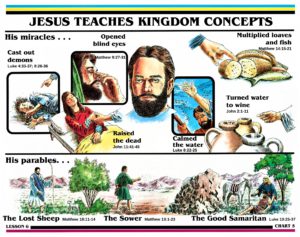
Chart Objective:
To explore Christ’s two methods of teaching kingdom concepts: miracles and parables. Miracles instilled faith, while parables made spiritual concepts more comprehensive to His listeners.
Chart Outline:
A. His miracles
B. Cast out demons
C. Opened blind eyes; raised the dead
D. Turned water to wine; multiplied loaves
and fish; calmed the water
E. His parables
F. The Lost Sheep
G. The Sower
H. The Good Samaritan
A. His miracles
No one—not even the Israelites—had an accurate concept of God. Heathen nations had pictured Him as weird, cruel, grotesque, immoral, or impersonal. Never had He been conceived as a God of love, as a heavenly Father.
When Jesus came to earth as a man, He was not like the proud, arrogant Pharisees. Nor was He like the great philosophers and religious teachers preceding Him. Jesus revealed the Creator as a God of love, a holy God Who could be approached.
The most sinful of men were attracted to Him. Publicans and sinners felt free to sit and eat with Him. They were unafraid of His holiness and drawn by His love. His mission was not to condemn, but to save.
Two main methods were utilized by Christ to attract an audience—His miracles and His teaching. Miracles excited the greatest attention everywhere He went.
His miracles can be classified into three categories:
• Controlling demons.
• Displaying power over disease and death.
• Controlling nature.
B. Cast out demons Luke 4:33-37; 8:26-36
One primary reason for Christ’s large following was His practice of expelling evil spirits. Throughout His ministry, a clear, open conflict raged between two spiritual kingdoms— the kingdom of God and the kingdom of Satan. A full fourth of Christ’s ministry was devoted to casting out demon spirits.
Expelling evil spirits taught Jesus’ audiences that Satan and demons were real, but they were subject to Christ’s control.
Christ’s ministry began on a Sabbath. While He and His disciples were worshiping at a synagogue in Capernaum, a man with an unclean spirit cried out in an irreverent, unruly manner, disturbing the service. Christ did not quietly remove him to a back room to deal privately with this embarrassing episode. Instead, He rebuked the spirit, commanded it to hold its peace, and to come out! The spirit obeyed, but not before it had violently “torn the man” with choking and shrieking.
How did Jesus’ first audience react to this shocking demonstration?
“And they were all amazed, . . . And immediately his fame spread abroad throughout all the region round about Galilee” (Mark 1:27-28).
Jesus explained his reasons for expelling evil spirits:
“The Spirit of the Lord is upon me, because he hath . . . sent me to heal the brokenhearted, to preach deliverance to the captives, and recovering of sight to the blind, to set at liberty them that are bruised, to preach the acceptable year of the Lord” (Luke 4:18-19).
How Christ must have longed to set His people free from the cruel slavery of evil spirits. Authority over evil spirits became one of His most unique features.
Miracles of healing, feeding hungry crowds, controlling forces of nature and raising the dead had all been duplicated by Old Testament prophets, such as Moses, Joshua, Elijah and Elisha. But the Master’s treatment of evil spirits was extraordinary! Speaking to them, commanding them to obey and leave— this was spectacular!
Astonished, the people exclaimed, “What new doctrine is this?” And nineteen centuries later, they ask this same question when captives are set free from the power of evil spirits!
C. Opened blind eyes; raised the dead Matthew 9:27-31; John 11:41-45 Much of Jesus’ ministry was devoted to physical needs:
“God anointed Jesus of Nazareth with the Holy Ghost and with power: who went about doing good, and healing all that were oppressed of the devil; for God was with him” (Acts 10:38).
As Jesus circulated from village to village, He was surrounded by the sick and dying. Everywhere He went, people clamored for restoration of health.
The blind longed for sight, the deaf for hearing, the lame for new strength to walk, the grief-stricken for restoration of loved ones. Some were paralyzed, some burned with raging fever, some bore the awful scars and stench of leprosy.
“And great multitudes came unto him, having with them those that were lame, blind, dumb, maimed, and many others, and cast them down at Jesus’ feet; and he healed them” (Matthew 15:30).
As He beheld suffering humanity, Jesus’ heart was “moved with compassion” (Matthew 9:36). No wonder! Here was man’s Creator watching the frightful wreckage sin had wrought. Without a thought for His own comfort, the Master reached out with His miraculous touch of healing.
While teaching in the synagogues and preaching the gospel of the kingdom, Christ busied Himself “healing . . . all manner of disease among the people” (Matthew 4:23).
No symptoms baffled Him. Instantly Christ perceived both cause and cure in every patient! As blind Bartimaeus shrieked for mercy, the compassionate Master touched him saying, “Go thy way; thy faith hath made thee whole” (Mark 10:52).
When the desperate woman plagued with a blood disease touched His garment after twelve disappointing years of suffering, Jesus said, “Daughter, be of good comfort; thy faith hath made thee whole” (Matthew 9:22).
Death was a barrier no more difficult to control than any disease or sickness. When Jesus’ company encountered a funeral procession at the city limits of Nain, He responded in like fashion. Immediately the Master reversed their grief into joy while commanding the corpse, “Young man, I say unto thee, Arise” (Luke 7:14).
When the grief-stricken sisters of Lazarus questioned the late arrival of their Friend, Christ responded with that loud, authoritative command at the gravesite, “Lazarus, come forth” (John 11:43)!
D. Turned water to wine; multiplied loaves and fish; calmed the water John 2:1-11; Matthew 14:15-21; Luke 8:22-25
Jesus’ first miracle involving nature was turning water into wine (John 2:1-11). Another was blessing loaves and fish offered by one small lad to provide more than ample food for five thousand men—plus women and children (Matthew 14:15-21; Luke 9:14-17).
Again Christ displayed miraculous power over the elements of nature when He calmed a storm on the Sea of Galilee by announcing:
“Peace, be still” (Mark 4:39). The forces of nature were defied when Jesus walked on the sea (John 6:19). Another miracle of nature involved a miraculous catch of fish by Christ’s disciples (Luke 5:6).
Nature immediately responded to the commands of the One who spoke the world into existence.
E. His parables
“And Jesus went about all Galilee, teaching in their synagogues, and preaching the gospel of the kingdom” (Matthew 4:23).
Christ did considerably more teaching than preaching. Every word carried the force of divine authority. One of the most fascinating features of His teaching was the constant use of parables, or short narratives, to illustrate the abstract concepts of His kingdom.
Constantly Jesus saw analogies, comparisons, and resemblances between the realm of nature and the realm of the spirit. The parable introduced an unfamiliar spiritual concept with the familiar.
However, the parable was not unique to Jesus’ teaching. Both the Jewish rabbis and Old Testament prophets utilized parables (II Samuel 12:1-4; Ezekiel 17). This type story is a common Oriental method of imparting truths.
Jesus’ skillful use of parables was much like a work of art. Most of His audiences were mixed—some hostile and quick to accuse; others friendly and eager to grasp every word. By using parables, Christ could reveal gems of truth to the receptive, yet conceal them from His enemies.
Often the stories said one thing, but meant quite another. The lost sheep that was sought and discovered by a good shepherd represented a lost man found by the Savior (Luke 15:3-7). Because of the double meanings, His followers readily understood, but the skeptics went away confused.
“Therefore speak I to them in parables: because they seeing see not; and hearing they hear not, neither do they understand” (Matthew 13:13).
These stories with hidden meanings compared spiritual concepts to familiar, everyday objects, such as: fishing, farming, seed, soil, crops, wheat, trees, sheep and goats.
Since the Jews had long envisioned an earthly kingdom that would conquer the iron hand of Roman oppression, He had to correct their misconceptions. Many of Jesus’ stories began “The kingdom of heaven is like . . .”
To stress the separation of sin from righteousness in His kingdom, He told the parable of the tares and wheat (Matthew 13:24-30, 36-42).
To emphasize the priceless value of His kingdom, a story was told of buried treasure (Matthew 13:44). Another narrative described a merchant seeking one priceless pearl gem (Matthew 13:45-46).
To show the importance of humble beginnings, Christ’s kingdom was compared to a grain of mustard seed (Matthew 13:31-32).
To explain how His kingdom would separate sinners from the righteous, the parable was used of the varied catch of fish (Matthew 13:47-49).
Why we should commune with our heavenly Father was emphasized with the Lord’s Prayer, followed by a parable of a persistent friend at midnight (Luke 11:5-8).
In response to Peter’s question about forgiveness, a parable was told of the unmerciful servant (Matthew 18:21-35).
F. The Lost Sheep Matthew 18:11-14
Many parables were in response to a problem or those who opposed Him. When the Pharisees criticized Jesus for mingling with sinners, He told the stories of the prodigal son, the lost coin and the lost sheep. This was His way of illustrating the value of reaching for a lost sinner.
The beauty of Jesus’ teaching ministry is perhaps best displayed in the tender story of the lost sheep:
“What man of you, having an hundred sheep, if he lose one of them, doth not leave the ninety and nine in the wilderness, and go after that which is lost, until he find it? And when he hath found it, he layeth it on his shoulders, rejoicing. And when he cometh home, he calleth together his friends and neighbours, saying unto them, Rejoice with me; for I have found my sheep which was lost” (Luke 15:4-6).
The question Jesus asked in this parable should have silenced His self-righteous accusers. Not one of them would hesitate to search for a lost animal. Yet Christ was interested in finding something much more precious than all the flocks of sheep that ever grazed on Judean hillsides. It was the soul of man He came to seek and save!
G. The Sower
Matthew 13:1-23
Stressing the importance of hearing and receiving God’s Word, Jesus told the parable of the sower and his varied crop (Matthew 13:1-9, 18-23). He compared the seed to the Word of God, the sower to the one who shares the Word, and the soil to the human heart— whether it be stony, shallow, crowded or fruitful ground.
Like seed, the Word must be planted to cause a reaction. It must be cultivated, nurtured and protected. Listening to the Word is not enough. We must hear it, receive it into our heart, and allow it to take root and grow.
Nineteen times in Matthew’s account of this parable, Christ used the word hear. He was not referring merely to the physical act of listening to sounds, but listening with the inner ear and receiving God’s Word deep into the heart. The way to a man’s heart is through his “spiritual” ears!
As we study each of these lessons together, we should determine that the seed of God’s Word will germinate in our hearts to bring forth good fruit!
H. The Good Samaritan
Luke 10:25-37
In response to a question about neighbors, Christ told the parable of the Good Samaritan (Luke 10:25-37). The critic who claims the Bible is not relevant to our modern world has never read this parable. The ingredients composing this familiar story are found in the pages of our daily newspapers!
This story talks about violence—a current problem with which we can relate. It speaks of crime, racial discrimination, and hatred. It emphasizes the neglect, selfishness and lack of concern by the priest and Levite. Yet we also see love and mercy.
The compassionate Samaritan came to the aid of the injured victim who had been stripped and ignored by the “religious” travelers. They were too involved in holy activities to render aid.
We know what the parable says, but what does it mean? In response to the lawyer’s question, “Who is my neighbor?” Christ used his query to teach a most important truth:You cannot separate your relationship with God from your relationship with your fellowman.