What Is Repentance?
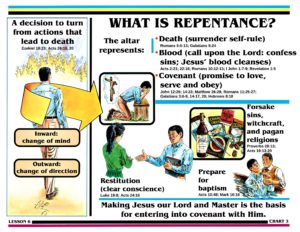
Chart Objective:
To determine the meaning of repentance—man’s first step of returning to God. The changing of one’s mind and actions is climaxed by accepting the atonement through Jesus’ blood and entering into Christ’s new covenant.
Chart Outline:
A. A decision to turn from actions that lead to death
B. Inward: change of mind; outward: change of direction
C. The altar represents: Death; Blood; and Covenant
D. Restitution
E. Forsake sins, witchcraft, and pagan religions
F. Prepare for baptism
G. Making Jesus our Lord and Master is the
basis for entering into covenant with Him
A. A decision to turn from actions that lead to death Ezekiel 18:23; Acts 26:18, 20 To the sinner God asks:
“Have I any pleasure at all that the wicked should die? saith the Lord GOD: and not that he should return from his ways, and live?” (Ezekiel 18:23).
Why should anyone choose wickedness and death—when they can choose to repent and live?
The original Greek word for “repentance” means “to change one’s mind.” Repentance is not an emotion that we feel, but a decision. When we truly repent, we change our mind, our attitude, and purpose about sin. We turn around “on the inside.”
Christ and all His apostles commanded “all men every where to repent” (Acts 17:30).
B. Inward: change of mind; outward: change of direction
Once our minds are changed, our whole life becomes rearranged. True repentance totally changes us.
Apostle Paul’s call from God sent him to the Gentiles:
“To open their eyes, and to turn them from darkness to light, and from the power of Satan unto God, that they may receive forgiveness of sins, and inheritance among them which are sanctified by faith that is in me. . . . that they should repent and turn to God, and do works meet for repentance” (Acts 26:18, 20).
Repentance is much more than an emotional display of tears, weeping, and groaning. Although the emotions may be affected, true repentance goes much deeper. We acknowledge that our actions and attitudes have not only hurt others, but we have offended God!
As this truth unfolds, we are deeply concerned about our relationship with God. Sin appears ugly—as He sees it. Our wrongdoing has insulted God’s holiness and love.
A beautiful example of repentance is found in Christ’s parable of the prodigal son. A proud, independent youth left his father’s home and traveled to a distant land. There he foolishly wasted his entire inheritance. But when he finally came to his senses, alone and in extreme poverty, he made this decision: “I will arise and go to my father.” That decision was promptly acted upon and “he arose, and came to his father.”
First is the decision to commit our life to Christ and allow Him to be our Lord and Master. Then follows the act of turning back to Father and home.
In his natural, sinful condition, every person born into this world has turned his back upon God, his Father, and upon heaven, his home. In this condition, each step takes us away from God’s plan to a frightful eternity of torment.
Every person traveling toward destruction must: stop, change his mind, turn around, and face the opposite way toward God. This essential act is the sinner’s first move to be in harmony with God’s plan.
Why is repentance so important? Because God insists that we realize the grave problem caused by sin. When Adam’s sin severed his relationship with God, death took dominion over man.
Man was created for God’s pleasure. But the first transgression abolished man’s fellowship with the Lord and the ability to serve Him.
God has no pleasure in man until he is first “reconciled,” or spiritually restored to his original condition. Repentance crumbles the barrier that separates man from God!
We must understand exactly how to repent. These four suggestions will show the way.
C. The altar represents: Death; Blood; and Covenant
Three significant acts occur when we bow before our heavenly Father. An “altar” represents a place where sacrifices are offered to Deity. At an altar—whether in a church, home, or car—we come to God with a sacrifice.
The altar of repentance may be traced to Israel’s brazen altar where sacrifices were offered to God. The blood of sacrificial animals provided a covering that hid their sins from a holy God. However, Christ’s blood does not merely “cover” sins, but eradicates and cleanses us so thoroughly, we appear to never have been dirty!
At the altar we die with our crucified Lord. Death awaits all who come to Christ. Not a literal, physical death—although the day may come when we must die for His cause—but a commitment. Our intellect that tries to rule and give orders must be surrendered. We are no longer the boss. That privilege hereafter is reserved for our new Master.
Paul said that the “old man” or the “body of sin” must die:
“Knowing this, that our old man is crucified with him, that the body of sin might be destroyed, that henceforth we should not serve sin” (Romans 6:6).
“And they that are Christ’s have crucified the flesh with the affections and lusts” (Galatians 5:24).
At the altar, we leave Satan’s family and rulership to join a new family and Lord.
When Jesus arose from the dead, He triumphed over man’s cruel taskmaster. What a joyous message we bring to an unsaved world! Jesus wants to become your new Master! The God of heaven wants to be your Lord!
Then Jesus’ blood begins to be applied as we “call upon the name of the Lord.” The act of turning to the Lord began with Adam’s sons: “then began men to call upon the name of the LORD” (Genesis 4:26).
Throughout the Old Testament, God heard the cries of those who called upon Him. Abraham built an altar and “called upon the name of the LORD” (Genesis 12:8; 13:4).
When Israel was oppressed by enemy nations, “their cry came up unto God by reason of the bondage” (Exodus 2:23; Judges 3:9, 15; 6:6-8).
On the Day of Pentecost, visiting Jews inquired about a strange phenomenon in an upper room. Peter replied by quoting from Joel’s writing:
“And it shall come to pass, that whosoever shall call on the name of the Lord shall be saved” (Acts 2:21).
Paul said that when he was baptized and “called on the Lord,” his sins had been washed away: “Rise and be baptized, and by calling upon His name wash away your sins” (Acts 22:16, Amplified).
Something begins when we call upon the Lord in faith!
After calling upon the Lord, we must confess our sins to God. To “confess” means to put thoughts into words. We tell God how bad we feel about all the wrong things we have done.
Specifically name sins one by one, such as pride, rebellion, hatred, anger, adultery, jealousy. As you think of sins, cry out to the Lord for mercy and forgiveness.
Do not say, “IF I have sinned . . .” Acknowledge that you ARE a sinner. Then mention specific offenses.
Complete honesty is most important. Why hide something from the One Who knows every thought? Let the words freely flow, without hedging or evading the issue.
Confession is never easy. But God wants us to express our guilt and specifically name sins so His blood can wash away every stain.
“If we confess our sins, he is faithful and just to forgive us our sins, and to cleanse us from all unrighteousness” (I John 1:9).
Jesus associated His blood with the New Covenant.
“For this is my blood of the new testament [New Covenant], which is shed for many for the remission of sins” (Matthew 26:28).
Paul also linked the covenant with the removal of sins.
“For this is my covenant unto them, when I shall take away their sins” (Romans 11:27).
When Abraham simply believed what God had promised, the two entered into a blood-covenant relationship. Before circumcision or other good works, he was declared to be “righteous,” or in right standing with God. Faith is also a vital part of entering the new covenant:
“So then they which be of faith are blessed with faithful Abraham. And if ye be Christ’s, then are ye Abraham’s seed, and heirs according to the promise” (Galatians 3:9, 29).
Jesus stated that if we are to enter into covenant with Him, we must believe that His blood cleanses us from our sins and promise to serve and obey Him.
“If a man love me, he will keep my words: and my Father will love him, and we will come unto him, and make our abode with him” (John 14:23).
Salvation begins at an altar. But it does not end there. After surrendering our self-rule, confessing our sins and promising to love, serve, and obey Christ, we are to be baptized in the name of Jesus Christ and ask God to fill us with His Spirit, the seal of the new covenant.
D. Restitution Luke 19:8; Acts 24:16
After we sincerely confess our sins and turn to God, we need to make things right with others. We call this restitution. Where possible, we restore what has been wrongly taken from others. The Gospels teach that restitution is part of repentance.
“And Zaccheus stood, and said unto the Lord; Behold, Lord, the half of my goods I give to the poor; and if I have taken any thing from any man by false accusation, I restore him fourfold” (Luke 19:8).
Wounded relationships must be repaired. Hurt feelings toward family members, friends, business relations, or others, should be cleared from the conscience. Our relationship with God will never be right unless our relationship with people is equally right. Paul stressed the importance of a clear conscience:
“And herein do I exercise myself, to have always a conscience void of offence toward God, and toward men” (Acts 24:16). Forsake sins, witchcraft, and pagan religions Proverbs 28:13; Acts 19:13-20 We prove to God our intentions by forsaking all sin. True repentance is turning away from everything that we know displeases God.
All former bad habits are broken. In fact, we sense a genuine hatred and disgust for the things once loved. If we experience difficulty in forsaking any sinful habit, we likely have never felt hatred for that sin.
“He that covereth his sins shall not prosper: but whoso confesseth and forsaketh them shall have mercy” (Proverbs 28:13).
Because of the prevalence of both “cults” and the “occult,” it is very important that all false teachings be renounced. A “cult” is any teaching that denies that Jesus Christ was God in flesh. Some of these unbiblical groups emphasize “mind-science,” reincarnation, pantheism, and metaphysics.
The “occult” or “psychic” beliefs include fortune-telling, extrasensory perception, telepathy, clairvoyance, astrology, mind expansion techniques (such as: drugs, hypnotism, and transcendental meditation), rock music, sorcery, witchcraft, spiritism, or spiritualism (communing with the dead).
Our world is being flooded with psychic phenomena. Before the Spirit of Christ can dwell within us, we must first renounce any involvement or relationship with any corrupt philosophy mentioned.
Ask God’s forgiveness, then in the name of Jesus bind and cast out any spirit connected with wrong teaching.
Believers at Ephesus confessed their deeds, then brought their curious arts and books together and burned them (Acts 19:13-20). Consequently, the Word of God grew and prevailed!
It is a good idea to thoroughly clean your house and then burn every book, magazine, record, tape, and other items associated with false teaching.
F. Prepare for baptism Acts 10:48; Mark 16:16
To climax repentance, we prepare for water baptism. This ceremonial act is for the remission of sins. Baptism completely renounces our life as a sinner. It is like saying, “I commit my whole life to Jesus Christ. I mean to serve Him. He is my new Ruler and I take His name in water baptism.”
Submitting to water baptism after repentance was the standard procedure for the early church. Notice Peter’s words to Cornelius’ household:
“And he commanded them to be baptized in the name of the Lord” (Acts 10:48).
Once the “old man” has been put to death at the altar of repentance, it is time to bury the “old man” in the waters of baptism.
G. Making Jesus our Lord and Master is the basis for entering into covenant with Him
The highest order of repentance is not weeping over past sins, but confessing Jesus Christ as your new Lord. We leave Satan’s family and rulership to join the family and lordship of Christ!
“Who hath delivered us from the power of darkness, and hath translated us into the kingdom of his dear Son” (Colossians 1:13).
Allowing Jesus to control your life is the way to salvation. Self-dependence and self-government must end. But He cannot be Lord unless we invite His Spirit to sit at the controls.
The altar represents death, surrender, commitment, vows, promises, covenant. Every sinner needs an altar. And every saint needs an altar to renew those promises.
Jesus died on a cross. We die at an altar. But do not stop here. Repentance is only the first step! As wonderful as it feels, there are greater, more thrilling experiences ahead as we proceed toward God!
As we adopt Christ’s new code of behavior and attitudes, repentance must become a way of life. Our initial repentance turns us from darkness toward God. But it does not end there. You can expect to make mistakes and to fail similar to a child learning to walk. Do not be discouraged. Forgiveness is available to all who will repent.