A “New” Book Opens For Us
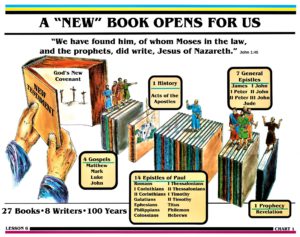
Chart Objective:
To examine the “new book” of hope that was opened for mankind. Written by many eyewitnesses of Christ’s earthly ministry, the New Covenant (Testament) restores man to God’s family with full sonship privileges!
Chart Outline:
A. “We have found him . . .”
B. God’s New Covenant
C. Four Gospels
D. One Book of History
E. Fourteen Epistles of Paul
F. Seven General Epistles
G. One Book of Prophecy
H. Birth of our New Testament
A. “We have found him . . .” John 1:45
The final page of Old Testament study concludes with a deep yearning and expectation. True, a beautiful story and plan have been revealed. But it is much like a magnificent frame with an obscure picture.
Old Testament prophets voiced an expectation for one who would solve national problems and heal their wounds. Every Israelite eagerly awaited with passionate longing and patriotism the coming King of the Jews.
Then the picture focuses. Finally, He comes! The promised One of Whom all the prophets foretold! The grand announcement theme is best expressed in John’s words:
“We have found him, of whom Moses in the law, and the prophets, did write, Jesus of Nazareth” (John 1:45).
A new era, more magnificent than all the hints and predictions of the ancient prophets, had finally arrived! The Messiah was much more glorious and wonderful in person than any prophet’s vision could describe!
B. God’s New Covenant
Moses’ law with its customs, ceremonies and ordinances was about to be changed. The coming Christ was opening a new book of hope for all mankind. His coming turned the page on the Old Testament and opened a New Covenant (Testament) for us all!
Let’s take a closer look at this most important part of our Bible. The New Testament is divided into sections, similar to the Old Testament. A simple way to remember the number of books is to multiply the number of letters in the word “New” by the number of letters in the word “Testament”—or 3 x 9 = 27.
C. Four Gospels
The first four books are called “Gospels,” or the “good news” about Jesus’ death, burial, and resurrection. The story of Jesus, the Son of God, was recorded by four writers— Matthew, Mark, Luke and John. While there is only one gospel of Christ, there are four presentations.
Why four? His story is told from four viewpoints. He is presented as the “King” by Matthew, the “Servant” by Mark, the “Son of Man” by Luke, and the “Son of God” by John.
The first three Gospels are called “synoptic Gospels” since, unlike John, they give a synopsis of Christ’s life. John’s Gospel stands alone as he presented a deeper portrait of Christ.
John assured that God had come to earth to live with men!
“The Word was made flesh, and dwelt among us” (John 1:14).
Each Gospel has much in common with the others as they deal with Christ’s earthly ministry, His death, resurrection, teachings, and miracles. Yet the three writers present different pictures of our Lord.
Matthew deliberately adds to his account what Mark omits. Standing alone, each Gospel is incomplete without the others. Not every detail could be included, as John explained: “And there are also many other things which Jesus did, the which, if they should be written every one, I suppose that even the world itself could not contain the books that should be written” (John 21:25).
The purpose of the Gospels is similar to that of a photographer capturing a story on film. He busily shoots pictures of his subject from every conceivable angle. Collectively, the shots present a more complete portrait of his subject.
Each Gospel gives a different and unique aspect of our Lord’s life on earth. Together, the complete picture unfolds.
Although the Gospels are included in the New Testament, that period was governed by the law of Moses. This was a transitory period, preparing for the new dispensation that was launched after the resurrection.
D. One Book of History
Next is the Book of Acts, recording the birth of the church and the spread of the gospel. It includes the beautiful plan of salvation, as well as the “acts” of the apostles. Luke, a Gentile companion of Paul, wrote this book. Luke is the only Gentile writer of the Bible.
What a thrilling design in this narrative! It complements and completes the preceding Gospels. While the Gospels reveal what Christ began to do, the Acts show what He continued to do by the Holy Spirit indwelling His disciples.
The Gospels present the teachings of Christ, but Acts allows us to see the effect of His teachings in the lives of the apostles.
Not all the apostles’ actions are given. Few details are mentioned of any apostles other than Peter and Paul. Rather, it records the “acts” of the Holy Spirit working through these men.
E. Fourteen Epistles of Paul
The Epistles instruct us how to live the Christian life. These books or “letters” were written to people who had already become Christians.
Paul’s fourteen books are called “Pauline Epistles.” Most were actually letters written to various churches Paul had founded or visited during previous missionary campaigns. These letters offer advice, instruction, exhortation and encouragement to the saints in his absence
F. Seven General Epistles
Seven “General” epistles follow, written by four men—James, Peter, John and Jude.
G. One Book of Prophecy
Finally, Revelation is the only book of prophecy in the New Testament. Written by John during his imprisonment and exile on the Isle of Patmos, its first chapters include letters to seven churches located in Asia. The latter chapters describe heaven and events that will unfold at the end of time.
“Revelation” comes from the word “Apocalypse,” which means “unveiling.” Like the Book of Daniel, much is symbolic writing. More than three hundred symbols speak and reveal wonderful truths concerning OUR future!
This fascinating book unveils the greatest drama of all time. An intense plot culminates in a final scene of Christ triumphing over the villain, Satan.
Revelation climaxes the great story begun in Genesis as the triumphant Christ declares, “Behold, I make all things new” (Revelation 21:4-5).
As all good stories should, the Bible concludes with a “happily ever after” in the presence of the Lord!
The importance of the New Testament is magnified by the fact that Genesis to Malachi covers about 4,000 years, while less than 100 years elapse in the New Testament period.
A good method for remembering the New Testament writers is to envision a car with four wheels (Matthew, Mark, Luke and John), and two men in the front seat (Peter and Paul). Of course, the driver is Peter since he was given the “keys.” Two men are pushing the car (James and Jude). Such a mental picture will help recall all eight writers of the New Testament.
H. Birth of our New Testament
The fact that the New Testament begins with four Gospels and Acts, followed by Paul’s epistles, tends to make the original order of writing difficult to imagine. When the church was first established, no thought was given to a “New Testament.” Their only Bible was the Old Covenant. Every new teaching was based on the authority of Christ as personally directed through His apostles.
Then came new inspiration to record those divine directives for churches and individuals.
Eventually, these writings became as authoritative as the Old Testament Scriptures.
Most of Paul’s epistles were written before the earliest Gospel. Epistles to the Thessalonians and Galatians are the oldest of the New Testament documents. Since no Gospels were available to Paul’s converts, they received the story of Jesus in an oral, rather than written form.
The necessity for having a written account of Christ’s life was not urgent while the personal eyewitnesses were alive. But few were still living near the end of that century.
Roman Christians invited Mark, the companion of Peter, to permanently record the apostle’s often related story of Christ’s passion.
Shortly after Mark’s Gospel appeared, Luke, the physician and travel-companion of Paul, traced the origin of Christianity from eyewitness accounts. Luke produced a twofold history, the Gospel according to Luke and the Acts of the Apostles.
Still another Gospel appeared in the Syrian region, containing strong emphasis for the Jews. This is our Gospel according to Matthew.
Toward the close of the century, the last Gospel narrative appeared at Ephesus—the work of John the beloved, the last survivor of the Twelve.
How were the epistles collected? After Paul’s martyrdom, perhaps the true worth of his life’s work was more appreciated. Around A.D. 100, his literary works were collected and made available for all believers. Realizing a deep sense of loss, Christians determined to preserve everything they could find of this great apostle’s work.
Congregations that had known Paul and received his letters were eager to find more. Archives were ransacked for entire letters or even fragments. This informal collecting and sharing of letters is responsible for preserving much of Paul’s correspondence.
Because of the value of his letters, they were read and re-read in regular church worship. Eventually they were collected and published.
About the middle of the second century, Justin Martyr related that during Sunday worship, Christian assemblies read “memoirs of the apostles” as well as the “writings of the prophets.” Peter recognized the great value of Paul’s letters and referred to them as Scripture (II Peter 3:15-16).
All New Testament books were recognized as Scripture by A.D. 200. Then in A.D. 397 at the Synod of Carthage, a church council ratified the general consensus that the twenty-seven books—which we also recognize today—were the divinely inspired Word of God, worthy of equal esteem as the Old Testament.