Dispensations of Time
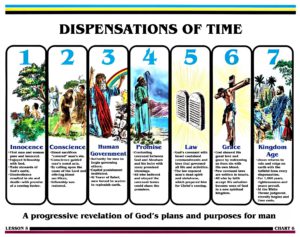
Chart Objective:
To explain the revelation of God’s plans and purposes for bringing man back into complete harmony and fellowship with his Creator. The beautiful dispensation of grace will only be superseded in majesty by the final period, the kingdom age.
Chart Outline:
A. A progressive revelation of God’s plans
and purposes for man
B. Innocence
C. Conscience
D. Human Government
E. Promise
F. Law
G. Grace
H. Kingdom Age
A. Progressive revelation of God’s plans and purposes for man
A chart of dispensations has been added as a pivotal point between the Testaments. This provides an excellent review for the five previous dispensations and prepares us for the sixth.
Bible scholars have divided the entire span of time from Creation through the final judgment into seven distinct eras or dispensations: innocence, conscience, human government, promise, law, grace, and the kingdom age. By studying dispensations, we can systematically cover the various Bible periods and become acquainted with people of that era.
Various forms of the word “dispensation” are used in the New Testament twenty times. The Greek word oikonomeo actually means “stewardship” or “to be a steward.” Thus, a dispensation refers to how man performs his stewardship in various ages.
Dispensationalists view the world as God’s household in which His affairs are to be administered or “dispensed” in the particular way He has designed. Since the beginning, He has chosen to reveal Himself to man in stages—a little at a time. When God reveals more of Himself and His plans or fresh instructions about pleasing God are given, we call it a new “dispensation” of enlightenment.
God is the same—yesterday, today, and forever. His plan remains the same. But man constantly changes. We are continually learning more about the unfathomable will and plan of our heavenly Father.
When a new baby is born, very little is required of that child. Parents love and cuddle the tiny new one, expecting nothing in return for their monumental expenditures except smiles and hugs.
But as the child grows from a toddler, to an adolescent, and then to an adult, responsibilities are constantly added. As his physical strength, understanding, and reasoning ability develop, more household duties are demanded. Each new stage of development has its rules and regulations.
The same is true with man’s relationship with God. From innocence, to conscience, to human government, to promise, to law, to grace—man was learning about God and what was expected of him.
Every dispensation poses the same question: Will man respond favorably toward his new obligations? History reveals many failures. Yet God faithfully continued to show His love and grace and power until at last He came in person to provide the perfect plan for our dispensation!
B. Innocence
Innocence was an age of sinlessness when Adam and Eve enjoyed direct fellowship with God. Their responsibilities as stewards were to maintain fellowship, dress the garden, and obey the one command of refusing to eat the fruit of the Tree of Knowledge of Good and Evil. This was the “plan of salvation” for the first couple.
However, the first pair failed the test. Consequently, Adam relinquished his position as world ruler to Satan. Death entered his spirit, and Adam’s nature became like his new master’s, the devil.
God’s judgments were pronounced upon the man, woman, and serpent. Since reproduction would come through the birth process, death passed to their family, their descendants and all creation. Expulsion from the garden was inevitable.
C. Conscience
Conscience was awakened when Adam and Eve ate of the forbidden fruit. From that moment, conscience has been the faculty that guides the moral acts of man.
This title does not imply that man had no conscience before or after this time any more than the dispensation of law implies that there was no law before or after that period.
During this era the “plan” was that man respond to God through the promptings of his conscience.
Fellowship with the Creator could be restored by calling upon the name of the Lord, loving and worshiping Him, and obediently offering acceptable blood sacrifices.
Few responded to the plan. Abel, Enoch and Noah are mentioned. Because of wide-spread violence and wickedness, God’s judgment came in the form of the Flood.
D. Human Government
Human government became effective immediately after the Flood. New regulations were given: animals would fear man; the flesh of animals could be eaten for food; and the institution of capital punishment.
The right to inflict the punishment of death for taking another’s life revealed God’s high estimation of life.
Although man was given the authority to govern others, his failure to govern successfully appeared almost at once.
Rather than obeying God’s “plan” to scatter and replenish the earth, men defiantly united to construct a tower. Confusion of languages at the site of construction encouraged them to obey what God had said.
E. Promise
After dealing only with the entire human race, God chose to work through one man. Abraham and his descendants became the chosen lineage through whom God would reveal His glory to the world.
This dispensation began when God cut a covenant with Abraham. The “plan” incorporated rules from previous eras: obey the voice of conscience; call upon the name of the Lord; offer blood sacrifices; and wisely govern other men.
The new revelation was that Abraham believe God’s promises concerning: numerous descendants; inheriting the land of Canaan; a spiritual seed through Whom the world would be blessed; and financial prosperity.
Abraham’s part was to separate himself unto God, refuse to indulge in idolatry and wickedness, and enforce the rite of circumcision upon all the males of his household. All who obeyed the covenant terms could share the promises.
Because of a severe famine in the Promised Land, Abraham’s descendants had moved to Egypt. Had they not been subjected to slavery, they would have contentedly remained there.
God chose Moses to lead Israel back to their Promised Land and punished Egypt for its harsh treatment of His covenant people.
F. Law
Abraham’s blood-covenant was everlasting. All who enter into covenant with God must come by way of His covenant—not the law.
The dispensation of law began when Moses received the Ten Commandments and laws that governed all life and activities. It was in effect for 1,520 years.
The “plan” was to abide by the terms of Abraham’s blood-covenant relationship with God—plus obedience to the Mosaic law.
The law exposed the guilt of man and made him conscious of what was displeasing to God, but their sinful natures hindered obedience.
At the close of this period, Christ came to fulfill and replace Moses’ law. Thus, the dispensation of law ended at Calvary.
G. Grace
Jesus, the last Adam, came to redeem man from the curse of sin with His blood and give life to our dead spirits. Christ’s coming exhibited such marvelous “grace” (divine favor; pleasure; goodwill) toward man, all previous displays were as nothing.
This dispensation provided a new covenant with God’s laws written in the heart. As Abraham entered into covenant by faith and obedience, so we enter into the new covenant by believing and accepting the free gift of salvation:
“For by grace are ye saved through faith; and that not of yourselves: it is the gift of God” (Ephesians 2:8).
In reality, salvation in every dispensation has been based upon God’s grace. No one has ever performed enough good deeds to merit salvation. All who believed and obeyed His revealed plan became recipients of His grace.
In this dispensation, the “plan” is to believe the gospel, then identify with Christ’s death, burial, and resurrection. Those who believe and obey the gospel become sons of God and members of Christ’s church (“called out” believers) in a new spiritual kingdom.
H. Kingdom Age
After Christ returns to earth at the Battle of Armageddon, His kingdom will be set up at Jerusalem, fulfilling all the promises given in both Testaments.
Jesus Christ will personally rule the affairs of the world during this period of one thousand years. The faithful from every dispensation will rule and reign with Him.
In this era, the “plan” will be to love the King and obey His laws. Satan will be bound, righteousness will prevail, and disobedience will be quickly punished.
However, at the close of this peaceful age, rebels will join in a formidable army, daring to attack the seat of government (Revelation 20:7-9). The rebels’ unsuccessful revolt will result in everlasting punishment.
At the White Throne judgment, eternity will begin and time shall end. The eternal destiny of each individual who has lived on earth will be determined by whether or not he obeyed the revealed “plan” for his dispensation.
What exciting designs God has in store for the willing and obedient! And the best is yet to come!