Between the Testaments
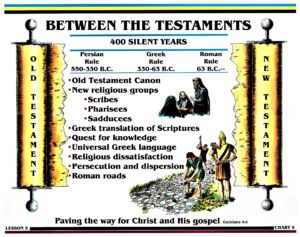
Chart Objective:
To explain events during the four hundred silent years that prepared the way for Christ’s first coming. Again, we await the fulfillment of
prophecies that must precede His return.
Chart Outline:
A. 400 silent years
B. Old Testament Canon
C. New religious groups
D. Greek translation of Scriptures
E. Quest for knowledge
F. Universal Greek language
G. Religious dissatisfaction
H. Persecution and dispersion
I. Roman roads
J. Paving the way for Christ and His gospel
A. 400 silent years
After the completion of the writing and ministry of the Minor Prophets, God ceased speaking with Israel. During this time of silence, scant historical records reveal the struggle to obey the law while enduring opposition from pagan conquerors.
The interval between the Testaments is termed the “four hundred years of silence,” meaning there were no vocal messages from God. However, there was a deep longing and yearning in every Jewish bosom for the freedom their coming Messiah would bring.
Four hundred “silent” years? To the historian and Bible scholar, these centuries were anything but silent! While God was not vocal, His hands were steadily preparing the way for the coming Messiah. Although the Jews could not comprehend what was happening, all the events now fit together like pieces of a puzzle.
Prophets were no longer ministering, yet the echoes of Daniel’s prophetic voice rang throughout the centuries. Nebuchadnezzar’s image of Gentile kingdoms was now making sense! It was all happening just as Daniel had explained!
At the conclusion of the Old Testament, Babylon’s head of gold had been overthrown. The Medes and Persians, represented by the silver chest and arms, had been ruling the world about one hundred years. For another one hundred years, Persia continued to reign over Judea—the new name given to Palestine. Persia’s world dominance lasted from 550 B.C. to 330 B.C.
About the middle of the fourth century, a new world power emerged as Daniel had predicted. Philip of Macedon began to weld together Greek city-states into a powerful military force.
Greece had long been a cultural center among the Mediterranean nations with its established language and customs. With the combination of several city-states under powerful Philip, Greece became a terrifying force.
In 336 B.C., Philip’s son, Alexander, took command of the Greek forces when his father died. Though youthful, he displayed skill as a military leader and soon his campaigns made him world-famous.
Swiftly Alexander’s forces swept across Egypt, Syria, Assyria, Babylon and Persia, making him a world ruler by 331 B.C. Superpower Greece was indicated in Nebuchadnezzar’s image as the brass thighs.
Alexander the Great showed special kindness to the Jews and spared Jerusalem. He even offered incentives to persuade the Jews to settle in the city of Alexandria, Egypt, which had been built in his honor.
The victorious armies of Alexander the Great established Greek cities wherever they went. The Greek language and culture flourished as these cities became centers of a new civilization known as “Hellenic” culture.
After only a brief reign, Alexander died at age thirty-three, having conquered more territory than any of his predecessors. His vast empire was then carved into four parts: Egypt, Syria, Greece, and an area now known as Turkey.
Palestine was first ruled by Syrians. Then Egyptian kings took control. Jewish life was peaceful during this period. Synagogues were established in many cities, and Alexandria, Egypt, became an influential center of Judaism.
Later, in 198 B.C., Syria again gained control of Palestine. Antiochus the Great determined to force the Jews to accept the Greek culture. Then in 175 B.C. a new king, Antiochus Epiphanes, came to rule Syria. Since the unique Jewish religion conflicted with the Greek Hellenism, he decided to destroy them.
Thus began one of Israel’s darkest periods. The pagan image of Jupiter was erected upon the Temple altar—which the Jews termed “the abomination of desolation” spoken of by Daniel (8:11-13).
Greek soldiers performed profane rites in the very sacred Temple courts and swine were sacrificed on the altar. Under penalty of death, Jews were forbidden to practice circumcision, observe the Sabbath or other Jewish festivals. All copies of Hebrew Scriptures were ordered to be destroyed and laws were enforced to promote Hellenism.
But the Greeks went too far. Their zeal for erasing the old order of Judaism prompted one of the most heroic struggles in history. Led by Mattathias, a courageous Jewish priest, and his son, Judas, a succession of battles were won against unbelievable odds.
Finally, the city of Jerusalem was retrieved from Syrian control and the Temple purified and re-dedicated.
The word “Maccabee” means “hammer.” Because of the hammer blows dealt the Syrian armies, Judas and his men became known as “Maccabees.”
From 167 B.C. to 63 B.C. the Jews enjoyed a period of independence. But then a new world power arose. In 63 B.C. the image’s “legs of iron” described by Daniel came into power.
Palestine was conquered by the Romans under Pompey. Judea’s newly appointed governor was Antipater. His son, Herod the Great, ruled Judea from 37 B.C. to 4 B.C.
To gain favor with the Jews, Herod the Great rebuilt the Temple at Jerusalem in magnificent splendor. But at heart, he was a brutal ruler. Herod was also the cruel monarch ruling when Christ was born and was responsible for the massacre of innocent babies in the surrounding region (Matthew 2:1-23).
B. Old Testament Canon
Literature from this period reveals what occurred during the four-hundred-year period between the Testaments. The Maccabees wrote books describing the Jews’ struggle for freedom. However, their writings were not considered divinely inspired and therefore were not included in the canon of Holy Scripture. Neither the Jews, the noted Jewish historian Josephus, or Jesus and the early Christians accepted or quoted from any of these fifteen books.
During the era from Malachi to the time of Christ, a most important event was the compiling of sacred writings. The word “canon” means a measuring stick or rod; a standard by which a thing is measured or judged. When applied to the Old Testament, it means that the selection of sacred writings of that period met a particular standard of divine inspiration. Other writings were omitted from the collection.
Ezra is believed to have played a vital role in collecting and preserving these sacred books. The collection accepted by the Jews as the Word of God were never questioned either by ancient Jews or Christ and His apostles.
C. New religious groups
A quick look at the New Testament reveals several religious groups that developed during the period between the Testaments.
The distinguished “Sanhedrin Court” presiding at Christ’s trial evolved during this era. As the governing body of the Jewish nation, the Sanhedrin may have formed as early as the third century B.C. They dealt with religious matters and were permitted to rule the Jews.
The Sanhedrin consisted of about seventy members, most of whom were priests. The court itself was led by the high priest.
“Scribes” were secretaries who both copied and interpreted the Old Testament scriptures. Having been given the power of interpretation, the scribes were highly esteemed among the people.
“Pharisees” were Jewish leaders of the third century who fought viciously in the Maccabean wars to oppose the influence of Hellenism. The word “Pharisee,” meaning “separated one,” identified those who had separated from outside worldly influence.
A system of oral traditions developed among them was quite burdensome to Judaism during the time of Christ. Their traditions were not merely commentaries upon the law but were ultimately raised to the level of Scripture itself. The desire to be seen of men replaced living for God’s glory.
The “Sadducees” of the New Testament era became the party of the Jerusalem aristocracy and the high priesthood. Cooperating with political rulers and having attained positions of wealth and influence, they were responsible for Temple administration and rituals. The Sadducees held themselves aloof from the masses.
Traditions and oral laws developed by the Pharisees were quite unacceptable to the Sadducees. Their canon seems to have been limited to the Pentateuch, or Moses’ five books of law.
“Essenes” were a more isolated and extreme Jewish sect. Most of them lived in monastic communities, such as the one at Qumran, from which the Dead Sea scrolls originated. Their lives were rigorous and simple. Devotion and religious study occupied an important place in the community. Scripture and other religious books were studied and copied by Essene members, though each member was required to perform manual labor to make the community self-supporting.
D. Greek translation of Scriptures
Another significant event of this period was the translation of Old Testament Hebrew Scriptures into Greek. This task was performed in Alexandria, Egypt, by a group of Hebrew and Greek scholars.
First the Pentateuch, then the entire Old Testament was translated. Greek had become the common language and the Septuagint (referring to the “seventy” translators) became the Bible of the common people.
Both Christ and His apostles used the Septuagint (pronounced “Sep-too-a-jint”), thus approving it as an authentic version.
Translating the Scriptures into the language of the people was a most important stepping-stone for Christ and His gospel.
E. Quest for knowledge
Wherever the Greek military marched, their culture was scattered. Grecians taught the world the importance of learning and education.
Accelerated learning no doubt produced its share of atheists, yet a desire also blossomed in others to discover the meaning of life. Why are we here? Where did we come from?
The Septuagint Version provided the answers! Grecian influence created a quest for knowledge that ripened thousands for the coming message of Christ.
F. Universal Greek language
Another vital aid in spreading the gospel message was the development of a language of the people. While the world was under Grecian influence, everyone learned to speak Greek—in addition to his own native tongue.
This gave Christ and His disciples the tremendous advantage of preaching and writing the gospel in a language all could understand.
G. Religious dissatisfaction
The two major religious sects had little to offer. The cold, hypocritical Pharisees were disgusting. The worldliness of the Sadducees was sickening. Having to choose between legalism and ritualism left a spiritual void.
Consequently, the formal religious groups prompted a longing for Messiah to come.
H. Persecution and dispersion
The Jewish captivity had scattered them to all parts of the world. Many Jews remained in the land of their captivity—Assyria, Babylon and Persia. Others traveled to distant lands. Settlements of Jews could be found in every major city.
Each locality had synagogues and Old Testament Scriptures. Soon Gentile nations would accept the message rejected by the Jews. Therefore, their presence in foreign lands paved the way for greater acceptance of Christ’s gospel.
A less desirable feature was the persecution endured under Antiochus Epiphanes. His rule prompted a deep longing in the heart of every devout Jew for deliverance.
While the Roman government was not murdering Jews as Antiochus had done, their taxation system terribly irritated the Jews.
Before God performs a spectacular work, His people must first desire that it happen. Persecution and oppression are useful tools for accomplishing His purposes. Although distasteful, they became paving stones!
I. Roman roads
With the rise of the Roman Empire, an era of road building flourished. Rome was responsible for building roads and developing world waterways. The most remote areas were discovered by her great ships in the quest for international trade and commerce. Rome had approximately one hundred years to build roads and establish trade routes before those routes would be used to spread the gospel. The disciples’ mission would have been impossible unless Rome had literally paved the way for Christ and His gospel!
Paving the way for Christ and His gospel Galatians 4:4
Christ did not come until the time was precisely right! Scripture indicates there was indeed a specific time for His birth.
“But when the fulness of the time was come, God sent forth his Son, made of a woman, made under the law” (Galatians 4:4).
Just before Jesus ascended, He gave signs that would precede His return to earth. Preparation for His first coming spanned several hundred years. But Jesus declared that the signs pointing to His second appearing would occur within the lifetime of one generation (Matthew 24:34).
Many of the events preceding His birth could be duplicated before His second appearing.
Scriptures translated. In one generation, the Bible has been translated into every major language of the world by the American Bible Society and other groups.
Coldness in religion. Legalism and formalism continue to sicken our generation with a dead, dull, boring religion. As the church blazes with revival fires, a ready audience will be waiting.
Travel made easy. Highways dot every nation. International airfare is becoming affordable. Why? So every nation can hear the good news within the lifetime of one generation!
Persecution and scattering. This part is undesirable. But it could be the motivating force that encourages the church to finish its task.
Jesus’ words could apply to no other generation than ours:
“Then shall they deliver you up to be afflicted, and shall kill you: and ye shall be hated of all nations for my name’s sake” (Matthew 24:9).
Persecution and hatred could be responsible for the final thrust:
“And this gospel of the kingdom shall be preached in all the world for a witness unto all nations; and then shall the end come” (Mat-thew 24:14).
God is doing a sovereign work among believers of all denominations. Our world is on the threshold of the catching away of the church of Jesus Christ!
An air of expectancy fills the earth as we patiently watch and wait for the completion of the “fullness of time” that will bring back our King!