A Remnant Is Restored
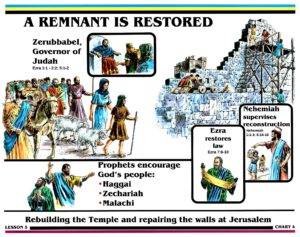
Chart Objective:
To survey the return of Israel’s “remnant” from the land of their captivity. They came to rebuild, restore and replenish the land, providing a lineage for the promised coming Messiah.
Chart Outline:
A. Remnant Is Restored
B. Zerubbabel, Governor of Judah
C. Rebuilding the Temple and repairing the walls
D. Ezra restores law
E. Nehemiah supervises reconstruction
A. Remnant Is Restored
About twenty-three years after the death of Nebuchadnezzar, his grandson, Belshazzar, was ruling. He hosted a feast, typical of extravagant luxury, self-indulgence and idolatry.
The king commanded that the sacred gold and silver vessels taken from the Temple at Jerusalem be given to drunken men and women to toast their idol gods. Suddenly, the fingers of a man’s hand began writing a message on the palace wall.
The sobered monarch ordered that some-one interpret the strange words. Daniel was brought to supernaturally reveal the words of doom for Belshazzar and his nation. That night the Medes and Persians conquered mighty Babylon and killed her king.
In the first year of Cyrus, king of Persia, the Lord caused him to release the Jews and allow them to build the Lord God a house in Jerusalem. His unusual benevolence resulted from Daniel showing him the prophecies of Jeremiah that had already been fulfilled (Jeremiah 25:11-12; 29:10) and the prophecies of Isaiah. This prophet had predicted that the Jews would return and rebuild Jerusalem and named Cyrus specifically (Isaiah 44:26-28; 45:1, 13)!
In the year 536 B.C., Cyrus issued a decree permitting Jews to return home. The sacred vessels were also restored. However, most Jews were affluently settled in the land of exile and preferred to remain there. A mere 42,000 people and 7,300 servants packed for the return trip to Jerusalem.
Zerubbabel, Governor of Judah Ezra 1:1 – 2:2; 5:1-2
Cyrus appointed Zerubbabel to be the governor of Judah. Seven months after arriving in Jerusalem, these determined exiles had erected the altar on its ancient site and the priests were again offering sacrifices.
Rebuilding the Temple and repairing the walls
Preparations were made to begin rebuilding the Temple. However, numerous setbacks and opposition delayed it for several years. Through the encouragement of prophets Haggai and Zechariah, Temple construction was finally completed in 516 B.C., though the city itself was in ruins and the walls shattered.
At last, the Jews had a house of worship and religious life. The Temple was constructed on the same general plan as Solomon’s, though much inferior by comparison.
Ezra restores law Ezra 7:6-10
Sixty years after completion of the second Temple, a priest-scribe named Ezra gained permission from the fourth king of Persia, Artaxerxes I, to return to Jerusalem. Ezra and 1,700 other Jews returned to Jerusalem. His primary purpose was to teach the law and restore Temple service.
The Jews re-established their worship. However, Jerusalem was not yet a fortified city.
Nehemiah supervises reconstruction Nehemiah 1:1-3; 6:15-16
After Ezra had been in Jerusalem for thirteen years, reports came to the court of King Artaxerxes concerning the sad state of Jerusalem and its exiles. At that crucial time, hope came to God’s chosen people through Nehemiah, a Jewish cupbearer to the king. Nehemiah received a leave of absence to lend help to his fellow countrymen.
Nehemiah should be honored for his constructive leadership in spite of opposition, hostility, and threats. His ability to organize the people for work and defense produced results that transformed the city of Jerusalem into an inhabitable place, after 150 years of desolation and desertion. The wall was completed in only fifty-two days!
Nehemiah joined Ezra in an effort to deepen the religious life of the people. In a public assembly, the law was read in the hearing of every citizen. Repentance and confession of sins renewed their covenant to God and to the law of Moses.
But as the years elapsed, so did their consecration to God. Malachi, who prophesied about one hundred years after the exiles returned from Babylon, had to reprove them for irreverence, unfaithfulness, failure to pay tithes and corruption of the priesthood.
Against a background of man’s failure and departure from God, the Old Testament story ends. God promised to remove the curse of darkness with the coming “Sun of righteousness.”