The Kingdom Is Divided
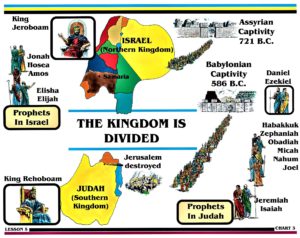
Chart Objective:
To explain how disobedience and idolatry resulted in the tragic division of God’s kingdom of covenant people. God’s prophets, although unheeded, accurately predicted captivity for both the northern and southern kingdoms, leaving the Promised Land desolate and abandoned.
Chart Outline:
A. The Kingdom is Divided
B. Israel – Northern Kingdom
C. Prophets in Israel
D. Assyrian Captivity
E. Judah – Southern Kingdom
F. Prophets in Judah
G. Babylonian Captivity
A. The Kingdom is Divided
Solomon’s reign is often termed the “Golden Age” of ancient Israel. Actually, Solomon reigned over a rather impressive empire assembled by his father.
When Solomon died, civil war loomed on the horizon.
Solomon’s son, Rehoboam, succeeded the throne. Because he exhibited such arrogance and lack of concern for his subjects, the kingdom split.
When the people requested a reduction of taxes, Rehoboam instead announced that the burden would increase. Ignoring the wise counsel of the elders, the young king identified with his youthful advisors and assured the division of Israel’s united kingdom.
The ten northern tribes revolted and appointed Jeroboam king. Rehoboam retained possession of only two tribes—Judah and Benjamin. The northern kingdom became known as Israel and the southern kingdom was called Judah.
B. Israel—Northern Kingdom
Israel’s capital was erected at Samaria. In the next two hundred years, her nineteen kings were responsible for an abundance of murders, suicides, and assassinations that kept the political situation in turmoil. Dedication to God was forgotten in the flurry of worshiping idols Jeroboam himself encouraged. Occasionally, God sent prophets to warn Israel of her rebellious ways.
C. Prophets in Israel
Such prophets as Elijah and Elisha provided human lips and tongues for the “Word of the Lord” to speak to His people. Separated unto God, they were divine instruments to call the nation to repentance. Through their preaching, hope for redemption was preserved for the remnant—despite the destruction, disaster, and despair.
Accompanied by numerous miracles, Elijah unashamedly preached repentance— even to wicked King Ahab and Queen Jezebel.
This fiery prophet is perhaps best remembered for the contest staged on Mount Carmel against the prophets of Baal. It was a “show-down” to determine whose god was real.
When God’s fire consumed both the sacrifice and altar of stones, He embarrassed the religion and prophets of Baal. For Israel, it was a summons to support the God of their fathers Who had repeatedly delivered them.
Elijah’s ministry climaxed as he was caught up in a whirlwind into a fiery chariot drawn by horses of fire. Elijah’s mantle was thrown to Elisha, thereby assuring his requested double-portion of the spirit of his predecessor.
Elisha’s ministry closely resembled Elijah’s, except that he participated in twice as many miracles.
D. Assyrian Captivity
Meanwhile, internal disorder and political instability had invited invasion by surrounding nations on the northern kingdom. The Egyptians and Syrians constantly threatened and weakened Israel.
Finally, in 721 B.C., the king of Assyria captured the Israelites and destroyed the capital city at Samaria.
The destruction had been clearly prophesied in preaching and writings by the prophets Amos and Hosea.
Another prophet of this era was Jonah, who warned Nineveh of impending doom. The writings of all three prophets are categorized among Old Testament books as “Minor Prophets.”
Thus, within 200 years after Solomon’s death, half of his great kingdom was obliterated. As a nation, the people of Israel never returned. Their land was populated by Assyrians, who intermarried with the poor class of Israelites left behind after the Captivity. From this mixture sprang the Samaritans of the New Testament.
E. Judah—Southern Kingdom
From the time of Solomon until the Assyrian captivity, seven different families or dynasties reigned in Israel. However, in Judah, the ruling lineage remained unbroken. To assure that the house of David would father the promised Messiah, this family line-age remained intact, preserving the ancient promise that the “sceptre shall not depart from Judah” (Genesis 49:10).
Nineteen kings and one queen occupied the throne of Judah at Jerusalem. Some of the kings were righteous. Others were extremely wicked and idolatrous, even desecrating the Temple of God. Great religious revivals took place during the reign of five kings.
F. Prophets in Judah
Numerous prophets warned Judah of judgment, but their influence was resisted. Eight prophets wrote warnings to Judah long before she was destroyed.
Joel is among the earliest prophets of Judah. He described forthcoming plagues and destruction. If the priests and Judah would fast and weep before the Lord, He would hear their cry and restore their fellowship.
Known as the “prophet of Pentecost,” Joel highlighted his book with the promised outpouring of the Holy Spirit upon the future Christian church. Joel foresaw a day of spiritual renewal when the hearts of the people would be receptive to God.
Joel’s prophecy was fulfilled in part on the Day of Pentecost hundreds of years later when Peter repeated Joel’s sermon (Acts 2:14-21). Our generation is witnessing the completion of the “latter rain” promise (Joel 2:23-31).
Nahum prophesied and reiterated to Nineveh the call to repentance which Jonah had issued 150 years earlier.
Micah, a small town prophet, ministered for the benefit of the poor. He condemned the wealthy leaders of Judah and Israel. Although without obvious effects, his prophecies were precise and exact. Micah cited the very birthplace of the future Messiah:
“But thou, Bethlehem Ephratah, though thou be little among the thousands of Judah, yet out of thee shall he come forth unto me that is to be ruler in Israel; whose goings forth have been from of old, from everlasting” (Micah 5:2).
Obadiah prophesied warnings during the end of the Old Testament era to Judah’s neighbor, Edom.
Zephaniah cautioned Judah to repent or be destroyed.
Habakkuk preached a similar message of coming judgment.
Two other prophets, Isaiah and Jeremiah, exercised significant influence. Their ministry and writings were more widespread; thus they are classified as Major Prophets.
Isaiah was a brilliant court preacher, who experienced prophetic visions of the coming Messiah. His portrait of the suffering Christ is the most vivid and descriptive.
Jeremiah’s writings related to preserving truth in Judah. Because of his relentless passion, he was severely hated, persecuted, and imprisoned as a traitor. Yet Jeremiah’s ministry continued and his predictions proved accurate.
G. Babylonian Captivity
In 606 B.C., more than 130 years after the northern kingdom had been taken captive by Assyria, the southern kingdom was conquered by Nebuchadnezzar, king of Babylon. A small portion of the population was displaced, but twenty years later, the Babylonians returned to burn the Temple and palaces, flatten the walls of Jerusalem, and destroy the city.
Judah’s King Zedekiah was blinded and taken with a group of prisoners into Babylon. Only the poorest citizens remained to cultivate the land.
Judah’s exile into Babylon was temporary. It lasted seventy years—just as Jeremiah had predicted.
Daniel, another Major Prophet, was among the first group of Jews deported to Babylon. His experience in the lions’ den occurred during the latter part of the Captivity. Both Daniel and Ezekiel are regarded as Exilic Prophets since they ministered during the Babylonian exile.
Israel is a prime example of a nation that disregarded God, His covenant and spokes-men. By His very nature, God is undefeatable. He remained God—even to Israel—through-out their captivity.
From the “set-apart” remnant in exile, God would again restore His people. Only as proud people are humbled and victimized to greater powers can God intervene.
One of Israel’s hardest lessons was under-standing that exile did not equate to defeat. She learned that Jerusalem, the Temple, and the Promised Land itself were not the most important things.
Jeremiah, Isaiah, and Ezekiel answered Israel’s hopeless cry, “How shall we sing the LORD’S song in a strange land?” (Psalm 137:4).
Through strong prophetic encouragement, the exiles began to renew their dedication to Yahweh and realize that restoration was possible.
An exact census is not recorded of these Babylonian captives. There was a minimum of 15,000 (Lovelace, Compass Points for Old Testament Study).
Was there a good purpose served during the Babylonian exile? God’s judgment was severe, yet many beneficial things resulted.
First, the Jews were forever cured of idolatry. Never again did they worship meaningless gods of gold, silver, wood, and stone.
Secondly, synagogue worship was instituted. The people assembled around a priest or scribe, whom they called “rabbi.” He rehearsed the laws of Moses and the prophets.
The canon of holy Scriptures was also formed. The prophets’ scrolls became more comforting and precious. Ezra and other men of God gathered these scrolls, making the Old Testament Scriptures a sacred possession of the people.
Finally, by dispersing the citizens of Judah and Israel, the knowledge of the one true God was taken to the civilized world. Every nation became acquainted with Israel’s Yahweh, the Sabbath, the Ten Commandments, and the hope of a coming Messiah. Thus, the groundwork was laid for the gospel’s missionary outreach in the approaching New Testament era.
God’s prophets continued to write, exhort, encourage, and preach. Listening from the mire of their helplessness, the people heeded their message more readily than before.
God was at work in the lives of His exiled people and in His plans for the world. Many hidden secrets were revealed to His prophets that relate to our own generation!
Daniel and Ezekiel played a very important role in the plan of God for the captive Jews and for us as well.
Having successfully completed numerous military campaigns, King Nebuchadnezzar enjoyed undisputed dominion over a vast majority of the world. He surely wondered about the future kingdoms that could be conquered.
Then one night the form of a terrible image appeared to the king in a dream. But it faded from his memory. His magicians were unable to reveal the dream, but Daniel accurately recalled and interpreted it.
This is perhaps the most dramatic of all prophecies in the Bible. It was presented in a most unusual setting and it traced the course of history from that day to ours—and beyond!
Five world empires were described. These were “Gentile”—not Jewish empires. Had Israel honored God, the nation may have become a dominant world power.
This prophecy is the basic structure of Daniel’s later prophecies.
The golden head represented Nebuchadnezzar’s Babylonian kingdom. The silver chest and arms typified the second world dominion of the Media-Persian kingdom that began seventy years later.
The brass stomach and thighs depicted the empire founded by Alexander the Great of Greece. The meaning of the iron legs—both in chapter 2 and in his vision of four beasts in chapter 7—is not specified. But it is termed the “Roman” empire because the Romans succeeded the Grecian empire as the center of world dominion. The feet were a combination of iron and clay, depicting rule by the masses (clay) and kings (iron).
Daniel explained that God had given world dominion unto Gentile nations. Four powers would successively rise and govern the world. In the time of the fifth, God Himself would set up a kingdom that would crush all the others and itself endure forever.
We shall see how this prophecy began to be fulfilled.