Judges and Kings in Israel
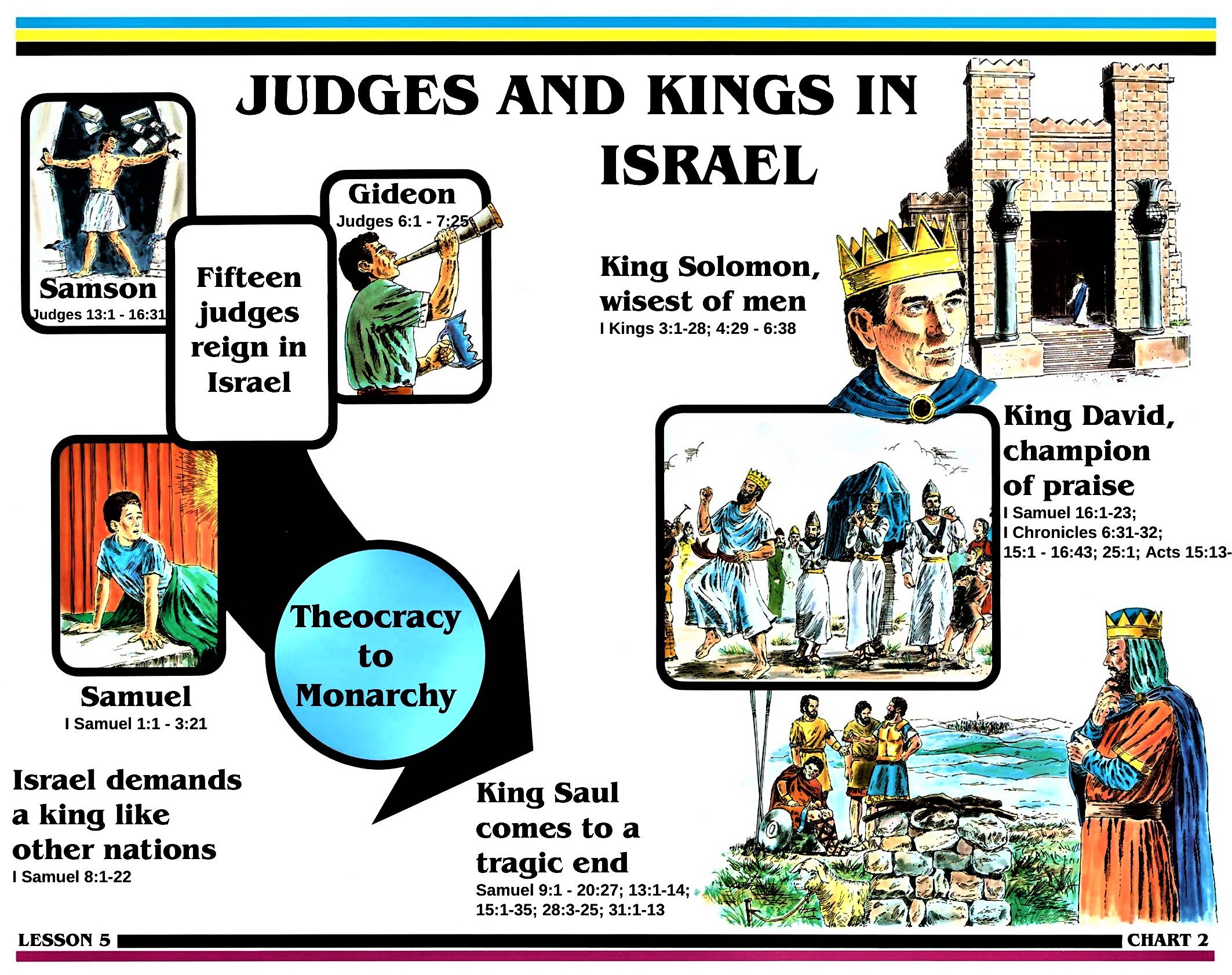
Chart Objective:
To explain the changing of Israel’s leadership. Anointed leaders called “judges” were replaced with kings like other nations. Thus, theocracy was changed to a monarchy, which flourished for 120 years.
Chart Outline:
- Fifteen judges reign in Israel
- Gideon
- Samson
- Samuel
- Israel demands a king like other nations
- Theocracy to Monarchy
- King Saul comes to a tragic end
- King David, champion of praise
- King Solomon, wisest of men
A. Fifteen judges reign in Israel
For two hundred years after Joshua’s death, Israel endured turbulent testings and trials. Scripture designates this period as “the days when the judges ruled” (Ruth 1:1). The entire era was a struggle for survival.
Judges were appointed to defend the people. However, such leaders were not like the magistrates of our courts of law. Israel’s judges were military types who brought victory while the people were settling in their homeland.
Frequently, the judges influenced both the government and religious life. Some possessed special inherited gifts of leadership.
No special deeds were attributed to five of the fifteen judges. Nor is there any particular chronological order in which they ruled. Several may have served simultaneously in different locations.
From a human viewpoint, these special judges saved Israel from constant threats by the Moabites, Midianites, Ammonites, and Philistines.
Throughout this period, a definite pattern emerged in Israel’s lifestyle. When the people strayed from godly principles and practiced idolatry, God allowed oppression and attacks from heathen neighbors. The people would repent and return to God. Then He appointed a judge to save Israel and restore peace.
When the judge’s influence diminished, the monotonous cycle was repeated.
Personalities described in the Book of Judges are diverse. Shamgar obtained victory over the Philistines by killing six hundred men with only an ox goad for a weapon.
Another triumph came through a woman judge, Deborah. Ehud overcame the Moabites by stabbing the king as he sat on his throne.
B. Gideon
Judges 6:1 – 7:25
One of the most notable judges was Gideon. For seven years the Midianites had stolen Israel’s crops and inflicted terror. God called Gideon to deliver Israel.
At Gideon’s call for volunteers, 32,000 men responded. Compared to the multitude of Midianites, this was indeed a tiny group. But Gideon directed the 22,000 fearful to return home. Only 10,000 remained—still too many!
Gideon instructed his troops to drink out of a brook. Some fell to their hands and knees. Others dashed water to their mouths, showing a sense of alertness toward the enemy. Only 300 passed the test.
Each man carried a trumpet in his right hand and a torch concealed in a pitcher in his left. At a signal, the crash of 300 pitchers, the blast of 300 trumpets, the shout of 300 voices, and the flash of 300 torches pierced the darkness.
Terrified, the Midianites began to kill each other. Gideon’s 300 were used by God to “[turn] to flight the armies of the aliens” (Hebrews 11:34), without sword or spear. Thus God proved that great numbers or human strength are not required to win battles. Just willing and obedient hearts and minds are necessary.
C. Samson
Judges 13:1 – 16:31
Samson was the most unusual judge. He led no army, yet performed great supernatural feats by himself. He possessed miraculous physical power, yet he had recurring moments of moral and spiritual weakness.
Samson was not a giant, nor was the great strength his own. He was empowered by God to occasionally perform great feats of strength.
But falling in love with a Philistine woman brought Samson’s downfall. Delilah pressured Samson to reveal the secret of his amazing strength. Three times Samson declined, but finally betrayed the secret of his strength. His head had never felt the touch of a razor. This Nazarite vow meant he was separated and specially dedicated to the will of God.
When the Philistines attacked, Samson’s strength was gone, he fell helpless to their capture, and was cruelly blinded.
The remainder of Samson’s life was torturous as he grinded at the mill in a Philistine prison. During a heathen feast, the Philistines displayed Samson as a victory trophy. While they mocked him, Samson prayed a final prayer. He asked for God’s power to again be manifested through him. He then pulled down the pillars of the heathen temple, killing more Philistines at his death than in all the victories of his lifetime.
D. Samuel
I Samuel 1:1 – 3:21
From the confusion and turmoil of the judges era comes one of the greatest Old Testament figures—the prophet-priest-judge, Samuel.
God called Samuel while a small boy sleeping in the Tabernacle at Shiloh. In the darkness, the child heard a voice calling, “Samuel!” He quickly arose and went to the aged Eli. But Eli said he had not called. After he returned to his bed, the voice was heard a second time.
Finally, after a third time, Eli realized this was God’s call and instructed the boy to answer, “Speak, for thy servant heareth.”
At the fourth call, the boy responded. Then God revealed to the youth an important message for Eli and called Samuel to be a great leader in Israel.
Samuel bridged the gap between the judges and kings of Israel.
Each year Samuel traveled in circuit to Bethel, Gilgal and Mizpeh to judge Israel and advise about legal and spiritual matters. He was also responsible for establishing “schools of the prophets” where young men studied the law of Moses, composed sacred poetry and music and became skilled in musical instruments (I Samuel 10:5; II Kings 3:15; I Chronicles 25:1, 6).
As a wise statesman, Samuel was responsible for educating and instructing the people, thus advancing the Hebrew nation.
E. Israel demands a king like other nations I Samuel 8:1-22
When the elders approached the aged Samuel to ask for a king—“like all the nations” (I Samuel 8:5), he took it as a personal insult. Their request was interpreted as a rejection of his own leadership. However, God thought differently:
“They have not rejected thee, but they have rejected me, that I should not reign over them” (I Samuel 8:7).
F. Theocracy to Monarchy
No longer was Israel interested in being God’s unique people. They wanted to be exactly what God did not want them to be— “like all the nations.” He has always wanted a separate people, dedicated to Himself. There should always be a marked difference in their conversation, attitudes, dress and manner of life so that all will recognize God’s prized ones.
Willing to relinquish her unique position to be like her contemporaries, God agreed to give Israel their heart’s desire.
Thus began the monarchy in Israel. Under the rule of three kings—Saul, David, and Solomon, the nation lived peaceably for 120 years, with each monarch reigning forty years each.
G. King Saul comes to a tragic end
I Samuel 9:1 – 10:27; 13:1-14; 15:1-35;
28:3-25; 31:1-13
That God instructed Samuel to anoint Saul as king seemed to indicate divine approval for this change in Hebrew government. However, human kingship was not in God’s original plan. Israel soon discovered what inherent dangers were involved in human rulership.
Saul was much admired by the people. “From his shoulders and upward he was higher than any of the people” (I Samuel 9:2).
A leader was expected to have these appealing physical characteristics.
In the early years of his reign, Saul led several military triumphs. God worked through him despite his lack of spiritual understanding. However, his glaring mistakes lessened his usefulness.
Once, Saul boldly assumed the priestly duties to offer sacrifice. Then he disobeyed Samuel’s command to totally destroy the Amalekites.
Failing to obey God’s directive, Saul severed himself from blessings. Samuel informed the king that God would reject him as ruler for rejecting God’s Word.
Another of Saul’s mistakes was his raging jealousy against David. The king challenged David for popularity and power. But soon it became apparent that David was God’s chosen leader.
The last chapter of Saul’s life is tragic. Saul tried twice to kill David. The embittered king committed suicide on the battlefield.
God called him, Samuel instructed him. Yet Israel’s first king perished by his own sword.
H. King David, champion of praise
I Samuel 16:1-23; I Chronicles 6:31-32;
15:1 – 16:43; 25:1; Acts 15:13-17
David’s reign began by divine approval. Combining God’s anointing with personal shrewdness and military expertise, he laid a foundation for a united kingdom. Through his brilliant efforts, the northern and southern tribes of Israel were firmly united. David reigned as supreme monarch in the royal city of Jerusalem.
David was a young shepherd when Samuel anointed him to be king. He achieved fame by his famous duel with the giant, Goliath. Such faith and trust were exhibited in God that the victory was single-handedly won for Israel. His success showed no ill effects as they had on Saul.
The Bible attributes David as “a man after God’s own heart.” In all of the Old Testament writings, he expressed the most gratitude. Praise and thanksgiving overflowed for all God’s blessings to him.
How he loved the house of God! What contributions he made to the worship of Yahweh!
Surely David was a “champion” of praise! His psalms have provided an outlet for praise and worship in every succeeding generation.
He was unique in that he was self-taught in the ways of pleasing the Lord. Without a scriptural precedent, he created his own expressions of worship.
The shepherd’s field was his classroom. While tending sheep, David’s joyful, exuberant spirit touched the heart of God!
Not only did he offer praise himself, but David continually urged others to do so.
“Oh that men would praise the LORD for his goodness, and for his wonderful works to the children of men!” (Psalm 107:8).
He instructed choirs and musicians to praise God with beautiful hymns, then appointed singers to praise the Lord continually.
David was thirty years old when he became king. Having established his capital at Jerusalem, plans were assembled to build a permanent Temple to replace the mobile Tabernacle. However, David was denied this privilege because of so much bloodshed during his reign. His son, Solomon, was allowed to build the Temple.
However, the Lord promised to build David a “house” or dynasty. His ancestors would “sit on the throne forever” meaning that Christ would emerge through the lineage of David.
Domestic difficulties illustrated defects in David’s character. The king committed adultery, then arranged the husband’s murder in an attempt to cover and justify David’s wicked deeds.
Nathan, the prophet, was sent by God to reveal the sin and evoke the king’s sincere confession and repentance.
Psalm 51 is the inspired record of David’s humility before God as he pled for forgiveness. God loves an attitude of repentance. Filled with remorse and deep shame, David’s prayer gushes forth like waters from a swollen stream.
David reaped the tragic fruits of his sins. But his life demonstrates how a repentant per- son can be forgiven and restored.
I. King Solomon, wisest of men I Kings 3:1-28; 4:29 – 6:38
Solomon was the wisest of all Israel’s kings. He was David’s son by Bathsheba and became the third king.
At the beginning of his reign, God invited Solomon to “ask what I shall give thee.”
The young king requested that God would grant him wisdom, knowledge, and an under- standing heart to discern between good and evil. God granted his request but also gave him riches, power and a long life.
A mother carrying a dead child and a mother carrying one who was alive sought Solomon’s counsel. Both claimed the live child. The king’s marvelous wisdom was displayed when he suggested to equally divide the living child between the mothers. Immediately the true mother pleaded for the child to be spared and given to the other woman.
Such simple, yet profound wisdom made Solomon renowned throughout the world. The queen of Sheba traveled a great distance to test his wisdom. She concluded that the half had not been told her of Solomon’s wisdom and the vast beauty of his kingdom!
Solomon began building a Temple for the Lord God in Jerusalem. David had accumulated much material and supplies for the project, yet Solomon searched the world for additional riches, gold, and silver.
The pattern resembled the Tabernacle with a Holy Place, a Holy of Holies, courtyard, and additional rooms and porches. It was larger and much more ornate. Such a structure was unequalled for its beauty and lavish extravagance.
Solomon’s life ended sadly. Although he had been blessed with profound wisdom, his wives “turned away his heart.” He had a thou- sand wives and concubines who persuaded him to build shrines for their foreign deities in Jerusalem. Such idolatry was repulsive and caused irreparable harm to Israel.
Meanwhile, many hidden forces weakened his kingdom. His policy of forced labor caused rebellion and discontent. Unbearable taxes were also levied. Judgment came to Solomon’s errant ways in the form of a divided kingdom.