Chart Objective:
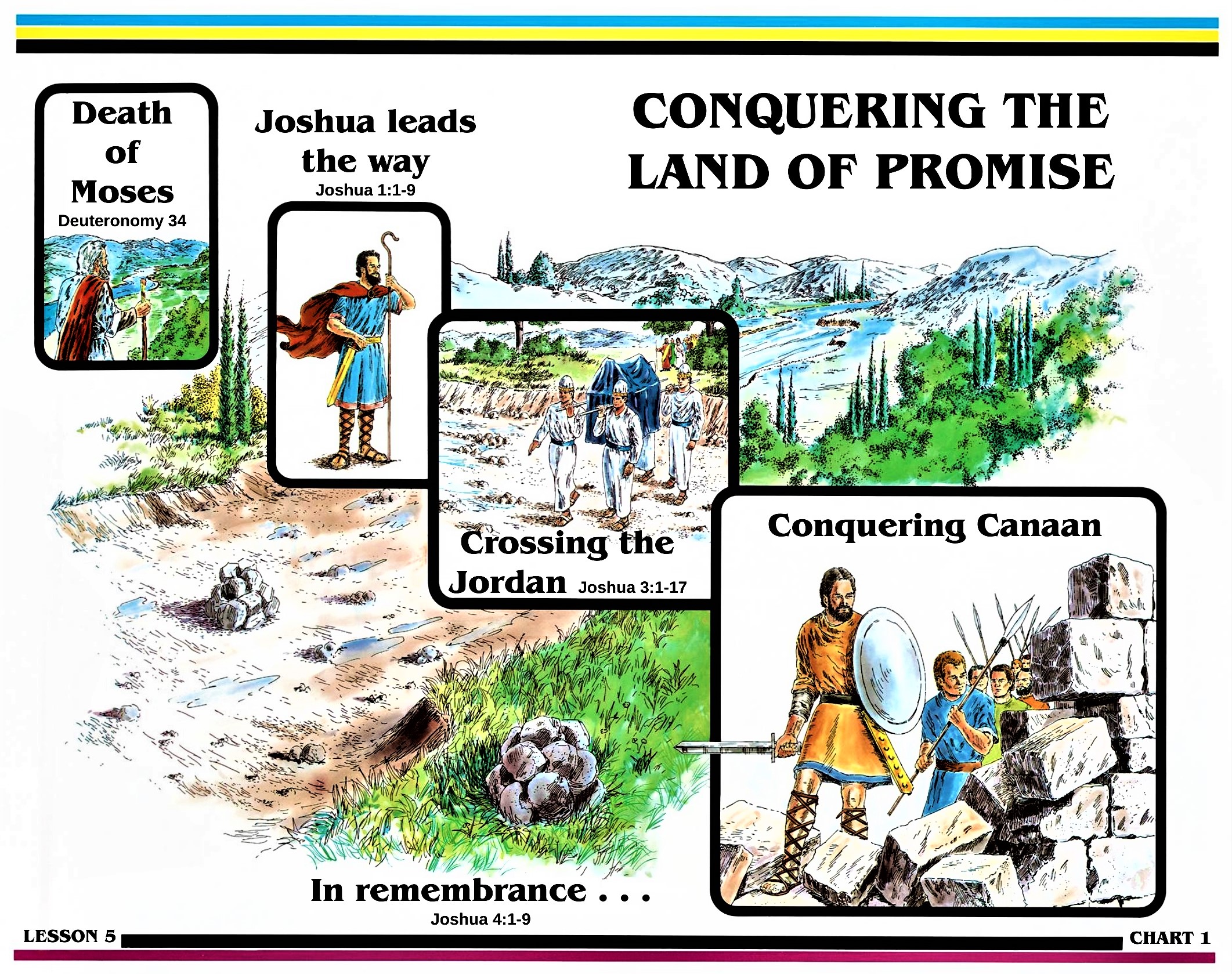
To travel with God’s covenant people, after a forty-year delay, to their new home in Canaan. The power of Israel’s covenant God was mightily displayed before heathen kingdoms as Israel conquered the land.
Chart Outline:
- Death of Moses
- Joshua leads the way
- Crossing the Jordan
- In remembrance . . .
- Conquering Canaan
A. Death of Moses Deuteronomy 34
For thirty-eight years, Israel wandered in the wilderness. Little is recorded of that period. They simply wandered until the unbelieving generation died and a new one could claim the land promised to Abraham.
Finally, Israel returned to Kadesh, the exact place where they had turned back to begin their long trek in the wilderness.
Moses was prohibited from entering the Land of Promise. When there had been no water, God instructed Moses to speak to the rock. Instead, reacting to the criticizing people, he struck the rock twice with his rod. An abundant supply of water gushed forth, but this disappointing reprimand was sounded:
“Because ye believed me not, to sanctify me in the eyes of the children of Israel, therefore ye shall not bring this congregation into the land which I have given them” (Numbers 20:12).
At the age of 120, Moses delivered his farewell address. It spans the entire book of Deuteronomy, which means “second law- giving” or “law repeated.” Moses purposely reinforced God’s laws once again in the minds of the people.
On the brink of Canaan, after a forty-year struggle with their unbelief and disobedience, Moses re-emphasized the importance of loving and obeying God:
“And thou shalt love the LORD thy God with all thine heart, and with all thy soul, and with all thy might. And these words, which I command thee this day, shall be in thine heart” (Deuteronomy 6:5-6; also 10:12-13; 11:1; 13:3).
To love and obey God is still the most important principle we can learn.
Having completed his blessing upon the people, Moses ascended Mount Nebo, the highest peak of the Pisgah range. The form of this beloved leader slowly vanished into the distance for the last time.
The grand old leader of Israel retained a clear vision and youthful strength. His mental and spiritual powers had not diminished. But God’s work for him was completed.
Somewhere near the top of the mountain, God paid His respects to Moses and buried him. The exact burial place is unknown. Angels contended over his body, but Satan lost the battle (Jude 9).
Moses was not seen again until centuries later when he stood with Elijah and Christ on the Mount of Transfiguration. At last he stood on a mountain inside the Land of Promise, worshiping and testifying of that greater Prophet who had finally come (Matthew 17:1-5).
B. Joshua leads the way Joshua 1:1-9
Another leader stepped forward. Joshua was a man of power, courage, wisdom and immediate action. He was one of two survivors of the original twelve spies sent to Canaan almost forty years earlier. Joshua and Caleb had given a positive report of faith.
After thirty days of mourning for Moses, the call came to march forward. The responsibility for two million people was entrusted to their new leader.
The biblical narrative continues in the Book of Joshua. The first five books of law were written by Moses. The next section covers the History of the nation of Israel.
An impossible task awaited Joshua. The flooding Jordan River barricaded them from the land of Canaan. How could he lead this host of people across an overflowing, turbulent river, while enemy nations guarded the other side?
Joshua’s earlier espionage experience exposed him to the giant races, the skilled, warlike people, their chariots of iron and the colossal, walled cities.
The Lord commanded:
“Moses my servant is dead; now therefore arise, go over this Jordan, thou, and all this people, unto the land which I do give to them, even to the children of Israel” (Joshua 1:2).
C. Crossing the Jordan Joshua 3:1-17
The people were instructed: “Prepare for crossing Jordan.” The trek itself was directed by their ministry—the Levites. The priests carried the ark, representing the presence of God.
God’s plan remains that ministers of the gospel be examples in courage, guidance and leadership. When faithful ministers lead, the people will follow.
Between the ark and the people was a distance of 2,000 cubits (about a mile), so that all could see the way. It was as if God were saying to the heathen Canaanites, “Come and battle against Me if you can. My people are behind; I alone will meet and defy you all!”
The pillar of cloud had vanished. Israel was forced to walk by faith rather than sight. Crossing the swollen river required a miracle. In the spring season, melting snows from Mount Hermon created flooded conditions. But when the priests’ feet touched the
“brim of the water,” it happened!
The waters stopped at the city of Adam, about fifteen miles north of the Dead Sea, leaving a wide, dry expanse for the Israelites to cross. Far to the right, the waters were miraculously drawn into a heap, while the waters below quickly drained into the Dead Sea.
God’s people hurried across the dry riverbed, past the priests standing in the midst of the Jordan. About five to ten miles west of Jordan, they camped at Gilgal. This became headquarters for the women, children and cattle until the land was conquered and divided among the tribes.
D. In remembrance . . . Joshua 4:1-9
Joshua ordered the erection of two memo- rials to commemorate the miracle of the Jordan crossing. A man from each tribe carried a stone from the riverbed to build one on the west bank. A second memorial was constructed by Joshua in the Jordan riverbed itself.
Twelve stones were stacked where the priests had carried the ark. At this height, the monument extended out of the water most of the year unless the river was overflowing.
Under the law, many memorials were erected. God designed that the story of His provision and special covenants be related from generation to generation. Thus, the two Jordan monuments provided a focal point for youthful questioning minds.
Parents responded to such inquiries to sow seeds of instruction. Fathers recounted how that Yahweh had brought Israel across the Jordan on dry ground, just as He had earlier delivered their forefathers at the Red Sea.
The purpose for instructing through memorials was that “all the people of the earth might know the hand of the Lord, that it is mighty: that ye might fear the Lord your God for ever” (Joshua 4:24).
An Israeli child’s inquisitiveness was an important means of perpetuating the faith of Yahweh. Instruction in the sacred traditions was a perpetual obligation. In fact, it’s a wonderful method for teaching our own families!
When the priests came out of the Jordan riverbed, the heap of water fell and again overflowed the banks. This meant there was no turning back for Israel. The wilderness life was erased forever. Now within the scope of their promised inheritance, their task was to drive out the enemy and possess the land.
Another very important practice had to be renewed. The covenant sign of circumcision had evidently been neglected during the wilderness wandering. None of the new generation had been circumcised.
The miraculous crossing of the Jordan surely inspired God’s people to eagerly desire the renewal of their covenant agreement with Him. This special distinctive mark in their flesh reminded each male both of his responsibilities and of his blessings as a member of God’s holy nation.
E. Conquering Canaan
Israel’s new homeland was a place of freedom and rest. It was not a new land, but the site of her forefathers. But now, heathen inhabitants had already cultivated the land, built homes, cities, planted orchards and vineyards. All Israel had to do was conquer and become the benefactor.
The Book of Joshua records the history of a seven-year triumphant military campaign. They suffered one major defeat. When Joshua and his people were absolutely obedient to God’s will and Word, they were victorious. Otherwise, when their own strategy was substituted, it resulted in failure and defeat.
During the bloody conquest of the Promised Land, Yahweh fought with Israel against her enemies.
Which people were to be victims? Only the Canaanites, the cursed lineage of Ham’s son, Canaan. They had been judged during Abraham’s day. But God declared,
“The iniquity of the Amorites is not yet full” (Genesis 15:16).
The Canaanite lineage had lasted an additional four hundred years for them to turn from their wickedness. They were so morally and spiritually corrupt that God finally warned:
“And the land is defiled: therefore I do visit the iniquity thereof upon it, and the land itself vomiteth out her inhabitants” (Leviticus 18:25).
God could no longer tolerate these vile practices: incest, bestiality, homosexuality, sodomy, adultery, prostitution, divination, offering human sacrifices to idol gods, enchanters, witches, observers of times, consulting with familiar spirits, wizards, necromancy, and sorcery (Leviticus 18; Deuteronomy 18:9-12; 23:17-18).
Bible historians and archeologists verify that the Canaanites were among the most corrupt civilizations ever to exist. Their religious cults and practices became a stench, and God determined to destroy them.
This command was God’s wrath against the Canaanites and also a precaution against the Israelites adopting pagan worship. All pictures, molten images, high places (places of worship on high ground associated with human sacrifice and immoral behavior) and monuments of idolatry were to be completely destroyed. Not a trace of their horrible abominations should remain in the land.
If God exiled the Canaanites for their immoral, idolatrous conduct, what judgment surely awaits our land!
After the conquest, the land was divided among the twelve tribes. Realizing that the people were inclining toward idolatry, Joshua announced a solemn assembly at Shechem.
In this farewell address, Joshua rehearsed Israel’s history, especially detailing God’s deliverance and blessing. Then he introduced several challenges. Israel faced whether they would continue serving Yahweh or be influenced by Canaanite heathen religions. Into the hands of the Hebrew people, he placed the choice.
At Sinai, their grandparents had chosen Yahweh and entered into covenant with Him. However, this new generation should decide for themselves. Joshua’s challenge remains relevant for today: “Choose you this day whom ye will serve.”
Then he determined for his family: “As for me and my house, we will serve the LORD” (Joshua 24:15). Today each individual must make that decision. Others may persuade, but they cannot decide for you. Others can pray, but they cannot control your destiny. The choice is yours—exclusively!
Joshua also warned that Yahweh was a “jealous God.” They must have no other gods before Him. All substitute idols must be rejected.
The people’s decision was a delightful one. Like their forefathers, they confessed,
“Therefore will we also serve the LORD; for he is our God” (Joshua 24:18).
Again, love, obedience and faithfulness to their covenant Partner and His law were the crucial test for Israel’s new life in Canaan.