Lessons in the Wilderness
This is a study of the lessons God taught His covenant people at Mount Sinai.
Bondage and oppression prompted God’s covenant people to long for their Promised Land. God heard their groans and sent a deliverer.
Ten plagues forced Egypt’s ruler to let God’s people go! The Passover became a perpetual ordinance for Israel and a beautiful type of our redemption from sin. The blood of our Lamb has not only “covered,” but has cleansed and remitted our sins.
After miraculously crossing the Red Sea, they journeyed toward Mount Sinai, their temporary schoolroom. Before becoming God’s peculiar treasure and model to all nations, Israel had much to learn.
They must enter into covenant and be taught laws for holy living, acceptable worship, how to get along with one another, discipline, obedience to Moses, and military training.
Because the Israelites were spiritually dead, the law must be obeyed from the soul (mind, will, emotions). Israel must be legislated in detail what would please God and what would not.
Now that our spirit is recreated when we believe and obey the gospel, His commands are written in our “heart” and spiritually understood.
When completed, students should be aware of the following concepts:
- God is willing and ready to deliver His people when they call upon His
- Unbelief hinders our spiritual progress and prevents us from obtaining God’s
- God still desires to occupy the central place in our As the Levites were positioned between Israelite tents and the Tabernacle, godly ministers now serve as our instructors and overseers.
- As His special possession, covenant people are to be marked and set apart from all others.
- The old covenant laws were visibly written on stone tables because of their dead spirits. New covenant laws are written in the hearts.
Additional books for reading:
- John J. Davis, Moses and the Gods of Egypt, Grand Rapids: Baker Book House, 1971.
- Charles Pfeiffer, Egypt and the Exodus, Grand Rapids: Baker Book House, 1964.
- W. Kenyon, The Bible in the Light of Our Redemption, Lynnwood, WA: Ken- yon’s Gospel Publishing Society, P. O. Box 973, Lynnwood, WA 98036, 1969.
Lesson 4 – Chart 1
God Sends A Deliverer
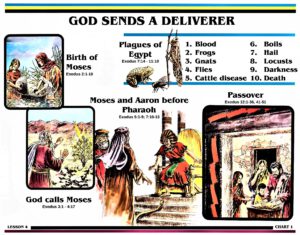
Chart Objective:
To prove that God will always deliver His people when they call upon His name. The Passover is a fascinating Old Testament type of Christ’s redemption from sin.
Chart Outline:
- God Sends a Deliverer
- Birth of Moses
- God calls Moses
- Moses and Aaron before Pharaoh
- Plagues of Egypt
- Passover
A. God Sends a Deliverer
We now leave “Genesis”—the book of beginnings—to study the other books of the “Pentateuch” (law).
“Exodus” describes the “exit” or departure of Israel from Egypt.
“Leviticus” (relating to the “Levites”) teaches the holiness of God and how to properly approach Him.
“Numbers” is so named because the Israelite fighting force was twice numbered (1:2-46; 26:2-51). This book describes Israel’s forty-year wilderness journey at Sinai, their murmuring and unbelief.
“Deuteronomy” (second law) records Moses’ farewell address. This book prepared Israel to enter the Promised Land and encouraged them to renew their covenant with God.
Exodus opens with God’s covenant people awaiting deliverance from a pagan land.
As we begin this practical study of the everyday life, struggles and temptations of the Israelites, remember: God is not nearly so concerned with what we go through as He is in how we respond to life’s varied situations.
Will we rebel, complain, and criticize or allow Him to be our Lord and Ruler?
In each of their difficulties, imagine yourself to be in Israel’s place. What would you do? How would you respond to the problem? Could you be patient and understanding or would you also be overcome with doubts and unbelief?
But why were they in Egypt? Did a loving God intend for His chosen ones to be cruelly treated and enslaved?
Had Israel and his sons remained in grandfather Abraham’s promised land, they would have died during the severe famine. In Egypt, they had flourished into a large nation. Fulfilling the promise made to Abraham, they had begun to multiply as the stars of heaven and sand on the seashore:
“And the children of Israel were fruitful, and increased abundantly, and multiplied, and waxed exceeding mighty; and the land was filled with them” (Exodus 1:7).
Why then, should the Israelites endure oppression and slavery? God’s purpose was to illustrate the benefits associated with affliction. Slavery toughened them for the wilderness journey and weaned them from Egypt’s prosperity. Without persecution, Israel might never have departed from their adopted land. As the whips of the Egyptian taskmasters lashed across their backs, thoughts of Canaan became more enticing. As the Hebrew slaves became more miserable, their sighs and cries blended into a groan; and God heard their groaning.
Suffering has the special quality of refining the heart. David said, “Before I was afflicted I went astray: but now have I kept thy word” (Psalm 119:67). Do you suppose that twenty-first-century pressures and problems might also be toughening us for trouble-some times just ahead? Paul reminded us:
“All things work together for good to them that love God, to them who are the called according to his purpose” (Romans 8:28).
Satan had sought to destroy the promised “seed of the woman.” Knowing that Abraham had been specified in that lineage, the enemy determined to destroy his descendants. When a pharaoh came to the throne who “knew not Joseph,” this was the devil’s chance.
Fearing that the Israelites would join with an enemy king in time of war, the pharaoh oppressed the Israelites, hoping to stunt their rapid growth. But during strenuous labor, they multiplied.
Then the Hebrew midwives were ordered to kill every male child at birth. But they feared God and would not obey the command. Finally, Pharaoh commanded the Egyptians to report the birth of male Hebrew babies; whereupon, the infants would be drowned in the Nile River.
B. Birth of Moses – Exodus 2:1-10
Paradoxically, the same measure chosen to destroy Israel effected their deliverance!
About this time, Amram and Jochebed, a godly couple of Levi’s tribe, were blessed with a fine baby boy. Something about this tiny son seemed special. They saw he was a “proper child” (Hebrews 11:23) and determined to keep him.
After concealing their baby at home for three months, Jochebed constructed a small chest-like ark of bulrushes, or papyrus plants, and sealed it with pitch. Her son became the ark’s precious cargo laid among reeds at the Nile’s bank.
What faith! How could a child be preserved where Pharaoh had directed that he be killed?
The tiny ark was strategically placed where the princess usually bathed. Miriam, the child’s sister, was instructed to watch. When the baby began to cry, motherly instincts were instantly aroused in the princess’ heart. She determined to rescue for herself this one Hebrew boy.
Quickly Miriam offered to find a nurse-maid, and Moses’ own mother received wages for doing what most pleased her!
The princess named the baby “Moses,” meaning, “I drew him out of the water.”
Moses’ most beneficial education was from his God-fearing parents. He learned precious truths and stories of Abraham, Isaac, Jacob and Joseph. No doubt Jochebed impressed upon her son that soon they would leave this terrible place of slavery to possess a promised land.
In the East, children are usually nursed the first three years. Moses’ mother had a short time to teach her son, but it was his only parental instruction about God’s ways.
The child was adopted by the princess and given a royal education. Moses’ parents had hoped only that he live. Never did they dream that he would become great, wise, rich, well educated and powerful!
Thus, God turned Satan’s evil scheme to be the means of deliverance for His chosen people. Pharaoh provided free lodging and education to the very man who would accomplish what Pharaoh was trying to prevent!
From Adam to Christ, no one accomplished more than Moses. He is among the few Bible characters whose life is sketched from infancy to death. God’s early dealings with Israel were transacted as Yahweh spoke face to face with this prophet, priest and king. As Moses matured to adulthood, he surely dreamed of ascending Egypt’s throne and instantly liberating his enslaved people. But such was not God’s way.
Once while visiting a royal construction project, the young Hebrew observed the inhuman treatment of his people. What should he do? Should he ignore their plight to seek his own fame and prestige among the Egyptians? Few people have had to make Moses’ decision. It would equal rejecting the presidency of the United States or the throne of England to associate with a chain gang on a prison farm.
Remembering his mother’s teaching, Moses made the wisest choice of his life:
“By faith Moses, when he was come to years, refused to be called the son of Pharaoh’s daughter; choosing rather to suffer affliction with the people of God, than to enjoy the pleasures of sin for a season; esteeming the reproach of Christ greater riches than the treasures in Egypt” (Hebrews 11:24-26).
Having made his decision, at the age of forty years, Moses launched into his role of deliverer—but without divine mission or command. In retribution to merciless treatment of his kinsmen, he reacted and killed an Egyptian taskmaster and hid the body in a shallow grave.
The following day he tried to settle a Hebrew dispute. But one asked, “Do you intend to kill me as you did the Egyptian?” With the secret exposed, Moses was compelled to escape for his life.
Moses fled to Midian. His Egyptian education completed, now he enrolled in God’s Wilderness University.
Another forty years were spent in the Sinai (pronounced “Sigh-nigh”) Desert as a shepherd. Yet he was mastering important leadership qualities for the future. Soon he would lead to this mountain, not a flock of sheep, but the flock of God’s people. Upon this same mountain he would receive one of the greatest revelations ever given to man.
C. God calls Moses – Exodus 3:1 – 4:17
Toward the end of Moses’ exile, another pharaoh came to the throne. God was ready to deliver His people.
Once while tending his sheep, a spectacular sight arrested Moses’ attention. A wild acacia bush was enveloped in flames—but was not consumed! As Moses investigated, the angel of the Lord spoke from the burning bush: “Moses! Do not come near. Put off your shoes, for the place where you are standing is holy ground.”
Moses had to learn of God’s holiness and that He must always be approached with reverence and awe.
Trembling, Moses hid his face. God spoke, “I am the God of Abraham, Isaac, and Jacob. I have seen the affliction of My people and I am come down to deliver them from the hand of the Egyptians and bring them to a land flowing with milk and honey. I will send you to Pharaoh that you may bring My people out of Egypt.”
Delivering Israel was exactly what he had wanted to do forty years ago. But now he felt inferior to the task. Graciously the Lord promised, “Certainly I will be with thee.”
Then Moses questioned what name of authority should be given. Who was the “God of his fathers”? Until then, He had been known as El, Elohim, Shaddai, or Yahweh. His new name would be “I AM THAT I AM,” meaning “He who alone exists.” The great “I AM” is ONE God!
After centuries, Yahweh introduced Himself as a personal, living Being ready to fulfill the covenant promises.
Every new revelation of God’s name from this time forward provides a fuller and clearer understanding: “Yahweh-Jireh,” “Yahweh-Nissi,” “Yahweh-Shalom.” Each compounded name reveals such attributes as: provision, righteousness, healing, peace, and others.
When Moses’ self-inadequacy persisted, God furnished a threefold symbolical reply that would silence his critics and encourage Moses himself. For the first time, a man was empowered to draw attention to God’s greatness through the working of miracles.
God commanded Moses to throw his ordinary shepherd’s staff to the ground. When it became a serpent, he fled in terror. But at God’s command to grasp the serpent by the tail, it again became a rod in Moses’ hand.
A second sign involved Moses’ hand: first it became leprous, then cleansed. The third sign was power to turn the Nile water to blood.
To Moses’ excuse of having a speech defect, the Lord appointed Aaron, Moses’ brother, as spokesman. With a divine com- mission, Moses returned to Egypt with his wife and two sons.
Before reaching his destination, however, Moses learned another important lesson. The covenant sign of circumcision had been neglected in one of his sons. While the family lodged for the night, Moses was suddenly stricken ill as the Lord “sought to kill him” (Exodus 4:24). When he and his wife perceived the purpose for the sickness, Zipporah herself performed the rite. Immediately, Moses recovered.
To be a lawgiver and leader, Moses must observe God’s first command to Abraham. Without circumcision, an Israelite was alienated from the covenant.
D. Moses and Aaron before Pharaoh Exodus 5:1-9; 7:10-13
Back at Egypt, the two brothers met with the elders of Israel to deliver a divine message. The time had finally arrived to leave Egypt for their long-promised home!
Then began the mightiest conflict in history. On one side was arrayed the power, wealth, and splendor of Egypt and its pagan- ism. On the other was a poor, aged, discredited man and his brother.
Through the palace gates they went, ask- ing the king to liberate three million people! At first the Egyptians must have scoffed and ridiculed. But soon their laughter would be turned to anxiety and then to pounding fear!
Haughtily Pharaoh asked,
“Who is the LORD, that I should obey his voice to let Israel go? I know not the LORD, neither will I let Israel go” (Exodus 5:2).
Unrelenting, Moses and Aaron presented persuasive reasons. But the pair were accused of inciting Hebrew laborers to discontent. Their labor was doubled. Formerly, straw had been provided. Now they must find stubble to make the bricks.
Incidentally, archeologists have uncovered Egyptian buildings with bricks made of stubble rather than straw, as recorded in Exodus 5:12. Doubtless, this book was written by someone who knew the facts!
Often the path to deliverance winds through the valley of “deeper trouble.” But God instructed Moses to quit begging or pleading. Deliverance strategy was about to commence! Moses and Aaron would contend against the gods of Egypt and magical heathen arts.
When Pharaoh demanded to see a miracle, Aaron threw Moses’ rod to the ground and it became a serpent. The sorcerers and magicians performed a similar feat, but Aaron’s rod swallowed up theirs.
Had He chosen to, the Lord could have instantly slain Pharaoh and all his people. Instead, He patiently exhibited supernatural power to prove the inferiority of the gods of Egypt and that He alone was worthy of worship.
Pharaoh had inquired, “Who is the Lord? I know not the Lord!” After the completion of the ten plagues, the two would be well acquainted!
E. Plagues of Egypt Exodus 7:14 – 11:10
Egyptian gods differed from deities of surrounding countries. Egypt’s idolatrous religion was morally and spiritually degrading.
Each Egyptian god and goddess was depicted having human bodies and animal heads. The bull, lion, ram, cat, wolf, dog, vulture, falcon, crocodile, cobra, frog, locust, and other animals and insects were considered sacred. Unlike other Eastern rulers, the Egyptian pharaoh did not rule for the gods, but was literally one of the gods. Naturally, a request for Israel’s release would be rejected. The first plague occurred as Pharaoh was offering his customary worship to the sacred Nile, the “Father of Life.” Emphatically, Moses announced that his people must be released or the Nile would turn to blood.
As Aaron stretched his rod over the Nile, every canal, pond, and container of stored water turned into blood. The whole population would have soon died of thirst. How embarrassing for the poor gods!
Pharaoh’s magicians counterfeited this miracle, but they were powerless to change the blood-red Nile to its original condition. For seven days, the river, once defiled with the blood of innocent Hebrew babies, was a mass of stinking pollution. Then unexpectedly, God withdrew the plague.
The consequences for Pharaoh’s next refusal was an epidemic of frogs. Deified as a goddess, the presence of small croaking frogs normally assured a good harvest. But this epi- demic greatly interrupted the comfort and happiness of the extremely clean Egyptians. The sacred little creatures could not be killed, and they were everywhere—houses, beds, kneading troughs, ovens!
Pharaoh’s magicians “did the same with their enchantments,” but were powerless to remove the plague. In desperation, Pharaoh promised that if Moses’ and Aaron’s God would prevent the plague, they could go and offer sacrifices. His knowledge of the Lord seemed to be improving!
But when the plague ended and the heaps of frogs were buried, Pharaoh denied his promise.
The third plague swarmed Egypt. As Aaron’s rod struck the ground, the dust turned to gnats, an almost invisible insect with a very annoying sting. Authorities believe that “lice” should have been translated as gnats or mosquitoes.
Egypt’s fertile, worshiped soil had become a curse. Man and beast were driven to madness by these tiny pests. But when Pharaoh assembled his magicians, the contest ended. Humbly they confessed this miracle to be “the finger of God.”
Next came a plague of flies. From this plague, the Israelites and their property were protected.
In despair, Pharaoh offered a compromise of allowing the people to go just a short distance. But when the flies were gone, he reneged.
A highly contagious cattle disease then infected the cattle, horses, donkeys, oxen and sheep. All livestock in the field or open air died. Although the Egyptian cows, bulls, rams and goats were considered sacred, their gods were helpless to defend them from this judgment. But not one head of cattle in Israel was affected.
Still, Pharaoh refused to allow Israel freedom.
As Moses and Aaron threw ashes heaven- ward, a sixth plague—open, running boils appeared on men and beasts. Even Pharaoh’s magicians were too grotesque to answer his call at the royal court.
The seventh plague was an unprecedented, violent hailstorm. A peculiar electrical display similar to fireballs and hail filled all the land—except Goshen. Flax and barley crops were totally destroyed. And the sky goddess was unable to intervene!
So impressed was Pharaoh by this hail, he confessed: “I have sinned this time: the LORD is righteous, and I and my people are wicked” (Exodus 9:27). However, when Moses raised his hands and the rain, hail and thunder ceased, Pharaoh’s penitence and promise were broken. Patiently Moses issued a new warning. If Pharaoh continued to balk, locusts would infest the earth. Royal servants joined the plea this time to release the people. But only an empty compromise was given, then withdrawn.
Locust plagues were so fearsome in ancient Egypt that peasants prayed to a locust god. A locust can daily eat its own weight in volume. One square mile might contain 100 to 200 million insects and a swarm might occupy an area of four hundred square miles (John Davis, Moses and the Gods of Egypt, pages 120-122).
Egypt’s crops, fruits and trees were stripped down to trunks and limbs. But when a strong west wind drove them into the Red Sea, Pharaoh cancelled the release of the Israelites.
In the ninth judgment, the Lord fought the entire host of divinities. Re, the sun god, was Egypt’s most superior. As Moses stretched his hand toward heaven, a thick darkness that could be “felt” covered the land (Exodus 10:21).
For three days the Egyptians suffered severe mental anguish. However, the Israelites, furnished with plenty of light, were preparing for the greatest event of their lives! To Pharaoh’s call, Moses and Aaron rejected another compromise. But they announced the final plague—death to the first-born of man and beast alike. Moses predicted the exact hour, the anguish, and ulti- mate expulsion of the Israelites from Egypt.
The final stroke would set Israel free!
F. Passover – Exodus 12:1-36, 41-51
While Egypt was under a plague of thick darkness, Israelites busily prepared to initiate a new ordinance. The Passover is more frequently mentioned in the New Testament than any other ordinance.
This new decree would be emphasized by a calendar change. Israel’s month of Abib (later changed to Nissan) would be the “beginning of months.” Abib is the same as our April.
As the last and most dreadful plague was readied, God introduced the plan whereby He would redeem man from sin—the blood of “atonement”—meaning “to cover man’s sins.” Notice in the Passover story the many comparisons with the coming Lamb of God. God instructed that a selected lamb would be offered as a substitute for the first-born child. The lamb must be an unblemished year-old male. To ensure its perfect condition, it must be penned up for four days and then inspected.
Each lamb must be killed in the evening and roasted with fire. All the flesh must be eaten with unleavened bread and bitter herbs. If one lamb was too much for a family to eat, it must be shared with another household to prevent waste.
As they ate, everyone must stand around the table, clad with shoes and staffs, ready for travel. No Israelite could leave the house until morning. Only inside a home protected by a lamb’s blood would they be safe.
Before eating the meal, each family leader must sprinkle the lamb’s blood on the two posts and lintel of the doorway. Animal blood had no innate cleansing power, but it declared the necessity of a blood covering for sin.
The entire Passover story illustrated that Christ would be sent to earth as God’s perfect Lamb. His sinless blood would cover and cleanse us from sin. As Paul wrote, “Once in the end of the world hath he appeared to put away sin by the sacrifice of himself” (Hebrews 9:26).
At midnight, the Lord Himself went through the land, executing judgment against the first-born and “all the gods of Egypt” (Exodus 12:12). Only those protected by the blood were “passed over.”
An angry God was in the streets that night.
In a sense, all the first-born were slain, both in Israel and Egypt. The Egyptian first-born died in person while the Israelite first-born were redeemed by a substituted sacrificial lamb.
From Pharaoh’s palace to the humblest shack, every first-born died—even of beasts. Most temples housed sacred animals worshiped as gods. The revered Apis bull at Memphis probably fell dead, along with other animal gods.
The death of Pharaoh’s son shocked the palace servants. There lay the pale, lifeless form of the boy who supposedly was born of the gods!
Orientals demonstrate their emotions with violent gestures and shrill, piercing screams. Imagine the cry that arose throughout the land as every home was affected by the death of a child, cattle, and household pets.
Finally, Pharaoh’s stubborn will was broken. Calling for Moses and Aaron, he urged Israel to leave immediately! No compromises, no qualifications. All the people must exit with their flocks and herds!
At God’s command, the Israelites went to their Egyptian neighbors and “borrowed”—or more correctly “requested”—jewels of silver and gold and clothing. Gladly the Egyptians parted with their possessions. Anything to remove these mysterious Israelites far out of their sight!
God had previously said to Moses; “And I will give this people favour in the sight of the Egyptians: and it shall come to pass, that, when ye go, ye shall not go empty: but every woman shall borrow of her neighbour . . . jewels of silver, and jewels of gold, and raiment: . . . and ye shall spoil the Egyptians” (Exodus 3:21-22).
The conquering nation was awarded the spoils of her enemy! However, in exchange for a century of slavery, this was actually small payment.
Would they really need such wealth in the wilderness? Oh yes! Much of the gold and silver would be used to construct the Tabernacle. Jewels would adorn the garments of the high priest. Instead of leaving as fugitives, they marched out like conquerors, dressed in splendor!