Fourth Dispensation—“Promise”
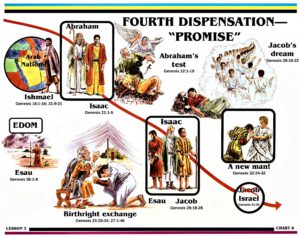
Chart Objective:
To trace the bloodline of the coming righteous One through Abraham and his descendants. Among those who qualified themselves for this honored position, a unique nation representing Yahweh began to grow and multiply.
Chart Outline:
A. Fourth Dispensation—“Promise”
B. Ishmael, father of Arab nations
C. Isaac, son of promise
D. Abraham’s test
E. Isaac, Esau and Jacob
F. Birthright exchange
G. Jacob’s dream
H. A new man! A new name!
A. Fourth Dispensation—“Promise”
Promise, the fourth dispensation, is so named because of the covenant promises first made to Abraham, then extended to Isaac and Jacob. Now we will see how the promises were fulfilled during their lifetimes.
Men now were required to love and believe in God and to obey the Abrahamic covenant stipulations. The first requirement was to be a holy people, separate and apart from all others.
B. Ishmael, father of Arab nations
Genesis 16:1-16; 21:9-21
One of the first promises God made to Abram was that his posterity would become a great nation. However, after ten years in Canaan, there were no children. Rather than seeking God’s counsel, Abram submitted to human reasoning.
Sarai persuaded Abram to utilize a custom recorded in ancient Nuzu tablets. Since marriage was more for procreation in those days,it was the wife’s responsibility to bear children. If she did not, she was obligated to provide a handmaid (Unger, Archaeology and the Old Testament, page 51).
Abram took Sarai’s maid, Hagar, as a wife. She gave birth to a son named Ishmael. But the plan failed to bring happiness to the household. Polygamy, though tolerated in Old Testament times, was never approved by God. God’s will was not to establish the covenant with Ishmael. Had Abram trusted God’s timing, much misery and tragedy could have been avoided.
This is another scriptural example that affirms to twenty-first-century believers: wait patiently until God fulfills His promises!
C. Isaac, son of promise
Genesis 21:1-5
Thirteen years elapsed without a single visit from God. Finally, the Lord appeared and changed His friend’s name from Abram (“great father”) to Abraham (“father of a multitude”). Sarai was changed to Sarah (“princess”).
They learned that the long-awaited son would be born the following year. Sarah laughed. Abraham was one hundred and Sarah ninety years old when Isaac (“laughter”) was born.
When Ishmael mocked the new baby, Sarah demanded that Abraham send him and Hagar away. In prayer, God advised Abraham to do so. The time had come for each son to fulfill his ordained role.
Ishmael became the father of the Arabs. But a constant struggle has existed between the Jews and Arabs until this day.
D. Abraham’s test
Genesis 22:1-19
Abraham’s loyalty to the covenant must be tested. Had the rite of circumcision been an empty ceremony, or had the patriarch pledged his very life to his Lord?
In unmistakable tones, Abraham heard God’s voice. But this request seemed unrealistic:
“Take now thy son, thine only son Isaac, whom thou lovest, and get thee into the land of Moriah; and offer him there for a burnt offering upon one of the mountains which I will tell thee of” (Genesis 22:2).
What a difficult task! An Oriental father prizes an only son more than his own life. To die without a son is terrible punishment. He must have an heir.
For Abraham to have surrendered his own aged life to God’s call would have been easy. But to surrender his only son and again become a childless old man was a different story.
For God to request a human sacrifice was unthinkable! There was no precedent in previous history to justify such a request.
Would Abraham do for his divine Friend equally as men would do for their human blood-covenant brothers? Only a faith that neither reasons nor questions could pass such a test.
This promised son, long delayed, had brought blessing and happiness to their home. Not only must Abraham give up his son, but in the worst manner possible. The extreme stipulation was that he himself must plunge the knife into the heart of the youth!
For three days, Abraham, Isaac, and two servants traveled together to the execution. As they reached the base of Mount Moriah, the servants and donkey remained. Isaac carried the wood, flint and knife as they climbed upward.
Isaac questioned, “Father, haven’t you forgotten something? Here is the wood and the fire, but where is the lamb?”
Abraham answered prophetically. “God will provide himself a lamb for a burnt offering.”
Abraham was declaring that God Himself would be the perfect sacrificial Lamb. A second person of Deity would not be sent to the world to die for man’s sins. Rather, God’s Spirit would inhabit human flesh to become our sacrificial Lamb—the long expected “God-Man”!
The altar was completed and the wood laid in place. Isaac could have overpowered his father, but as a type of Christ, he willingly lay upon the altar and was bound with thongs.
As Abraham raised the knife to slay his son, he again heard the Lord’s voice:
“Lay not thine hand upon the lad, neither do thou any thing unto him: for now I know that thou fearest God, seeing thou hast not withheld thy son, thine only son from me” (Genesis 22:12).
Having exhibited such devotion, Abraham’s blood-covenant Friend was pleased. Their loyalty to one another was assured.
Abraham belonged to God and God’s blessings were abundantly available upon request. Bound together in this covenant relationship, Abraham found Him to be the covenant-keeping God!
Then the father and son detected a welcome sound—the struggle of a ram caught in a thicket nearby. Immediately the animal was secured and sacrificed.
What strengthened the patriarch in this trial? Paul attested, “by faith Abraham offered up Isaac.” Although he knew of no previous resurrections from the dead, Abraham expected one. God had made specific promises concerning Isaac, and Abraham was certain they would come to pass!
Perhaps this is why Abraham became known as the “father of the faithful.”
From Mount Moriah one can view Calvary. Centuries later, another procession wound up that hill, led by three men bearing crosses. Like Isaac, Christ was obedient—but from the cross He would not come down. His love . . . not nails, held him to the cross.
When Isaac was thirty-seven years old, Sarah died. However, Abraham lived for another thirty-eight years. His next wife, Keturah, gave birth to six more sons!
God’s promise that he would be the “father of many nations” was fulfilled through these sons. They were the Midianites and other nomadic tribes. Although many nations descended from Abraham, most failed to await the promise of a coming Savior and offer blood sacrifices. Because they lapsed into heathenistic ways, they were no more righteous than other pagan societies.
E. Isaac, Esau and Jacob
Genesis 25:19-28
Isaac lived a quiet, peaceable life. He had the faith of his father, but lacked his energy and character.
At the age of forty, he married Rebekah. For twenty barren years Isaac prayed—and his wife gave birth to twin sons.
Before their birth, the Lord assured Rebekah that the elder would serve the younger. Esau was born first, hairy and red. His name implies
“Edom,” or “red.” Jacob, meaning “supplanter” or “deceiver,” was the younger.
The elder son became a mighty hunter. Jacob, a quiet, domestic youth, was a shepherd. Isaac favored Esau, and Rebekah was partial toward Jacob.
As eldest, the birthright privileges belonged to Esau. Therefore, he would maintain superior rank in the family and would inherit a double portion of his father’s wealth and property. As heir, he would assume the priestly office, or the spiritual leadership of the family.
But best of all, he would be entitled to Abraham’s covenant blessing, linking him to the genealogy of the promised Messiah. The birthright was treasured because it contained both material and spiritual blessings.
F. Birthright exchange
Genesis 25:29-34; 27:1-46
Both of Isaac’s sons realized the value of the birthright blessing. However, from the very beginning, Jacob craved these rights while Esau was indifferent.
One day, Esau returned weary and faint from hunting and noticed his brother Jacob preparing some lentil pottage. Famished and exhausted, he begged for a serving of the delicious food. Jacob recognized his chance. He agreed to share the pottage in exchange for his birthright.
Esau hastily agreed to trade his valuable blessing for a single meal!
“Swear unto me,” Jacob insisted. His twin swore. Thus the birthright was sold for one morsel of meat! In effect, Esau was shortsighted. “I cannot live on future promises. Give me something to eat and drink or else I will die.”
Today, people make similar agreements. They settle for temporal pleasures offered by the world—for now!
When Isaac became old and nearly blind, he instructed Esau to go hunting and prepare some venison. In return, he would immediately receive the patriarchal blessing.
Rebekah heard Isaac’s request. She directed Jacob to kill two kid goats. They were hastily prepared to Isaac’s taste. Dressed in Esau’s garments and wearing animal skins about his arms and neck to disguise his smooth skin, Jacob presented himself before his father.
Isaac was suspicious. He inquired how the deer had been so quickly killed. Jacob lied that the Lord had brought it to him. But Isaac remained unsure.
Next he demanded to examine Jacob’s arms. Then the aged father made a perceptive analysis. The hands seemed to be Esau’s, butthe voice belonged to Jacob.
Finally, Isaac ate the meat and then fully bestowed the covenant blessing upon Jacob. He prayed God to give him the dew of heaven and the fatness of the earth; that he would become a master served by other people; that nations would bow to him; and that he might become lord over his brethren. Then he promised that all who blessed this son would be blessed and all who cursed him would be cursed.
Esau returned from his hunt. When he presented a steaming, savoury meat dish to Isaac, the aged man began to tremble. There was Esau’s voice! But he had come too late. Loudly and bitterly, Esau implored to receive just one blessing.
Isaac falteringly blessed his elder son with prosperity, but that he must live by his sword and serve his brother.
Angrily, Esau planned to kill Jacob. When Rebekah learned of Esau’s threat, she sent Jacob to her brother Laban’s home. She never saw him again.
G. Jacob’s dream
Genesis 28:10-22
As the sun set that first evening of the journey, Jacob lay his head on a stone to rest. While he slept, God revealed some wonderful plans.
As the heavens opened, a ladder rose from the ground to the sky with angels ascending and descending upon it. Then the Lord confirmed the covenant with Jacob that he had received from his father. The land upon which he rested would be his. Numerous descendants and divine protection would also be given.
Jacob discovered for the first time that God is near and that God is merciful and forgiving.
The following morning, Jacob named the place “Bethel” and erected a stone monument. As oil was poured upon it as a sign of worship, Jacob vowed to commit himself to the Lord. He also promised to erect an altar there at Bethel upon returning to his homeland and to give a tenth of his possessions to God.
Both Abraham and Jacob voluntarily tithed a tenth of their goods long before the time of the law. Bit by bit, God was revealing to man His financial plan. As we give God His part, He ensures that divine blessings and prosperity will be given us.
For the next twenty years, Jacob lived with his uncle, Laban. He bargained with Laban to marry Rachel. But at the end of seven years, Jacob was deceived—as he had deceived his father—and was given Leah as a wife.
At the close of the marriage week, Rachel also became his wife, but he had to work for her father an additional seven years. He reaped the deceit inflicted on his own blind father!
An additional six years were spent working to accumulate a herd of sheep. During this time, eleven sons and one daughter were born.
Jacob returned to his homeland with a large family, multiplied herds and flocks. As he crossed the border of Canaan, a strange sight greeted him. Two companies of heavenly hosts came to welcome him home! The Lord’s host will always be present—whether seen or unseen—to protect and comfort believers in times of distress.
Then the bad news came. Esau and four hundred armed men were coming to meet Jacob. Did his twin intend to carry out his threat? Jacob strategically divided his flocks and family into two camps so that the latter might escape. Then Jacob approached God for divine protection.
H. A new man! A new name!
Genesis 32:24-32; 36:1-8
In the solitude of the night, Jacob began to pray. Whereupon, “there wrestled a man with him until the breaking of the day” (Genesis 32:24).
Desperately Jacob struggled with his angelic visitor as he declared: “I will not let You go except You bless me.”
As the sun rose, the angel of the Lord granted the desired blessing. The name Jacob (supplanter and deceiver) was changed to Israel (a prince with God).
The name of God’s chosen people would then be Israel. In the darkness of that night, a new nation was christened and introduced as God’s own!
The site of this midnight ordeal was named “Peniel,” meaning “the face of God.” Jacob had seen God face to face!
To mark this conflict, the angelic visitor touched the hollow of Jacob’s thigh so that it forever remained out of joint. To commemorate Jacob’s experience, Jewish dietary laws restrict the eating of the sciatic nerve, or thigh-vein, from slaughtered animals.
The following morning, Esau embraced Jacob in an emotional act of forgiveness and reconciliation. Esau agreed to leave the land of Jacob’s inheritance, and his family retired to the mountains of Seir, later called Edom.
What lessons can be learned from Jacob’s life! He had made great progress at Bethel and Peniel. The two companies of angels had taught him about God’s presence and protecting care. But yet another vital lesson awaited.
After immoral conduct by his three oldest sons, Jacob purposed to return to Bethel and renew his vows to God (Genesis 35:1-4). His wives and sons must cleanse and rid themselves of strange gods. They too must be committed to serve the Lord.
How important it is to make occasional searches of our own homes and hearts to remove anything that displeases God. If His people are to be holy and righteous, they cannot prosper with hidden sin.
Through sincere repentance and cleansing, God’s blessings returned to Jacob and his sons. From Bethel, the family returned to Shechem and erected an altar. Again Yahweh renewed the promises first made to Abraham.