The Beginning of Nations and Languages
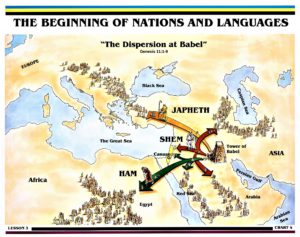
Chart Objective:
To emphasize the importance of Noah’s prophetic blessing and curse upon his three sons. His statements explain the origin of nations and the diverse languages resulting from man’s refusal to disperse over the whole earth.
Chart Outline:
A. The Beginning of Nations and Languages
B. Shem, Ham, Japheth
C. “The Dispersion at Babel”
A. The Beginning of Nations and Languages
Noah’s predictions about his three sons were most important—not only to his immediate family, but to each of us. Through this prophecy, we are informed about the origin of all nations, peoples, and races today.
Genesis, chapter 10, records the table of nations and stands alone in ancient literature to explain the distribution of people according to a genealogical framework.
Many today are especially interested in learning about their family roots. Through research, it is possible to trace lineage and construct a family structure showing ancestors and descendants from many previous generations.
However, the most complete family tree is the one reported by Moses in Genesis, chapter 10. It relates all the people of the world to one common ancestor—Noah. This astonishingly accurate document is without parallel among the literature of any other ancient people. Most of the names and “roots” given have been substantiated by archeological discoveries in the past century.
This chapter explains where the nations settled, their relationship with Israel, political and geographical positions, and territorial locations. It verifies that the nations of the world sprang from a common ancestry and that all men are indeed brothers. Despite our diverse races and nationalities, we are one in the sight of our Creator.
Notice carefully that all the human family is divided into three main groups surrounding Palestine. Every location can be spotted inside a circle within a radius of fifteen hundred miles around the Holy Land.
Also included is the major part of an area known today as the Near East. Here is the origin of all living—the cradle of civilization!
B. Shem, Ham, Japheth
Notice the migration of each of Noah’s three sons. The family of Shem moved eastward to Asia and Assyria.
The sons of Japheth settled primarily to the north and west in Europe. He fathered the vast and progressive European nations that would explore, colonize and settle much of the other side of the globe—including the Americas.
The sons of Ham (meaning “burning heat”) migrated southward to the warmer climates in Arabia and the continent of Africa.
Shem, the favored “messianic” line (from whom the Messiah would come), represents the Semitic peoples in the east from whom the Jewish race emerged. Abraham, the first patriarch, came from Shem’s lineage.
Ham’s sons were cursed and designated as a servile race because of immorality. They inhabited Phoenicia and Canaan. Constantly their tribes were in conflict with Israel.
Archeologists reveal that Canaanite religious cults were unequalled in profane and sexual pagan practices.
There is no basis whatsoever for relegating the black race to bondage because of a divine curse. The Hamites, from whom the black races probably came, were not the direct objects of the curse. Nor could Canaanites be considered black, for they settled primarily on the eastern Mediterranean. The prophetic curse of servitude was expressed for grandson Canaan—alone (Genesis 9:25).
The fact that Ham had no share in Noah’s blessing for Shem and Japheth indicates that his family was included by implication in the curse. Canaan’s servitude was literally fulfilled when the Hebrews defeated the Canaanites.
Many years elapsed between the day Noah gave prophetic utterances to his sons and its fulfillment. They did not scatter immediately, preferring to unite themselves on the plains of Shinar. After God interrupted their pattern of living, they dispersed, as described in the table of nations.
C. “The Dispersion at Babel” Genesis 11:1-9
Another question remains unanswered. How and why did the many languages and dialects originate?
One common language was spoken among Noah’s family. Their small group settled eastward in the rich, fertile soil of the plain of Shinar. Noah’s prophetic utterances began to be fulfilled soon afterward.
Ham’s grandson, Nimrod, became the first instigator of opposition. After a hundred or more years, the settlements on the plains of Babylonia had multiplied sufficiently to develop industries and arts. Humanism began to emerge when the citizens conspired an impressive project.
“And they said, Go to, let us build us a city and a tower, whose top may reach unto heaven; and let us make us a name, lest we be scattered abroad upon the face of the whole earth” (Genesis 11:4).
Nimrod founded a kingdom in Shinar with several large cities. Using his influence, he began building a great city for protection, counter to God’s protecting promise. Featured was a tower too tall for water to reach, in the event of another flood.
Boldly he turned men from the fear of God to a dependence upon himself. Nimrod planned to head a federation of governmental power. The tower would be the center of religious activity while Nimrod became the overseer of both the political and religious systems. Thus, he represents the first type of the Antichrist in the Old Testament.
More than two dozen temple-tower “ziggurats” have been found in various parts of Mesopotamia. Varied in color and built in step-like layers, the highest ziggurat was seven stories. Using such temple towers was doubtless copied from that built at Babel.
Historians indicate that the ancient Tower of Babel was actually an astronomical observatory from which the heavens could be studied. Chaldean priests used this tower to gaze at the stars and were the first to divide the heavens into the twelve sections of the zodiac. This pagan religion of stars controlling the destiny of men originated in a tower built to study the heavenly bodies, chart their courses, and make predictions.
This first tower was halted by the confusion of tongues. But it was later finished and became the temple of Belus, the principal god of Babylonia (Alexander Hislop, The Two Babylons).
The Lord allowed everything to progress for a time. Knowing their motives and plans to defy Him, the project had to be stopped.
Suddenly, chaos erupted! The masons could not understand each other. The carpenters could not follow the architects’ instructions. Construction workers and overseers became frustrated and confused. Without communication, progress came to a halt.
Having promised Noah that mankind would not be destroyed, God confused their language. Those who could communicate, separated into small groups to re-organize their lifestyle and settle together.
At this precise point, Noah’s prediction began to be fulfilled. After the confusion of tongues, “the LORD [scattered] them abroad upon the face of all the earth” in three broad directions—corresponding to the three sons of Noah. Modern linguistic scholars have now established that the various existing languages belong to three great families. Therefore, Babel gave birth to all nations and languages of the earth (Merrill F. Unger, Archaeology and the Old Testament)!
Consequently, mankind faced physical and sociological problems that could never be overcome. Modern man’s effort to minimize and resolve linguistic and racial differences indicates the massive problem created at Babel.
The confusion at Babel has no other explanation than a direct act of God. More than two thousand years later, something equally miraculous happened by divine design. Another group was assembled for a common purpose when suddenly they began to speak in unknown tongues.
The Holy Spirit baptism regathered all people to a heavenly inspired tongue. At the Tower of Babel, the speakers were confused.
On the Day of Pentecost in Jerusalem, the listeners were confused. Pentecost marked the reversal of Babel!
The word “Babel” is interesting since two different meanings are indicated in Scripture:
“Therefore is the name of it called Babel; because the LORD did there confound the language of all the earth: and from thence did the LORD scatter them abroad upon the face of all the earth” (Genesis 11:9).
In Hebrew, the word “Babel” means confusion. The Babylonians themselves intended Babel to mean, “We are the gate of God.” But the Jewish interpretation reacted, “No, you are confusion.”
The population scattered all over the earth. As they strayed from the vicinity of the ark, the worship and knowledge of God faded to the worship of nature (sun, moon, stars, fire) and then to idols. The oldest sacred books and traditions of each nation concur with the scriptural account. With his spirit dead, man’s sense knowledge led him farther and farther from the light of God’s Word and into the darkness of Satan’s bondage.
Satan’s strategy involved two methods to prevent the God-Man Redeemer from freeing mankind:
• Destroy the knowledge of God upon the earth.
• Destroy the righteous seed of the woman.
While Satan attempted to abolish the knowledge of God from the human mind, God had other ideas. It was time for a further revelation of His plans and purposes for man. He chose one man in whom precious truths could be deposited and through whom would come the Messiah. The beautiful story of redemption began to clarify with the selection of this man.