Third Dispensation—“Human Government”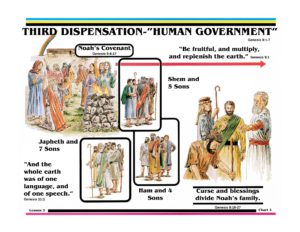
Chart Objective:
To illustrate God’s progressive revelation of
His plan for man that included self-government.
Noah’s three sons became the progenitors of all
the families of the earth.
Chart Outline:
A. Noah’s Covenant
B. Noah’s three sons multiply
C. Curse and blessings divide Noah’s family
A. Noah’s Covenant
Genesis 9:8-17
After the Flood, Noah’s ark settled on Mount Ararat, about five hundred miles from his home in Mesopotamia. Upon a cleansed earth, Noah’s family began a new life. Wickedness and evil had been erased.
A new plan of action then became effective. In addition to the guidance of man’s conscience, he received definite laws of conduct. Men became responsible for governing one another. Thus began the dispensation of human government.
Because man’s spirit was dead, he was forced to govern through the soul (mind, will, emotions). Human intellect is incapable of such a task.
Had his spirit been actively controlled by God’s Spirit, man could have righteously ruled the world. But his death nature prevented that. Gradually, man’s rightful dominion was delivered to Satan, who became the “god of this world” (Luke 4:5-6; II Corinthians 4:4).
Noah and his family left the ark, built an altar, and offered burnt sacrifices to the Lord. With this first act of worship, God was well pleased.
After the sacrificial offering, God proposed a “covenant” between Noah and Himself. A covenant is a mutual agreement or contract in force between individuals or nations. As we progress through our study of the Bible, we will discover several such important agreements.
A covenant is still in effect between God and those who love and obey Him. It promises a wealth of benefits!
Let’s examine the terms of this covenant between God and Noah. Actually, the agreement provided not only for Noah and his family, but for all creation. Through it, God promised that He would never again curse the ground or destroy all the inhabitants on earth by floodwaters. Peter declared the next destruction will be by fire (II Peter 3:6-7).
Prior to the Flood, man’s diet had been vegetarian. From this time forward, he was permitted to eat the flesh of animals—if the blood were properly drained. God also established the law of capital punishment:
“But flesh with the life thereof, which is the blood thereof, shall ye not eat. And surely your blood of your lives will I require; at the hand of every beast will I require it, and at the hand of man; at the hand of every man’s brother will I require the life of man. Whoso sheddeth man’s blood, by man shall his blood be shed: for in the image of God made he man” (Genesis 9:4-6).
To seal this covenant, God gave the sign of the rainbow. Every rainbow is a colorful reminder of God’s covenant. In return, man’s duty was to “be fruitful,” multiply and replenish the earth. Noah’s descendants were to be scattered over the earth and exercise authority over every part of creation. But again, we shall see that humanistic reasoning decided differently.
B. Noah’s three sons multiply
From Noah’s three sons—Shem, Japheth, and Ham—the entire world was to be repopulated. To Shem were born five sons; Japheth had seven sons and Ham, four sons. These sixteen grandsons were the first generation on the newly cleansed earth. Their behavior and attitude toward God greatly affected the course of history.
C. Curse and blessings divide Noah’s family
Genesis 9:18-27
As life began anew on the earth, Noah began farming. From the fruit of his vineyard, he became intoxicated and lay naked in his tent. While Noah was in this shameful condition, his youngest son, Ham, failed to show proper respect by covering him. Rather, he mocked Noah’s drunkenness.
The older sons, Shem and Japheth, took a garment, laid it over their shoulders, and walked backward into Noah’s tent to cover his shame.
When Noah awoke and learned of Ham’s behavior, he made some amazing predictions that included both blessings and curses for his three sons.
By the spirit of prophecy, Noah exposed the lustful tendencies in Ham and his son, Canaan.
“Cursed be Canaan; a servant of servants shall he be unto his brethren” (Genesis 9:25).
The curse would come through Canaan, although indirectly through Ham. Already the grandson must have been walking in his father’s profane ways.
Shem, meaning “renown,” would be exalted and his descendants especially blessed. Through Shem’s seed, God would reveal His saving name to the world. From this ancestral line would also come the promised Messiah!
A blessing was also offered Japheth and his descendants. “God shall enlarge Japheth,” meaning his people would be numerous, prosperous, and productive.
“He shall dwell in the tents of Shem.” This implied that the Gentile descendants of Japheth would also share the blessings of salvation and redemption introduced by the Messiah. How thankful we should be that Christ’s salvation plan has included every man, woman, boy and girl!