
God Makes a Covenant with Man
This lesson is a study of God’s covenant relationship with man.
Adam relinquished his God-given dominion over earth to Satan and became a member of Satan’s family. Until the promised seed of the woman would come to wrest it from him, Satan determined to fully exercise that dominion.
Man eagerly awaited the “Incarnation” when Deity would unite with humanity and restore man’s dominion. Only a “God-Man” could satisfy the claims of justice and bridge the awful chasm between God and man.
Satan used two principal tactics to prevent the Incarnation: destroy the righteous lineage; and corrupt men with evil, thus removing the knowledge of God.
Therefore, God was compelled to destroy wicked mankind with a worldwide Flood—except for righteous Noah and his family.
Once men were forced to disperse at the Tower of Babel, the worship and knowledge of Yahweh practically ceased.
Finally, God chose one man with whom He could cut a blood covenant of strong friendship. Abraham and his descendants became a repository for preserving the knowledge of the one true God and the channel through whom the “God-Man” would come. Abraham’s people were to testify that sin, sickness, poverty, hunger, and discord are from Satan—not from God. The covenant-keeping God never forgets His promises. Not only his natural descendants, but all who walk in the steps and faith of Abraham may share the covenant blessings.
When completed, students should be aware of the following concepts:
1. A “dispensation” is new information or enlightenment about how to please God. His plans and purposes for man have progressively unfolded, a step at a time, through the ages.
2. “Calling upon the name of the Lord” and offering blood sacrifices restored communication between man and God. There has always been a divine response when men have cried out to Him for deliverance or mercy.
3. “Cutting the covenant” is an ancient ritual that binds two people into an enduring relationship. Because of Abraham’s faith and obedience, God entered into covenant with him. God is still excited to find someone with an obedient faith!
Books for additional reading:
1. John C. Whitcomb, Jr. and Henry M.
Morris, The Genesis Flood, Grand Rapids:
Baker Book House, 1961.
2. Alfred M. Rehwinkel, The Flood, St.
Louis: Concordia Publishing House, 1951.
3. Charles F. Pfeiffer, The Patriarchal Age,
Grand Rapids: Baker Book House, 1961.
4. Merrill F. Unger, Archaeology and the Old
Testament, Chicago: Moody Press, 1954.
5. Alexander Hislop, The Two Babylons,
Neptune, NJ: Loizeaux Brothers, 1959.
6. E. W. Kenyon, The Bible in the Light of
Our Redemption, Lynnwood, WA:
Kenyon’s Gospel Publishing Society, P. O.
Box 973, Lynnwood, WA 98036, 1969.
7. H. Clay Trumbull, The Blood Covenant,
Kirkwood, MO: Impact Books, Inc., 1975.
Lesson 3 – Chart 1
Second Dispensation—“Conscience”
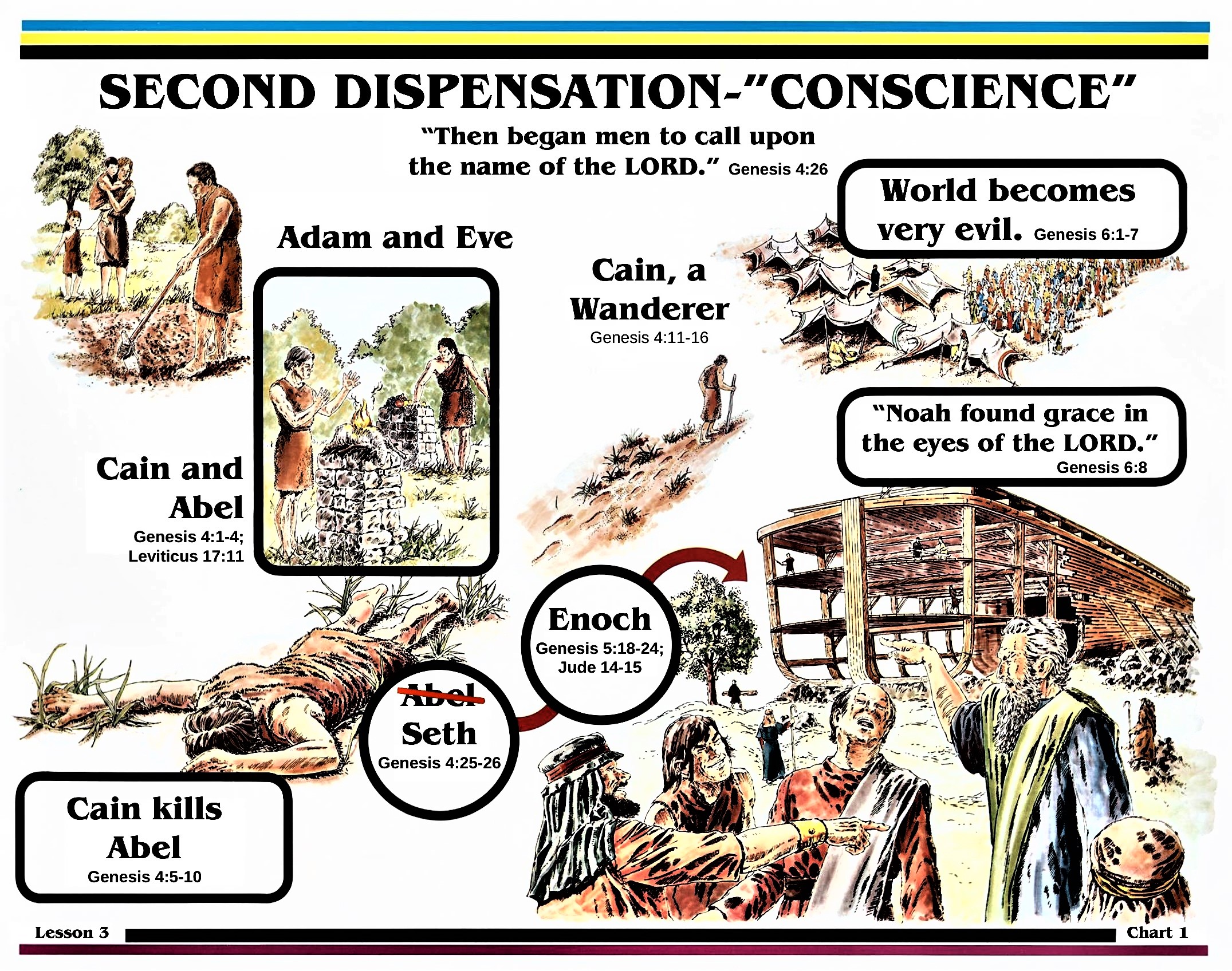
Chart Objective:
To explain the restoration of man’s communion with God. A plan was implemented whereby man could make right decisions as directed by the inner voice of conscience. Thus guided, men called upon the name of the Lord and offered blood sacrifices.
Chart Outline:
A. Adam and Eve
B. Cain and Abel
C. Cain kills Abel
D. Cain, a wanderer
E. Seth
F. “Then began men to call upon the name of
the LORD.”
G. Enoch
H. World becomes very evil
I. “Noah found grace in the eyes of the
LORD.”
A. Adam and Eve
The dispensation of conscience began when Adam was driven from the garden. After man’s spirit had died, God’s communion with His choice creation was interrupted. Therefore, until the time of the written law, God implemented another means for communicating instructions. God chose to speak with man through an inner voice called “conscience.”
Conscience, the faculty by which we know right from wrong, began to function when Adam and Eve ate of the Tree of Knowledge of Good and Evil. It has since been a guiding force in mankind’s moral actions.
God’s new plan for man involved his behavior: “If thou doest well, shalt thou not be accepted?” (Genesis 4:7).
All that was required of Adam and his descendants in this era was to love God and obey the voice of their conscience as it reinforced what God had told them to do. Therefore, they were constrained to do good and refuse evil.
Sometime after the original sin, children were born to Adam and Eve. Although Adam was formed from the earth’s soil and Eve from a rib, all other humans have come through the birth process.
B. Cain and Abel
Genesis 4:1-4; Leviticus 17:11
The Bible reports that Adam and Eve had many children, but only three sons are named in Scripture. The first was Cain, meaning “gotten.” At his birth, Eve exclaimed, “I have gotten a man from the LORD.” She may have assumed him to be the promised Redeemer Who would crush Satan once and for all.
Soon afterward, Abel was born. From their earliest years, opposite tendencies surfaced in the brothers’ characters.
Apparently Adam taught them what he knew about God’s command to cultivate the ground. Cain chose farming and Abel became a shepherd.
God showed Adam the proper method of offering sacrifices and Adam related it to his sons. They surely observed their father offering blood sacrifices to God.
By adulthood, both sons were well acquainted with the acceptable mode of sacrificial worship. Yet when they brought their offerings, something was amiss. Cain’s offering was fruit from the ground, while Abel presented one of his flock.
Two altars were erected, one piled high with fruit and grain, the other laden with a freshly slain animal.
Evidently, Abel’s sacrifice was consumed by fire from heaven as a sign of God’s acceptance. But Cain’s offering remained untouched.
What made the difference? Abel’s offering indicated love and obedience to the redemptive plan requiring a blood sacrifice. Because his sacrificial gifts were according to divine instructions, God witnessed that Abel was righteous:
“By faith Abel offered unto God a more excellent sacrifice than Cain, by which he obtained witness that he was righteous, God testifying of his gifts: and by it he being dead yet speaketh” (Hebrews 11:4).
“For it is the blood that maketh an atonement for the soul” (Leviticus 17:11).
Cain’s offering of fruit was from the earth—which was now cursed and quite unacceptable to God.
Rage mirrored Cain’s face. Instantly he resented Abel, was disappointed with himself and angry at God. Why was his offering still neatly stacked on the altar, while the other was swiftly consumed? Unfair! God was showing favoritism!
Then God spoke, “Why are you angry? Why has your countenance fallen? If you do well, you will be accepted. If you do not well, sin is crouching at the door.”
For the first time, the horrible word “sin” was used. It’s sad, dreadful note is echoed throughout the remainder of the Bible.
What a picture of sin and temptation! Crouching at man’s door, its body lowered to the ground ready to spring, is the cruel beast of sin. God warned Cain about the danger of future disobedience, but His clear warning was directed to every one of us as well.
C. Cain kills Abel Genesis 4:5-10
Because Cain refused to admit his error, bitterness spread through him like poison. Just how much time elapsed after God’s warning is not known.
As the brothers were together in the field, a strong arm was uplifted. With a crushing blow, Abel fell to the ground as murder severed earth’s tranquillity with its ugly gloom. The completion of sin—death!
Possibly at the next sacrifice, God’s voice inquired, “Where is Abel thy brother?” A deliberate murder was then covered with a deliberate lie: “I know not.”
Insulted, Cain asked, “Am I my brother’s keeper?”
Note the immediate effect of sin. How else could a man speak so impudently to God? Cain’s defying attitude revealed the malicious condition of his heart that led to murder. Had he maintained his fear of God, he would never have committed this crime. But sin poisons the heart and drugs the conscience.
How did God know of the crime? Abel’s blood was crying to Him from the ground.
Adam and Eve witnessed the results of their sin as their first son became a murderer and their second, the victim.
D. Cain, a wanderer Genesis 4:11-16
God spoke again to Cain. “Now you are cursed from the earth which has opened her mouth to receive your brother’s blood. Henceforth, when you till the ground it shall yield you no return. A fugitive and vagabond you will be.”
Perpetual exile from the region of Eden frightened Cain. Not only was he God’s enemy, but the earth’s as well.
“My punishment is greater than I can bear,” he lamented.
With the earth refusing him sustenance, Cain was forced to seek occupations of building cities and of mechanical invention. Denied a home, he wandered as a nomad. Endless disgrace haunted his steps as men feared to associate with a man marked by God.
Cain dwelled east of Eden. His wife was obviously a sister, as the marriage of immediate relatives was unavoidable in the early stages of propagation.
Cain’s descendants had names significant to their occupation and personality. Several had identical names to those of Seth’s lineage.
The Cainite families were distinguished for their proficiency in the arts and pleasures of life. Probably they were responsible for the high cultural development archeology has unearthed at the dawn of civilization.
E. Seth – Genesis 4:25-26
Satan may have presumed Abel to be man’s Redeemer. By destroying him, the enemy plotted to annihilate the righteous line. However, another child filled Abel’s place.
When Adam was 130 years old, another son was born named Seth, meaning “substitute.” Surely, Eve thought, he was God’s appointed replacement for the slain brother.
The righteous bloodline begun in Abel was now restored. Through Seth’s descendants the Redeemer would come to earth. However, there were not just two distinct lines of the human family. Adam begat “sons and daughters” (Genesis 5:4) and every son of Adam began a different branch of the race.
F. “Then began men to call upon the name of the LORD”
Genesis 4:26
After the birth of Enos, Seth’s son, men became God-conscious. But their righteousness was short-lived. Neither Seth nor Enos is listed among the patriarchs of faith. Seth’s line is singled out in Genesis, chapter 5, to show the particular branch through which the seed of the woman would descend.
As men began to call upon the name of the Lord and offer blood sacrifices, communication was restored between them and God. The Lord was pleased with those who came to Him with the appropriate offering to cover sins.
All through the Old Testament there is a divine response when men cried unto Him. In fact, salvation has always included this important initial act of “calling upon the name of the Lord” (Psalm 55:17; Joel 2:32; Acts 2:21; 22:16).
Repentance and turning to the Lord have always gained His attention. We can observe how this important step of salvation was first initiated near the dawn of creation.
G. Enoch Genesis 5:18-24; Jude 14-15
Of all the millions who lived during these first two dispensations, only three were labeled as godly—Abel, Enoch, and Noah. Not even Adam was so acclaimed. If God’s first created man was disobedient, how sinful later inhabitants of the world must have become!
Enoch, a descendant of Seth, was especially favored of God.
“And Enoch walked with God: and he was not; for God took him” (Genesis 5:24).
The New Testament gives him another favorable report:
“By faith Enoch was translated that he should not see death; and was not found, because God had translated him: for before his translation he had this testimony, that he pleased God” (Hebrews 11:5).
Wickedness became so rampant that Enoch warned his generation how the Lord would judge the ungodly:
“And Enoch also, the seventh from Adam, prophesied of these, saying, Behold, the Lord cometh with ten thousands of his saints, to execute judgment upon all, and to convince all that are ungodly . . . of all their ungodly deeds” (Jude 14, 15).
Because Enoch walked closely with the Lord and loved righteousness, he was “translated” or removed from the corrupt earth to be with God.
H. World becomes very evil Genesis 6:1-7
Cain and his wife founded a civilization in a city called Enoch, named after Cain’s oldest son. There were probably several hundred descendants by this time. And the corruption that had God appraised the wickedness: “every imagination of the thoughts of his heart was only evil continually” (Genesis 6:5). Thus, the declaration was made to destroy man from the face of the earth! Cain soon surfaced in his offspring.
I. “Noah found grace in the eyes of the LORD.” Genesis 6:8
Enoch’s son, Methuselah, lived longer than any other man in recorded history—969 years. From the same bloodline and lineage, another godly man was named—Noah, the grandson of Methuselah.
For hundreds of years, God tolerated wickedness without retribution. Finally, though, His patience exhausted.
Looking over His vast creation, God found one man alone to be faithful. Noah found grace in the eyes of the Lord. To this righteous man, God announced His plan to destroy the world.