God Creates His Earth
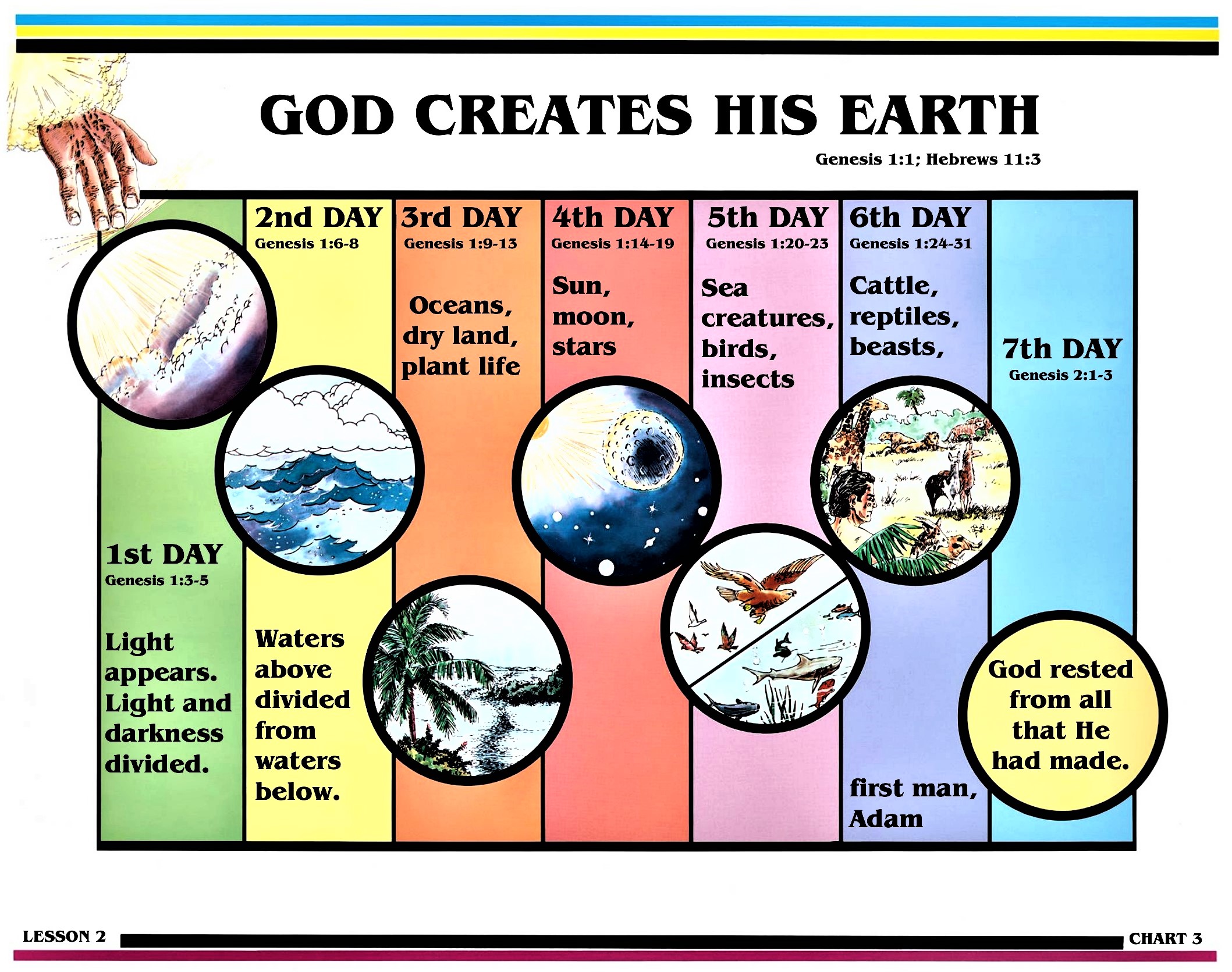
Chart Objective:
To explain how God’s perfectly beautiful earth, overflowing with every imaginable provision, was prepared for man’s pleasure. The six creative days did not require billions of years, but were intended as an example that man needs one rest day in every seven.
Chart Outline:
A. God Creates His Earth
B. First Day
C. Second Day
D. Third Day
E. Fourth Day
F. Fifth Day
G. Sixth Day
H. Seventh Day
A. God Creates His Earth
Genesis 1:1; Hebrews 11:3
The source of our creation study comes from Genesis, the first book of the Bible. Genesis is the “seedbed” of all the important Bible doctrines. Its message is for all people of all time periods. Genesis provides the foundation for understanding the remainder of the Bible.
The word “Genesis” means “beginnings.” What are some of these beginnings? God, His angels, Satan, sin, sickness, human life, the family, worship, death, languages, nations, and Israel—the chosen nation.
The most ancient Jewish records credit Moses with writing Genesis and the four books that follow. Christ and other New Testament writers also acknowledged Moses’ authorship. (Refer to Matthew 19:7-9; Luke 24:27; John 7:19).
Moses was well trained for the task, having been educated in “all the wisdom of the Egyptians” (Acts 7:22). Yet that training alone was insufficient. To obtain unavailable details and information, Moses had to be inspired by the Holy Ghost. Although the spoken traditions handed down from his fathers were invaluable, the final writing had to be inspired, overseen, and guided by the Holy Spirit to complete the account and keep it accurate.
Atheists and humanists contradict Moses’ account from every conceivable angle, yet his book remains a testimony to the miracle of divine inspiration.
Does true science contradict Moses’ account? No! Rather, there is a precise and complete concurrence between the established facts of physical science and the first chapter of Genesis.
How could a book written in the fifteenth century before Christ, a time of scientific ignorance and superstition, be so accurate? How could it be so reliable and in such precise agreement with the most recently discovered facts of physics, botany, astronomy, biology, and related sciences? Only God could author such a book!
Let’s look again at the very first verse of the Bible:
“In the beginning God created the heaven and the earth” (Genesis 1:1).
This powerful statement is repeated throughout the Bible. Have you wondered how God made His universe? The answer is simple:
“Through faith we understand that the worlds were framed by the word of God, so that things which are seen were not made of things which do appear” (Hebrews 11:3).
How long did it take God to perform each mighty act of creation? Only as long as it took to speak the Word:
“By the word of the LORD were the heavens made; and all the host of them by the breath of his mouth. . . For he spake, and it was done; he commanded, and it stood fast” (Psalm 33:6, 9).
No, God did not create everything in His universe at once. His method of creation was to speak, to state a desire, and matter converged to perform His will.
No long periods of time were required to accomplish His creation. He acted swiftly. To suppose that He needed eons for the evolution of our world unnecessarily limits God’s power. He can use time if He wishes, or He can dispense with it altogether.
To create our wonderful world, God used six days. Why He did not choose six million years will become apparent as our creation story progresses.
In the original Hebrew, the word “day” has various meanings: time, forever, continuous, age, and life. Therefore, some scholars suppose that the “day” mentioned in the creation account was a geologic age—perhaps thousands of years.
Some contend that each of those “days” was one thousand years, referencing this scripture:
“One day is with the Lord as a thousand years, and a thousand years as one day” (II Peter 3:8).
Others theorize an undetermined “gap” between the first two verses of Genesis, perhaps involving thousands or millions of years.
But to place an extended time period on God’s creation limits His power. He did not need a span of years. All power is in His spoken Word.
What evidence supports the Genesis account as twenty-four-hour solar days? First, each day was divided into periods of darkness and light—the same as a solar day. Because “evening” and “morning” describe a time period, we could assert these to be literal days and nights.
Consider that the vast world of botany was created on the third day. Had this “day” been age of one thousand years or longer, the grass, herbs, and trees would have experienced five hundred years of light and five hundred years of darkness. Plants cannot exist that long without light or with extended constant light.
God surely intended literal days to be used as a pattern for man’s lifestyle. We work six days and rest on the seventh:
“For in six days the LORD made heaven and earth, the sea, and all that in them is, and rested the seventh day: wherefore the LORD blessed the sabbath day, and hallowed it” (Exodus 20:11).
B. First Day
Genesis 1:3-5
“And God said, Let there be light.” Undoubtedly light existed from the creation of verse one: “In the beginning God created the heaven” and after that the earth. Since all light comprising the daylight comes from stellar regions, it surely was included in the original act of creating the heavens.
The light of the first day was no doubt derived from the sun and consisted of a diffused gleam that penetrated the vapor and the darkness.
A distinction is made in the first day and night by a period of light and darkness. The “evening and the morning” were the first day—and it was good!
C. Second Day
Genesis 1:6-8
On this day, the water above was divided from the waters below. The Hebrew actually means, “Let there be space between the waters.”
The work of this day contains many amazing scientific truths which Moses could not have known from personal knowledge.
Two distinct acts are recorded. The firmament was made and the waters were divided from each other. “Firmament” means “limitless expanse,” or the atmospheric heaven surrounding the earth; the air; the sky or heavens.
Scientific investigation reveals two distinct bodies of water, the upper and lower (Harry Rimmer, Modern Science and the Genesis Record). The oxygen supply essential for the life of both man and beast is in the atmosphere, or the air we breathe. The supply of oxygen in the ocean is constantly replenished from the atmosphere, which sustains marine life.
The lower body of water is visible to the human eye and is readily accepted. We sail on it and fish in it.
However, the upper body of water is equally real. The firmament is an ocean in suspension with waves and billows tossed by winds. It also has tides which ebb and flow. Man has learned to navigate aircraft, rockets and spacecraft through this upper ocean like the ocean liners and submarines in the lower ocean.
The upper waters of the firmament also furnish moisture for providing food and sustaining the life of man, beast, and bird through the process of evaporation and precipitation. In fact, the firmament is so extensive, it could hold in suspension several times the amount of the water in all the oceans on the face of the globe!
The creative work of the second day was completed—and it was good!
D. Third Day
Genesis 1:9-13
Three events are recorded on this wondrous day of creation. God formed the ocean, dry land, and plant life.
By a simple command, dry land appeared. Not a muddy, saline ooze, but “dry land.” An extended age of time is neither expressed nor implied.
While creating the oceans, God stocked them with salt necessary for man and animals that would soon appear. Oceans feed mankind with foods and plants and provide iodine that is essential in healing agencies.
Dry land, likewise, is packed with provisions for God’s creatures. It stores every good and perfect thing needed by man. Innumerable minerals lie buried in the dry earth, waiting to be extracted. All was placed there by a wise and loving God who provided far in advance for our needs.
Moses wrote that plants were the first living things to grace our earth. He also categorized botany into three general divisions: grasses, herbs, and trees. Science perfectly agrees with these conclusions.
And the third day was good!
E. Fourth Day
Genesis 1:14-19
On this day, the sun, moon, and stars became visible and began to function for our planet as “light holders.” They were already in existence as part of the heavens. But on this day, God implemented the solar system to govern seasons and regulate time on the earth.
The light of the first, second, and third days probably originated from the same source it has been coming from every day since—the sun. The work of the fourth day permanently regulated the solar system.
In verse 3, God said, “Let there be light.” In verse 14, God said of the fourth day, “Let there be lights in the firmament of the heaven to divide the day from the night.”
The Hebrew word for “light” in verse 3 is or; the “light” in verse 14 is ma-or, or light holder. The ma-or describes the suns and their reflecting satellites called moons, meteors, and stellar planets. The word or, however, is light itself.
Moses’ account has been criticized for attributing that light preceded the creation of the sun. Yet science concurs that there are many sources of light apart from sunlight: the northern lights; cosmic rays; and even the intriguing insect called the lightning bug.
That the stars and heavenly bodies have been set for signs and seasons, all navigators will acclaim. Stars are signposts by which travelers stay on course, whether on sea or land.
Farmers know that spring and its planting season is near when certain heavenly constellations begin to flame. Summer, winter, spring, and fall come in their exact order, year after year as the earth journeys through space and assumes a certain definite position in relation to all other planets in the solar system.
The entire cycle of organic life has been set to twelve hours of light for labor and twelve hours of darkness for rest. Plants and animals demand this schedule and suffer when the program is interrupted. All was planned and set in motion before man appeared.
And it was good!
F. The Fifth Day
Genesis 1:20-23
At the dawn of this day, vegetation was the only existing life. But by nightfall, the earth boasted fish, insects, and birds.
Consider the vast numbers of orders, families, species, and varieties that fill the water and air. The waters began literally swarming with living creatures!
“And God created great whales, and every living creature that moveth” (Genesis 1:21).
The Hebrew reads: “the rapidly multiplying creatures.” What a description of sea-life! Mammals reproduce very slowly in comparison with the fish. A female mackerel lays about 500,000 eggs at once. If each egg would mature and multiply accordingly in earth’s oceans, in ten years we could walk from continent to continent on the backs of living mackerel!
Minute creatures of the microscopic world were invisible to the human eye until the invention of the microscope. Yet Moses clearly describes their chief characteristic of rapid multiplication and accredits their life to God! The same law and order prevail in the most minute forms of life. Utmost care and thought were lavished upon each living creature.
The same Creator, who with marvelous skill painted a sunset and a rainbow, also with brilliant colors touched the fly’s wing. Why? Because He knew that man’s curiosity would compel him to study life under powerful artificial lenses. Therefore, He delicately and beautifully made every minute form of life, some so small that twenty of them can be found in a single drop of water. Yet each is exquisitely designed.
This day also produced the sciences of biology (animal life), protozoology (the study of protozoa), ornithology (the study of birds), and entomology (the study of insects).
And it was good!
G. Sixth Day
Genesis 1:24-31
On this day, the earth brought forth three types of animals:
• Cattle (domestic animals that serve man—cows, sheep, goats, horses, donkeys, and camels)
• Creeping things (all reptiles)
• Beasts of the field (all wild animals and other four-footed animals)
Crowning the work of the sixth day was the creation of man. Everything previous was done in preparation for the human race to inhabit God’s beautiful earth.
“And God said, Let us make man in our image, after our likeness: and let them have dominion over the fish of the sea, and over the fowl of the air, and over the cattle, and over all the earth, and over every creeping thing that creepeth upon the earth. So God created man in his own image, in the image of God created he him; male and female created he them” (Genesis 1:26-27).
With so many wonderful and fascinating creatures, why did God create man? Did He have a distinct purpose more noble than that expected of the others?
Yes. That clay form was molded in three parts: spirit, soul and body. To partake of God’s life, man had to be made in God’s class, in God’s realm, in the image and likeness of his Creator. To be God’s child and heir, he had to be created as nearly like deity as possible.
Man is a spirit-being, made to walk in fellowship with God. Man’s spirit was made to rule his soul (mind, will, emotions) and the subjected soul was meant to rule the body. The body is merely a house in which the spirit and soul dwell.
Man’s soul contains his reasoning faculties— mind, will, and emotions—which animals do not have. A crowning feature of the soul is man’s will. The power of choice and the ability to choose make man distinctly different. Without this will, he would have been mechanical. Since God could have no fellowship with a robot, He risked creating a being with a will—knowing that man could choose to disobey.
The divine purpose for creating man is expressed numerous times throughout the Bible: “Thou art worthy, O Lord, to receive glory and honour and power: for thou hast created all things, and for thy pleasure they are and were created” (Revelation 4:11).
Man was created to give pleasure to God! That is a new thought. Somehow we think only of God bringing pleasure to us. But we, the lesser, are intended to praise, honor and give pleasure to the Creator!
Thus, God made man for His own satisfaction. He yearns for a close, voluntary relationship with us, His choice creatures.
When a child crawls upon his father’s knee to hug and kiss him, is this affection required to complete his role as a father? No. But how he desires and enjoys this response in return for the love given his child!
Expressions of love for God complete His enjoyment of being our Father. God wants and receives genuine pleasure when each of us answers His love with sincere praise.
H. Seventh Day
Genesis 2:1-3
On the seventh day, God ceased His creative work and ordained a time of rest. Not because He needed rest, but as an example that man should work six days a week and reserve the seventh to his Maker for worship.
“Thus the heavens and the earth were finished, and all the host of them” (Genesis 2:1).
At last the earth was a place of beauty, fully capable of sustaining and providing for the billions of creatures and mankind who would eventually populate it. And everything God had done . . . was good!
Does man call it “good”? Ever since his beginning, man has questioned everything! Because of the reasoning powers given him by God, man seeks to find solid answers for all that happens. Who am I? Where did I come from? How did I arrive here?
Probably the most important issue confronting Christians today is the question of origins. The biblical creation account seems to be in imminent danger of rejection by the proponents of evolution.
The evolutionary perspective has captured the intellectual world and much of the religious world. Rarely is the biblical revelation of special creation accepted as an actual historical account.
What a man believes about origins ultimately affects his attitude toward his destiny and purpose for life.
Why have men developed theories of evolution? The first chapter of Genesis declares that God created life. But if this divine revelation is rejected, there is but one other explanation: Life must have appeared by itself without divine design or intent. By disallowing that God created the world, the remaining alternative is that creation created itself! That life sprang out of death, out of nothing.
The scientist who rejects God must accept as a very foundation of his belief a theory void of proof and contradictory to knowledge upon the subject. Every scientific experiment has proven that life is produced only by life.
Rather than beginning with God and working down, as the Bible does, evolutionary theory begins with matter and works upward. Evolution does not abolish God, but rather transforms the lifeless earth into God!
Essentially, the theory of evolution begins with the supposed generation of life in its most primitive form. “Spontaneous generation” theorizes that life spasmodically appears throughout the universe whenever conditions are conducive. However, no explanation is ever offered that suggests how life could appear out of nothing.
Another theory, “accidental creation,” suggests that creation was by accident. A lightning bolt or other cataclysmic chemical reaction brought the first germ of life into existence—perhaps a million or even a hundred million years ago.
Organic evolution in its simplest definition is best expressed by the word “transmutation,” or a gradual change, unaided by any outside force, from a low form of life into higher and higher forms until man appears.
The modern acceptance of evolution dates from the century-old Charles Darwin book, Origin of Species. Although his theories have been greatly modified, the basic principles are still widely accepted by biologists. Darwin’s theory has become the supreme delusion of the twentieth century, even usurping a place of credibility in public education.
Yet, in later years, even Charles Darwin saw the error of his ways. Students of evolution should be informed that in his final days, Darwin returned to his faith in the Bible. Bedfast, he made this confession to his companions: “I was a young man with unformed ideas. I threw out queries, suggestions, wondering all the time about everything. To my astonishment, the ideas took like wildfire. People made a religion of them”
(Meyers, Voices From the Edge of Eternity, pages 239-240). What a tragic confession! The “unformed ideas” of the young man Darwin stand today as the basis of modern evolution philosophy!