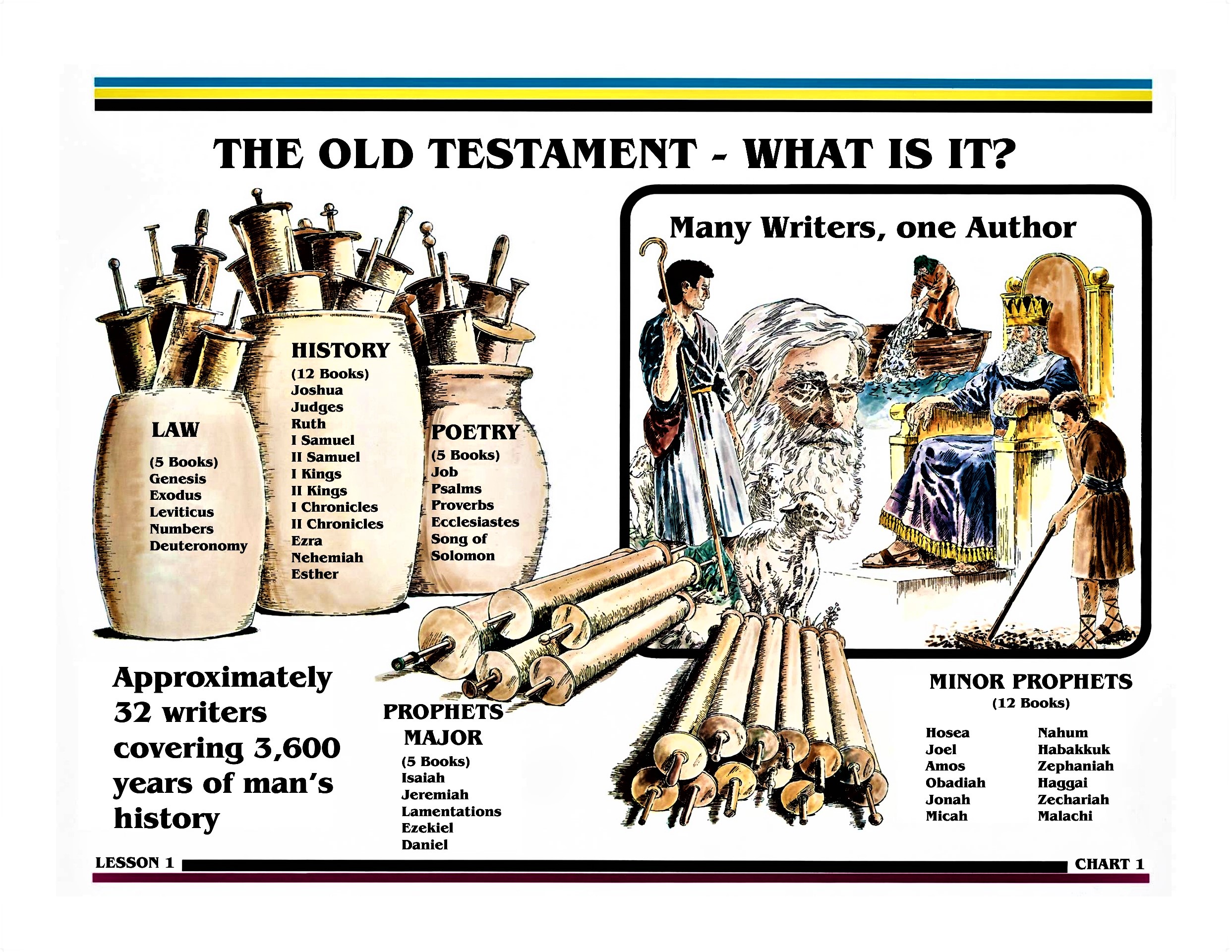
Chart Objective:
To explore Old Testament writings composed by many writers from various backgrounds and occupations. Although these men lived in different ages, every book perfectly agrees and harmonizes with all the others.
Chart Outline:
A. The Old Testament: What Is It?
B. Many writers, One Author
A. The Old Testament: What Is It?
As you hold the Bible and thumb through its pages, you may wonder what distinguishes it from other books. Yes, it is different. At first glance, the storyline appears to be incomplete. It’s many short chapters and numbered verses lend themselves to rigid reading. It’s language, although a literary masterpiece, is not easy to understand upon first reading. But let’s look closer. This isn’t a single book, but rather is a collection of books and letters—more like a library.
Some messages are so brief, they could be copied on a single page of paper—while others are so expansive that they require volumes of commentary. Why is your Bible labeled “Old” and “New” Testament, when all of it is very old? The word “testament” refers to a document disclosing the will of a departed person. It is a covenant or agreement between two contracting persons. Thus, the “Old” Testament is the covenant or agreement God made with man about salvation before Christ came.
The “New” Testament is God’s covenant with man about salvation after Christ came. Therefore, the entire Bible is composed of two major covenants between God and man. Our responsibility is to explore its wonderful terms and provisions.
There is very fascinating information about these agreements. You will not want to miss a single lesson as the secrets unfold regarding the amazing covenant privileges. Each Testament is divided into five sections. The Old Testament begins with the Law. This includes the first five books of the Bible written by Moses. These books contain the story of Creation, the Flood, and the origin of the Jewish people. Also included are the detailed list of God’s laws and the Ten Commandments to govern His people.
Next, come the twelve books of History of the Jewish people, their trials, division, captivity, and finally, restoration to their home in the Promised Land. These books cover eight hundred years from the thirteenth to the fifth century B.C.
Positioned near the heart of the Old Testament are five Poetry books. These are not short, rhymed verses, but are written in free verse. Among these are the well-known Psalms, extolling and praising the God of the Jewish people. These five are volumes of praises, promises, prayers, prophecies, and commandments.
Next, come the Major Prophets. Five books are devoted to events in Israel, both present and future, such as the coming Messiah, the church age, the end of time, and kingdom age.
Last, are the writings of the twelve Minor Prophets. They have termed “minor” not because their work is any less significant but because they are short. Some are less than one full page. The Minor Prophets declared God’s message of warning and instruction.
Briefly, that is a synopsis of thirty-nine Old Testament books. Remember the total number like this: The word “old” contains (3) three letters. The word “testament” has (9) nine letters. Place the two digits side by side and you have 39— the number of Old Testament books.
B. Many writers, One Author
The Old Testament was written over a period of 1,400 years by thirty-two writers and covers approximately 3,600 years. Although the writers came from all backgrounds, each perfectly harmonizes with the others. Amos was a country preacher. Isaiah was a brilliant court preacher. Moses was heir to the Egyptian throne. David was a king and composer. Solomon was the wisest man who ever lived. Still, there are no contradictions in their writings because there was really just one Author of all thirty-nine books—the Holy Ghost:
“For the prophecy came not in old time by the will of man: but holy men of God spake as they were moved by the Holy Ghost” (2 Peter 1:21).
Words were penned in different ages, different countries and by different men—some who never saw each other or knew that others had written on the same subjects. Yet when their writings became one Book, not one contradiction exists.
What do you suppose might happen if forty medical doctors from different countries and ages would write a book on the treatment for a certain disease? How much unity would prevail among their writings? Each would be asserting the others wrong and why his own theory is right. Generally, there is little unity of thought between the books of men on any subject. Yet there is perfect unity among the books of the Bible! This proves that although there are many writers, there is but one divine Author for all sixty-six books. Who but God could produce such a work!
Most of the Bible was written under difficult conditions. It was produced in pastures, prisons, or other unlikely writing situations. The writers had no typewriters, pens or smooth white paper. With quill or bone pens on parchment or skins, often with only a candle or a primitive oil lamp, they penned God’s message to the human race.